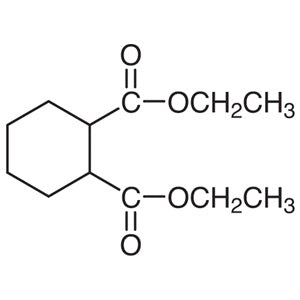
TCI D3713, also known as Diethyl cis-1,2-Cyclohexanedicarboxylate, is the diethyl ester of cyclohexane-1,2-dicarboxylic acid, carrying a cis configuration across the two neighbouring carboxylate groups. In the laboratory, this compound serves as a non-heterocyclic building block: a cyclic aliphatic framework that already bears two ester groups ready for modification. Its role is important for researchers who need a saturated cyclohexane scaffold with defined stereochemistry, whether for the synthesis of target compounds or as a model for studying how ring geometry influences the course of a reaction.
The property that most often drives its selection is the locked cis stereochemistry on two adjacent carbons, which places both ester groups on the same face of the ring where they can readily interact intramolecularly. This arrangement facilitates the formation of anhydrides, lactones, and other cyclisation products that are difficult to reach from the trans isomer. The two ester groups are also highly versatile: they can be hydrolysed to the diacid, reduced to the diol, converted to amides, or transesterified. The saturated cyclohexane framework contributes chemical stability and conformational rigidity that are useful in molecular design.
In Indonesian laboratories, this material is typically found in synthetic and organic chemistry research settings — university research groups, postgraduate work, and institutional or industrial R&D laboratories that build target molecules from defined intermediates. It is generally used at bench scale for multi-step synthesis routes, method development, and stereochemistry-focused teaching or research exercises, where a well-characterised building block with a known configuration shortens the route and reduces the need to prepare the scaffold in-house.
- Multi-step organic synthesis: supplies a ready-made saturated cyclohexane core with two modifiable ester handles, shortening synthetic routes toward more elaborate alicyclic target molecules.
- Intramolecular cyclisation studies: the cis arrangement holds both ester groups on the same ring face, favouring anhydride and lactone formation that trans isomers cannot readily achieve.
- Stereochemistry and reaction-geometry research: serves as a defined-configuration model compound for investigating how ring geometry and substituent orientation influence reaction pathways and product distribution.
- Functional group transformation work: both esters can be hydrolysed to the diacid, reduced to the diol, amidated, or transesterified, making it useful for method development exercises.
- Preparation of alicyclic intermediates: provides a rigid, chemically stable cyclohexane framework for building intermediates used in further derivatisation and molecular design projects.
| Brand | TCI (Tokyo Chemical Industry) |
|---|---|
| CAS number | 17351-07-4 |
| Molecular formula | — |
| Purity | — |
| Category | Chemistry > Building Blocks > Non-Heterocyclic Building Blocks |
| Pack sizes | available in standard laboratory research pack sizes; please confirm the currently offered options when ordering |
| Physical form | — |
| Storage | keep in a cool, dry place in a tightly closed container, following the manufacturer's product documentation |
- Catalogue Number: D3713
- Chemical Name: Diethyl cis-1,2-Cyclohexanedicarboxylate
Store the container tightly closed in a cool, dry, well-ventilated area, away from heat sources, direct sunlight, ignition sources, and strong oxidising agents. Keep the material in its original manufacturer-supplied container or in a compatible tightly sealed glass bottle, clearly labelled and dated on receipt and after first opening. Handle in a fume hood using standard personal protective equipment: safety glasses, chemical-resistant gloves, and a laboratory coat. Avoid contact with skin and eyes and avoid inhaling vapours. Transfer with clean, dry glassware to prevent moisture ingress, which can promote ester hydrolysis over time. Always consult the manufacturer's Safety Data Sheet before use, and dispose of residues and contaminated materials as chemical waste in accordance with your institution's procedures.
—
Produk Terkait
-
Bicyclo[2.2.2]octane-1,4-dicarboxylicAcid TCI B5595
Regular price Rp 5.518.800,00Regular price -
Bicyclo[2.2.2]octane-2,3,5,6-tetracarboxylic2,3:5,6-Dianhydride TCI B6198
Regular price From Rp 3.335.850,00Regular price -
Bicyclo[1.1.1]pentane-1,3-dicarboxylicAcid TCI B6522
Regular price Rp 5.342.400,00Regular price -
(+)-CamphoricAcid TCI C0012
Regular price From Rp 1.358.700,00Regular price -
cis-1,2-CyclohexanedicarboxylicAcid TCI C0458
Regular price From Rp 1.122.450,00Regular price -
trans-1,2-CyclohexanedicarboxylicAcid TCI C0474
Regular price From Rp 2.450.700,00Regular price -
trans-1,4-CyclohexanedicarboxylicAcid TCI C0475
Regular price From Rp 2.096.850,00Regular price -
Diethylcis-1,2-Cyclohexanedicarboxylate(containsDiethyltrans-1,2-Cyclohexanedicarboxylate) TCI C0476
Regular price From Rp 1.949.850,00Regular price
![Bicyclo[2.2.2]octane-1,4-dicarboxylic Acid (CAS 711-02-4) - TCI B5595 - AMI Scientific](http://amiscientific.com/cdn/shop/files/TCI2510B5595.jpg?v=1767092548&width=533)
![Bicyclo[2.2.2]octane-2,3,5,6-tetracarboxylic 2,3:5,6-Dianhydride (CAS 2754-40-7) - TCI B6198 - AMI Scientific](http://amiscientific.com/cdn/shop/files/TCI2510B6198.jpg?v=1768816002&width=533)
![Bicyclo[1.1.1]pentane-1,3-dicarboxylic Acid (CAS 56842-95-6) - TCI B6522 - AMI Scientific](http://amiscientific.com/cdn/shop/files/TCI2510B6522.jpg?v=1767093799&width=533)