

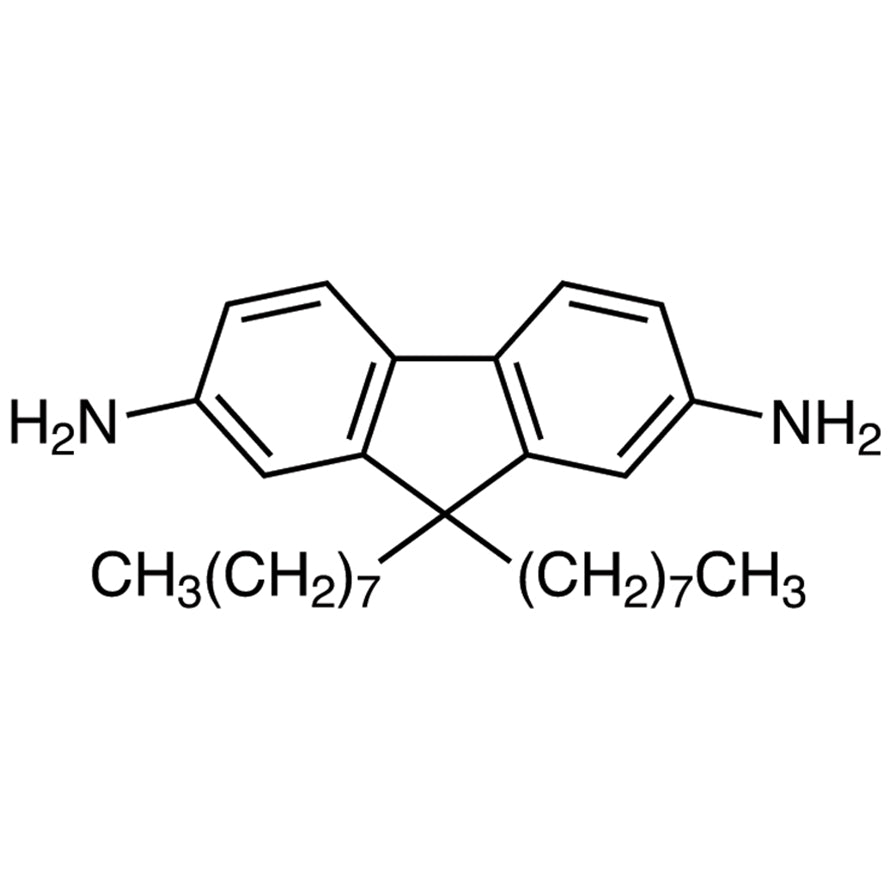
TCI D4719 2,7-Diamino-9,9-di-n-octylfluorene is a fluorene-based monomer carrying two amino groups at the 2 and 7 positions and two n-octyl chains at the 9 position. The compound is classified as a polymer and macromolecule semiconductor building block, meaning it serves as a starting material for constructing organic materials that transport charge or emit light. The fluorene core is one of the most important units in organic electronics because its structure is flat, conjugated, and possesses an energy gap suitable for light emission, which is why it is widely used in research on devices based on organic materials.
The properties that make this monomer a preferred choice lie in the combination of its three structural elements. The two octyl chains at the 9 position substantially increase solubility in common organic solvents, so the polymerised material can be processed by solution methods such as spin coating or printing — a major advantage over inorganic materials. The two amino groups at the 2 and 7 positions are electron-rich and act as versatile reaction sites: they can be polymerised through metal-catalysed amine coupling, converted into amides or imines, or used as electron-donor units within a larger conjugated system.
In Indonesian laboratories, this building block is typically handled in university and institutional research groups working on organic electronics, conjugated polymer synthesis, and functional materials chemistry. It is normally used at small synthetic scale on a Schlenk line or in a glovebox, followed by purification and characterisation before the resulting polymer or oligomer is deposited as a thin film. Its solution processability suits laboratories that rely on spin coating and bench-top film fabrication rather than large vacuum deposition facilities.
- Conjugated polymer synthesis — the two amino end groups at the 2 and 7 positions provide symmetric, reactive sites for step-growth polymerisation into fluorene-containing backbones.
- Organic light-emitting device research — the flat, conjugated fluorene core has an energy gap suitable for light emission, making it a standard unit for emissive layer materials.
- Solution-processed thin film fabrication — the two n-octyl chains raise solubility in common organic solvents, allowing spin coating or printing of the resulting materials.
- Donor–acceptor material design — the electron-rich amino groups let this unit serve as an electron-donor segment when combined with acceptor units in a conjugated system.
- Amine derivatisation chemistry — the amino groups can be converted into amides or imines, giving researchers a flexible route to new fluorene derivatives and functional monomers.
| Brand | TCI (Tokyo Chemical Industry) |
|---|---|
| CAS number | 851042-10-9 |
| Molecular formula | — |
| Purity | — |
| Category | Materials Science > Material Building Blocks > Polymer/Macromolecule Semiconductor Building Blocks |
| Pack sizes | supplied in standard TCI research-scale packaging; please confirm the available pack size when ordering |
| Physical form | — |
| Storage | keep in a tightly closed original container, protected from light and air |
- Chemical name: 2,7-Diamino-9,9-di-n-octylfluorene
Store the material in its tightly closed original container in a cool, dry, well-ventilated place, protected from light and away from oxidising agents. Aromatic amines are prone to darkening on exposure to air and light, so containers should be resealed promptly and, where the intended synthesis is moisture- or oxygen-sensitive, kept under inert gas or inside a desiccator or glovebox. Amber glass or the supplied container is preferred over open transfers. Handle in a fume hood using gloves, safety glasses, and a laboratory coat, avoid dust formation and skin contact, and consult the manufacturer's safety data sheet before use and for waste disposal.
—
Produk Terkait
-
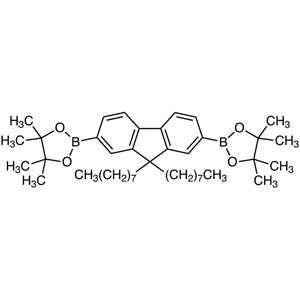
2,7-Bis(4,4,5,5-tetramethyl-1,3,2-dioxaborolan-2-yl)-9,9-di-n-octylfluorene TCI B3582
Regular price Rp 3.551.100,00Regular price -
9,9-Di-n-octylfluorene-2,7-dicarboxaldehyde TCI D4671
Regular price Rp 6.360.900,00Regular price -
3,7-Diamino-2,8-dimethyldibenzothiopheneSulfone(contains2,6-Dimethylisomer) TCI T1419
Regular price Rp 5.274.150,00Regular price -
3,9-Bis[2-(3,5-diamino-2,4,6-triazaphenyl)ethyl]-2,4,8,10-tetraoxaspiro[5.5]undecane TCI B1724
Regular price Rp 1.035.300,00Regular price -
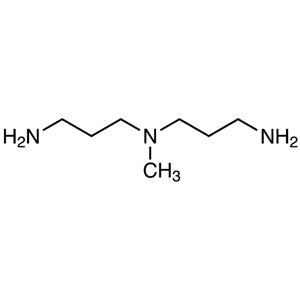
3,3'-Diamino-N-methyldipropylamine TCI B0821
Regular price From Rp 477.750,00Regular price -
2,2'-Diamino-N-methyldiethylamine TCI M1085
Regular price Rp 16.773.750,00Regular price -
4,4''-Diamino-p-terphenyl TCI D3390
Regular price From Rp 3.180.450,00Regular price -
2,4-Diamino-6-[2-(2-undecyl-1-imidazolyl)ethyl]-1,3,5-triazine TCI D3239
Regular price Rp 1.298.850,00Regular price


![22535-90-6 3,9-Bis[2-(3,5-diamino-2,4,6-triazaphenyl)ethyl]-2,4,8,10-tetraoxaspiro[5.5]undecane - AMI Scientific](http://amiscientific.com/cdn/shop/files/TCI2510B1724.jpg?v=1768815237&width=533)


![2,4-Diamino-6-[2-(2-undecyl-1-imidazolyl)ethyl]-1,3,5-triazine (CAS 50729-75-4) - TCI D3239 - AMI Scientific](http://amiscientific.com/cdn/shop/files/TCI2510D3239.jpg?v=1767105841&width=533)