9,9-Di-n-octylfluorene-2,7-dicarboxaldehyde is a chemical compound widely used in scientific research, particularly in the field of materials science and technology. This compound serves as a building block in the synthesis of polymers and macromolecules, playing a crucial role in the development of advanced materials. Its unique molecular structure enables it to be a key component in the creation of semiconductor materials and optical compounds. In laboratory settings, it is a valuable resource for researchers aiming to explore new material properties and functionalities.
The compound is prized for its chemical stability and controlled reactivity, making it ideal for precise chemical reactions. Its fluorene-based structure provides distinct optical properties, such as the ability to absorb specific wavelengths of light. These characteristics make it a preferred choice for applications requiring high-performance materials. The compound’s versatility allows it to be used across various research domains, including optoelectronics and nanotechnology.
In Indonesian laboratories, this compound is commonly used by researchers in educational institutions and research organizations. It is a key material in the development of new materials, especially in semiconductor and optical technology research. Due to its high-quality and reliable performance, it is frequently selected as a primary component in advanced material synthesis projects.
TCI brochures (PDF)
- Building Blocks for Organic Semiconductor 2026-03-24 · p. 36
Related TCI products
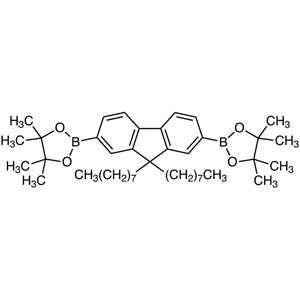
- TCI B3582 196207-58-6 2,7-Bis(4,4,5,5-tetramethyl-1,3,2-dioxaborolan-2-yl)-9,9-di-n-octylfluorene
- TCI D4719 851042-10-9 2,7-Diamino-9,9-di-n-octylfluorene
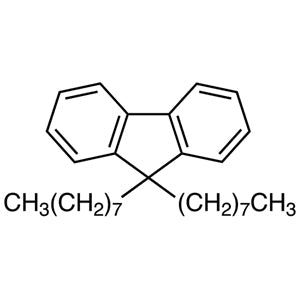
- TCI D3285 123863-99-0 9,9-Di-n-octylfluorene
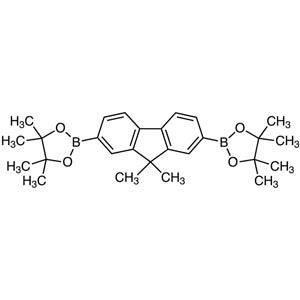
- TCI B5157 325129-69-9 2,7-Bis(4,4,5,5-tetramethyl-1,3,2-dioxaborolan-2-yl)-9,9-dimethylfluorene
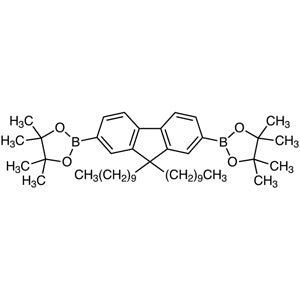
- TCI B4588 711026-06-1 2,7-Bis(4,4,5,5-tetramethyl-1,3,2-dioxaborolan-2-yl)-9,9-didecylfluorene
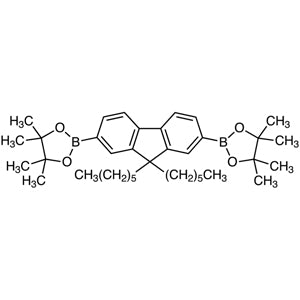
- TCI B4029 254755-24-3 2,7-Bis(4,4,5,5-tetramethyl-1,3,2-dioxaborolan-2-yl)-9,9-dihexylfluorene
- Semiconductor material synthesis due to its optical and electronic properties, enabling the creation of advanced optoelectronic devices.
- Polymer and macromolecule development as a building block for creating high-performance materials with tailored properties.
- Optical material research because of its ability to absorb specific wavelengths of light, useful in photonic applications.
- Nanotechnology applications where precise molecular structures are required for the fabrication of nanoscale components.
- Material characterization studies to investigate the chemical and physical behavior of complex compounds under various conditions.
| Brand | TCI |
|---|---|
| CAS number | 380600-91-9 |
| Molecular formula | — |
| Purity | — |
| Category | Materials Science > Material Building Blocks > Polymer/Macromolecule Semiconductor Building Blocks |
| Pack sizes | Available in standard laboratory quantities as per supplier specifications |
| Physical form | Solid, crystalline appearance |
| Storage | Store in a cool, dry place away from direct sunlight and moisture |
This compound should be stored in a cool, dry environment to maintain its chemical stability. It is recommended to use airtight containers to prevent exposure to moisture and air, which could affect its properties. Due to its potential reactivity, it should be handled in a well-ventilated area, and appropriate personal protective equipment should be worn. Avoid contact with incompatible materials to ensure safety. Regular monitoring of storage conditions is essential to maintain the integrity of the compound. Proper labeling and secure storage are necessary to prevent accidental exposure and ensure safe laboratory practices.
—
Produk Terkait
-
2,7-Bis(4,4,5,5-tetramethyl-1,3,2-dioxaborolan-2-yl)-9,9-di-n-octylfluorene TCI B3582
Regular price Rp 3.551.100,00Regular price -
2,7-Diamino-9,9-di-n-octylfluorene TCI D4719
Regular price From Rp 3.551.100,00Regular price -
9,9-Di-n-octylfluorene TCI D3285
Regular price Rp 4.902.450,00Regular price -
2,7-Bis(4,4,5,5-tetramethyl-1,3,2-dioxaborolan-2-yl)-9,9-dimethylfluorene TCI B5157
Regular price From Rp 2.809.800,00Regular price -
2,7-Bis(4,4,5,5-tetramethyl-1,3,2-dioxaborolan-2-yl)-9,9-didecylfluorene TCI B4588
Regular price Rp 9.461.550,00Regular price -
2,7-Bis(4,4,5,5-tetramethyl-1,3,2-dioxaborolan-2-yl)-9,9-dihexylfluorene TCI B4029
Regular price Rp 7.871.850,00Regular price -
Thieno[3,2-b]thiophene-2,5-dicarboxaldehyde TCI T3212
Regular price From Rp 1.298.850,00Regular price -
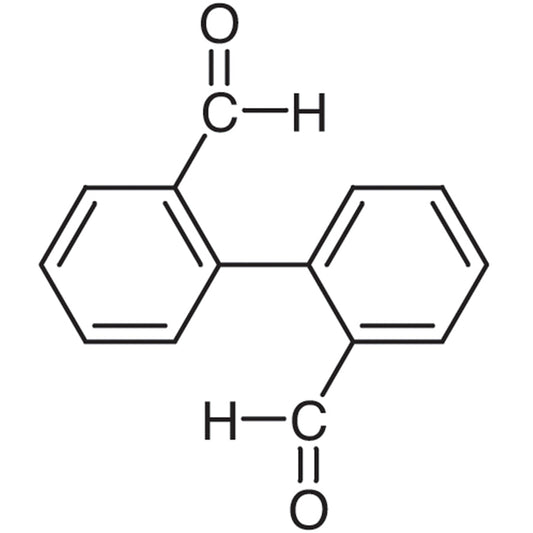
Biphenyl-2,2'-dicarboxaldehyde TCI B2056
Regular price Rp 4.028.850,00Regular price

![37882-75-0 Thieno[3,2-b]thiophene-2,5-dicarboxaldehyde - AMI Scientific](http://amiscientific.com/cdn/shop/files/TCI2510T3212.jpg?v=1767143893&width=533)