2,7-Bis(4,4,5,5-tetramethyl-1,3,2-dioxaborolan-2-yl)-9,9-dimethylfluorene is a versatile organoboron compound widely used in organic chemistry laboratories. This reagent plays a crucial role in facilitating carbon-carbon bond formation through various coupling reactions. It is particularly valuable in synthetic processes that require high precision and controlled molecular interactions. Its unique structure allows it to act as a boron source in multiple chemical transformations, making it a key component in advanced synthetic strategies.
The compound's stability under specific conditions and its ability to react selectively with aromatic and aliphatic halides make it a preferred choice for chemists. Its reactivity and specificity enable it to participate in a wide range of reactions, including S-N coupling and Suzuki-Miyaura cross-coupling. These properties make it especially useful in the synthesis of complex organic molecules and heterocyclic compounds. Its compatibility with various substrates further enhances its utility in diverse synthetic applications.
In Indonesian laboratories, this compound is commonly used in organic chemistry research, particularly in the development of pharmaceutical compounds and organic materials. It supports the synthesis of complex structures with high efficiency and reliability. Researchers in Indonesia rely on this reagent for its consistent performance and its ability to meet the demands of modern synthetic methodologies. Its presence in laboratory workflows underscores its importance in advancing chemical research in the region.
TCI brochures (PDF)
- Fluorenes and Fluorenones 2026-04-15 · p. 4
- Suzuki-Miyaura Cross Coupling Reaction 2025-12-01 · p. 18
- Boron Compounds 2025-10-07 · p. 17
- Building Blocks for Organic Semiconductor 2026-03-24 · p. 13
Related TCI products
- TCI B5656 728911-52-2 2,7-Bis(4,4,5,5-tetramethyl-1,3,2-dioxaborolan-2-yl)-9,9'-spirobi[9H-fluorene]
- TCI P2571 1035631-57-2 9-Phenyl-2,7-bis(4,4,5,5-tetramethyl-1,3,2-dioxaborolan-2-yl)-9H-carbazole
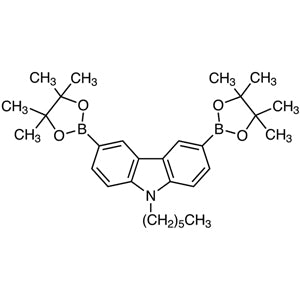
- TCI H1649 628336-95-8 9-Hexyl-3,6-bis(4,4,5,5-tetramethyl-1,3,2-dioxaborolan-2-yl)-9H-carbazole
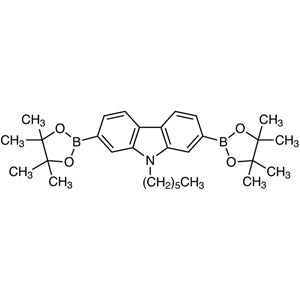
- TCI H1642 871696-12-7 9-Hexyl-2,7-bis(4,4,5,5-tetramethyl-1,3,2-dioxaborolan-2-yl)-9H-carbazole
- TCI E1325 448955-87-1 9-(2-Ethylhexyl)-3,6-bis(4,4,5,5-tetramethyl-1,3,2-dioxaborolan-2-yl)-9H-carbazole
- TCI E1324 476360-83-5 9-(2-Ethylhexyl)-2,7-bis(4,4,5,5-tetramethyl-1,3,2-dioxaborolan-2-yl)-9H-carbazole
- Organic synthesis of heterocyclic compounds due to its ability to form carbon-carbon bonds through coupling reactions.
- Preparation of complex organic molecules in pharmaceutical research through precise and controlled molecular interactions.
- Facilitation of Suzuki-Miyaura cross-coupling reactions, which are essential in creating aromatic and aliphatic carbon-carbon bonds.
- Support for S-N coupling reactions, enabling the synthesis of nitrogen-containing compounds with high structural complexity.
- Contribution to the development of advanced organic materials through its reactivity and compatibility with various substrates.
| Brand | TCI |
|---|---|
| CAS number | 325129-69-9 |
| Molecular formula | — |
| Purity | — |
| Category | Chemistry > Organometallic Reagents > Organoboron [Organometallic Reagents] |
| Pack sizes | — |
| Physical form | — |
| Storage | Store in a cool, dry place away from moisture and direct sunlight |
This compound should be stored in a cool, dry environment to maintain its stability and reactivity. It is recommended to keep it in a sealed container to prevent exposure to moisture and air. Proper ventilation is essential when handling the material to minimize inhalation risks. Avoid contact with skin and eyes, and use appropriate personal protective equipment such as gloves and safety goggles. The compound should be handled in a well-ventilated laboratory setting to ensure safety. Always follow standard chemical safety protocols when working with organoboron reagents to prevent any potential hazards.
—
Product Categories
Produk Terkait
-
2,7-Bis(4,4,5,5-tetramethyl-1,3,2-dioxaborolan-2-yl)-9,9'-spirobi[9H-fluorene] TCI B5656
Regular price Rp 3.815.700,00Regular priceRp 2.683.800,00Sale price Rp 3.815.700,00 -
9-Phenyl-2,7-bis(4,4,5,5-tetramethyl-1,3,2-dioxaborolan-2-yl)-9H-carbazole TCI P2571
Regular price From Rp 1.776.600,00Regular priceRp 1.257.900,00Sale price From Rp 1.776.600,00 -
9-Hexyl-3,6-bis(4,4,5,5-tetramethyl-1,3,2-dioxaborolan-2-yl)-9H-carbazole TCI H1649
Regular price From Rp 1.563.450,00Regular priceRp 1.108.800,00Sale price From Rp 1.563.450,00 -
9-Hexyl-2,7-bis(4,4,5,5-tetramethyl-1,3,2-dioxaborolan-2-yl)-9H-carbazole TCI H1642
Regular price From Rp 1.538.250,00Regular priceRp 1.090.950,00Sale price From Rp 1.538.250,00 -
9-(2-Ethylhexyl)-3,6-bis(4,4,5,5-tetramethyl-1,3,2-dioxaborolan-2-yl)-9H-carbazole TCI E1325
Regular price From Rp 2.597.700,00Regular priceRp 1.832.250,00Sale price From Rp 2.597.700,00 -
9-(2-Ethylhexyl)-2,7-bis(4,4,5,5-tetramethyl-1,3,2-dioxaborolan-2-yl)-9H-carbazole TCI E1324
Regular price From Rp 3.153.150,00Regular priceRp 2.220.750,00Sale price From Rp 3.153.150,00 -
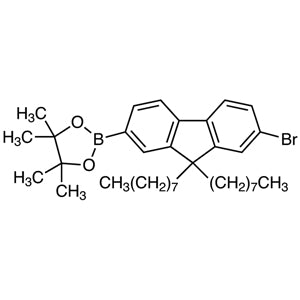
2-(7-Bromo-9,9-di-n-octyl-9H-fluoren-2-yl)-4,4,5,5-tetramethyl-1,3,2-dioxaborolane TCI B5580
Regular price Rp 3.735.900,00Regular priceRp 2.628.150,00Sale price Rp 3.735.900,00 -
9,9-Bis(2-ethylhexyl)-2,7-bis(4,4,5,5-tetramethyl-1,3,2-dioxaborolan-2-yl)fluorene TCI B4892
Regular price From Rp 3.207.750,00Regular priceRp 2.258.550,00Sale price From Rp 3.207.750,00