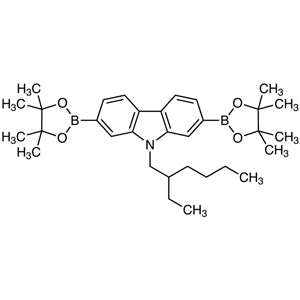
9-(2-Ethylhexyl)-2,7-bis(4,4,5,5-tetramethyl-1,3,2-dioxaborolan-2-yl)-9H-carbazole is an organoboron compound widely used in advanced chemical reactions, particularly in the synthesis of complex heterocyclic compounds and intricate molecular structures. This compound plays a crucial role in laboratory settings where precise chemical transformations are required. Its unique structure enables it to participate in various catalytic processes, making it an essential reagent for chemists working on synthetic pathways. It is especially valuable in applications that require the introduction of boron-based functionalities into organic molecules.
The compound’s stability under specific conditions combined with its reactivity in catalytic reactions, particularly with transition metals like palladium, makes it a preferred choice for organic synthesis. Its ability to form stable intermediates during coupling reactions, such as the Suzuki-Miyaura reaction, enhances its utility in creating complex molecular architectures. The presence of boron groups allows for versatile functionalization, which is critical in developing pharmaceuticals and advanced materials. Its compatibility with a wide range of substrates further broadens its application in chemical research.
In Indonesian laboratories, this compound is commonly used in organic chemistry research, especially in the synthesis of complex molecules and drug development. Its role in creating intricate molecular structures through boron-mediated reactions has made it a key component in both academic and industrial research settings. The compound’s reliability and effectiveness in catalytic processes have solidified its position as a valuable tool in chemical synthesis within the Indonesian scientific community.
TCI brochures (PDF)
- Boron Compounds 2025-10-07 · p. 20
- Building Blocks for Organic Semiconductor 2026-03-24 · p. 21
Related TCI products
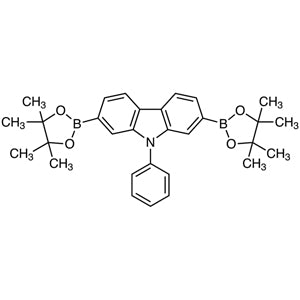
- TCI P2571 1035631-57-2 9-Phenyl-2,7-bis(4,4,5,5-tetramethyl-1,3,2-dioxaborolan-2-yl)-9H-carbazole
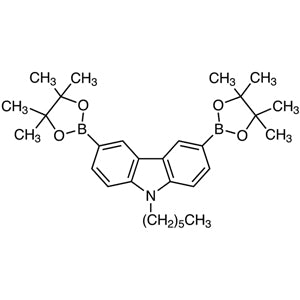
- TCI H1649 628336-95-8 9-Hexyl-3,6-bis(4,4,5,5-tetramethyl-1,3,2-dioxaborolan-2-yl)-9H-carbazole
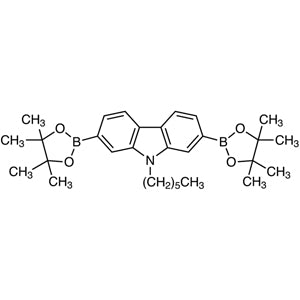
- TCI H1642 871696-12-7 9-Hexyl-2,7-bis(4,4,5,5-tetramethyl-1,3,2-dioxaborolan-2-yl)-9H-carbazole
- TCI E1325 448955-87-1 9-(2-Ethylhexyl)-3,6-bis(4,4,5,5-tetramethyl-1,3,2-dioxaborolan-2-yl)-9H-carbazole
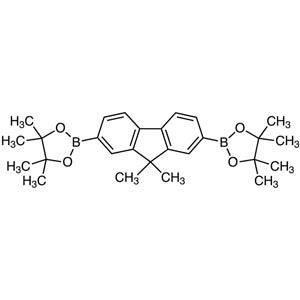
- TCI B5157 325129-69-9 2,7-Bis(4,4,5,5-tetramethyl-1,3,2-dioxaborolan-2-yl)-9,9-dimethylfluorene
- TCI B5656 728911-52-2 2,7-Bis(4,4,5,5-tetramethyl-1,3,2-dioxaborolan-2-yl)-9,9'-spirobi[9H-fluorene]
- Organic synthesis of complex heterocyclic compounds due to its ability to participate in boron-mediated reactions.
- Catalytic coupling reactions such as Suzuki-Miyaura, where the compound acts as a key reagent for forming carbon-carbon bonds.
- Development of pharmaceutical compounds through the synthesis of intricate molecular structures requiring boron functionality.
- Research in advanced materials science where the compound is used to create novel molecular architectures.
- Investigation of transition metal-catalyzed reactions, as it interacts effectively with metals like palladium in catalytic processes.
| Brand | TCI |
|---|---|
| CAS number | 476360-83-5 |
| Molecular formula | — |
| Purity | — |
| Category | Chemistry > Organometallic Reagents > Organoboron [Organometallic Reagents] |
| Pack sizes | Available in various quantities as per supplier specifications |
| Physical form | Solid |
| Storage | Store in a cool, dry place away from moisture and direct light |
This compound should be stored in a cool, dry environment, away from moisture and direct sunlight to maintain its chemical stability. It is recommended to use airtight containers made of materials that do not react with organoboron compounds, such as glass or high-density polyethylene. Laboratory personnel should handle the material with care, using appropriate personal protective equipment to avoid exposure. Due to its reactivity in certain conditions, it should be kept separate from strong oxidizing agents and incompatible substances. Proper labeling and storage conditions are essential to ensure safety and effectiveness in laboratory applications.
—
Product Categories
Produk Terkait
-
9-Phenyl-2,7-bis(4,4,5,5-tetramethyl-1,3,2-dioxaborolan-2-yl)-9H-carbazole TCI P2571
Regular price From Rp 1.724.100,00Regular price -
9-Hexyl-3,6-bis(4,4,5,5-tetramethyl-1,3,2-dioxaborolan-2-yl)-9H-carbazole TCI H1649
Regular price From Rp 1.510.950,00Regular price -
9-Hexyl-2,7-bis(4,4,5,5-tetramethyl-1,3,2-dioxaborolan-2-yl)-9H-carbazole TCI H1642
Regular price From Rp 1.485.750,00Regular price -
9-(2-Ethylhexyl)-3,6-bis(4,4,5,5-tetramethyl-1,3,2-dioxaborolan-2-yl)-9H-carbazole TCI E1325
Regular price From Rp 2.545.200,00Regular price -
2,7-Bis(4,4,5,5-tetramethyl-1,3,2-dioxaborolan-2-yl)-9,9-dimethylfluorene TCI B5157
Regular price From Rp 2.809.800,00Regular price -
2,7-Bis(4,4,5,5-tetramethyl-1,3,2-dioxaborolan-2-yl)-9,9'-spirobi[9H-fluorene] TCI B5656
Regular price Rp 3.763.200,00Regular price -
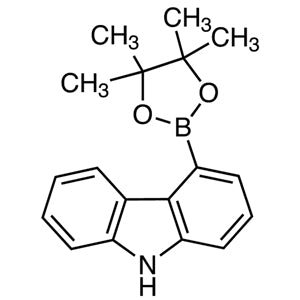
4-(4,4,5,5-Tetramethyl-1,3,2-dioxaborolan-2-yl)-9H-carbazole TCI T3747
Regular price Rp 5.194.350,00Regular price -
3-(4,4,5,5-Tetramethyl-1,3,2-dioxaborolan-2-yl)-9-(p-tolyl)-9H-carbazole TCI T3612
Regular price From Rp 1.060.500,00Regular price


![2,7-Bis(4,4,5,5-tetramethyl-1,3,2-dioxaborolan-2-yl)-9,9'-spirobi[9H-fluorene] (CAS 728911-52-2) - TCI B5656 - AMI Scientific](http://amiscientific.com/cdn/shop/files/TCI2510B5656.jpg?v=1768204431&width=533)