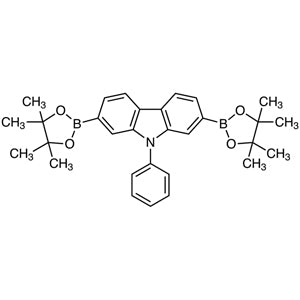
9-Phenyl-2,7-bis(4,4,5,5-tetramethyl-1,3,2-dioxaborolan-2-yl)-9H-carbazole is an organoboron compound widely used in chemical laboratories for its versatility in synthetic applications. This compound plays a crucial role in the development of complex molecular structures, particularly in the field of organic chemistry. It is a key reagent in coupling reactions, such as the Suzuki and Kumada reactions, which are essential for the synthesis of aromatic and heterocyclic compounds. Its unique structure enables it to participate in a variety of chemical transformations, making it a valuable tool for researchers.
The compound is known for its high reactivity and ability to form stable bonds with various ligands, including halides, alkoxides, and other organic compounds. These properties make it a preferred choice for chemists seeking reliable and efficient reagents for synthetic processes. Its stability under certain conditions and ease of synthesis in laboratory settings further enhance its appeal. Additionally, its cost-effectiveness and availability contribute to its widespread use in both academic and industrial research.
In Indonesian laboratories, this compound is commonly used in organic chemistry research, especially in the development of new compounds with applications in pharmaceuticals, materials science, and technology. Its presence in research projects highlights its importance in advancing scientific innovation. The compound is frequently encountered in studies aimed at creating novel molecules with specific functional properties, demonstrating its relevance in modern chemical research.
TCI brochures (PDF)
- Boron Compounds 2025-10-07 · p. 20
- Building Blocks for Organic Semiconductor 2026-03-24 · p. 22
Related TCI products
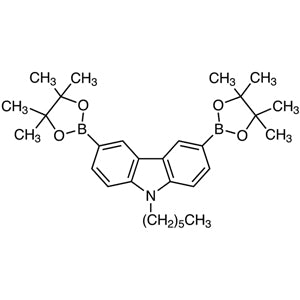
- TCI H1649 628336-95-8 9-Hexyl-3,6-bis(4,4,5,5-tetramethyl-1,3,2-dioxaborolan-2-yl)-9H-carbazole
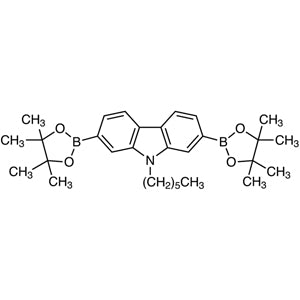
- TCI H1642 871696-12-7 9-Hexyl-2,7-bis(4,4,5,5-tetramethyl-1,3,2-dioxaborolan-2-yl)-9H-carbazole
- TCI E1325 448955-87-1 9-(2-Ethylhexyl)-3,6-bis(4,4,5,5-tetramethyl-1,3,2-dioxaborolan-2-yl)-9H-carbazole
- TCI E1324 476360-83-5 9-(2-Ethylhexyl)-2,7-bis(4,4,5,5-tetramethyl-1,3,2-dioxaborolan-2-yl)-9H-carbazole
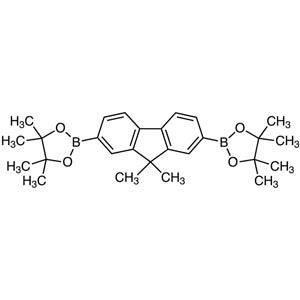
- TCI B5157 325129-69-9 2,7-Bis(4,4,5,5-tetramethyl-1,3,2-dioxaborolan-2-yl)-9,9-dimethylfluorene
- TCI B5656 728911-52-2 2,7-Bis(4,4,5,5-tetramethyl-1,3,2-dioxaborolan-2-yl)-9,9'-spirobi[9H-fluorene]
- Organic synthesis applications benefit from this compound's role in coupling reactions, enabling the creation of complex aromatic and heterocyclic structures.
- Pharmaceutical research utilizes it for the development of new drugs, where precise molecular structures are essential for therapeutic efficacy.
- Material science projects employ it to synthesize compounds with unique properties, such as conductivity or optical characteristics.
- Academic research in Indonesian universities often incorporates it in teaching and experimental studies to demonstrate advanced synthetic techniques.
- Industrial chemical processes use it to produce intermediates for a wide range of commercial products, including polymers and specialty chemicals.
| Brand | TCI |
|---|---|
| CAS number | 1035631-57-2 |
| Molecular formula | — |
| Purity | — |
| Category | Chemistry > Organometallic Reagents > Organoboron [Organometallic Reagents] |
| Pack sizes | — |
| Physical form | — |
| Storage | Store in a cool, dry place away from moisture and direct sunlight. |
This compound should be stored in a cool, dry environment, away from moisture and direct sunlight to maintain its stability and reactivity. It is recommended to use airtight containers made of materials that are chemically inert, such as glass or polyethylene, to prevent any unwanted reactions. In laboratory settings, it should be handled with appropriate personal protective equipment, including gloves and safety goggles, to ensure safety. Due to its reactivity, it should be stored in a well-ventilated area, and any spills should be cleaned up promptly with suitable solvents. Regular monitoring of storage conditions is advised to ensure the compound remains in optimal condition for use in chemical experiments.
—
Product Categories
Produk Terkait
-
9-Hexyl-3,6-bis(4,4,5,5-tetramethyl-1,3,2-dioxaborolan-2-yl)-9H-carbazole TCI H1649
Regular price From Rp 1.510.950,00Regular price -
9-Hexyl-2,7-bis(4,4,5,5-tetramethyl-1,3,2-dioxaborolan-2-yl)-9H-carbazole TCI H1642
Regular price From Rp 1.485.750,00Regular price -
9-(2-Ethylhexyl)-3,6-bis(4,4,5,5-tetramethyl-1,3,2-dioxaborolan-2-yl)-9H-carbazole TCI E1325
Regular price From Rp 2.545.200,00Regular price -
9-(2-Ethylhexyl)-2,7-bis(4,4,5,5-tetramethyl-1,3,2-dioxaborolan-2-yl)-9H-carbazole TCI E1324
Regular price From Rp 3.100.650,00Regular price -
2,7-Bis(4,4,5,5-tetramethyl-1,3,2-dioxaborolan-2-yl)-9,9-dimethylfluorene TCI B5157
Regular price From Rp 2.809.800,00Regular price -
2,7-Bis(4,4,5,5-tetramethyl-1,3,2-dioxaborolan-2-yl)-9,9'-spirobi[9H-fluorene] TCI B5656
Regular price Rp 3.763.200,00Regular price -
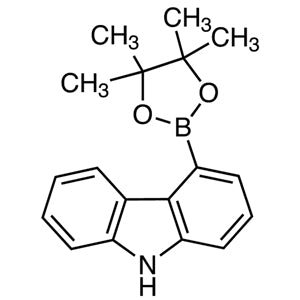
4-(4,4,5,5-Tetramethyl-1,3,2-dioxaborolan-2-yl)-9H-carbazole TCI T3747
Regular price Rp 5.194.350,00Regular price -
3-(4,4,5,5-Tetramethyl-1,3,2-dioxaborolan-2-yl)-9-(p-tolyl)-9H-carbazole TCI T3612
Regular price From Rp 1.060.500,00Regular price


![2,7-Bis(4,4,5,5-tetramethyl-1,3,2-dioxaborolan-2-yl)-9,9'-spirobi[9H-fluorene] (CAS 728911-52-2) - TCI B5656 - AMI Scientific](http://amiscientific.com/cdn/shop/files/TCI2510B5656.jpg?v=1768204431&width=533)