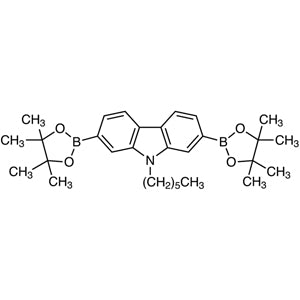
9-Hexyl-2,7-bis(4,4,5,5-tetramethyl-1,3,2-dioxaborolan-2-yl)-9H-carbazole is a complex organic compound widely used in laboratory settings for advanced chemical synthesis. It belongs to the organoboron family and plays a crucial role in various organic reactions, particularly in the development of heterocyclic compounds and complex molecular structures. This compound is essential for researchers working on synthetic pathways that require precise control over molecular architecture and reactivity. Its unique structure and functional groups make it a versatile reagent in both academic and industrial research environments.
The compound's high reactivity and stability under controlled laboratory conditions make it a preferred choice for specialized chemical applications. The presence of two boronic acid groups attached to a carbazole core enhances its utility in coupling reactions such as Suzuki and Kumada. These reactions are fundamental in the synthesis of pharmaceuticals, polymers, and advanced materials. The molecule’s ability to form new bonds efficiently and selectively contributes to its effectiveness in creating complex chemical structures with high precision.
In Indonesian laboratories, this compound is commonly used in organic chemistry research, especially in projects involving the synthesis of heterocyclic compounds and functionalized materials. Its reliability and performance in controlled environments make it a standard reagent for advanced chemical processes. Researchers in Indonesia rely on its consistent quality and predictable behavior to achieve accurate and reproducible results in their experiments.
TCI brochures (PDF)
- Boron Compounds 2025-10-07 · p. 20
- Building Blocks for Organic Semiconductor 2026-03-24 · p. 21
Related TCI products
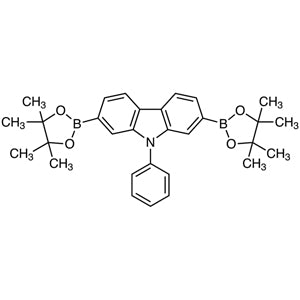
- TCI P2571 1035631-57-2 9-Phenyl-2,7-bis(4,4,5,5-tetramethyl-1,3,2-dioxaborolan-2-yl)-9H-carbazole
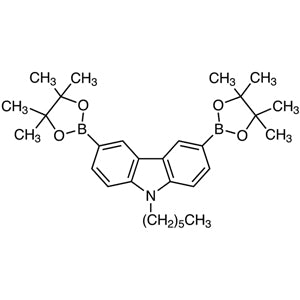
- TCI H1649 628336-95-8 9-Hexyl-3,6-bis(4,4,5,5-tetramethyl-1,3,2-dioxaborolan-2-yl)-9H-carbazole
- TCI E1325 448955-87-1 9-(2-Ethylhexyl)-3,6-bis(4,4,5,5-tetramethyl-1,3,2-dioxaborolan-2-yl)-9H-carbazole
- TCI E1324 476360-83-5 9-(2-Ethylhexyl)-2,7-bis(4,4,5,5-tetramethyl-1,3,2-dioxaborolan-2-yl)-9H-carbazole
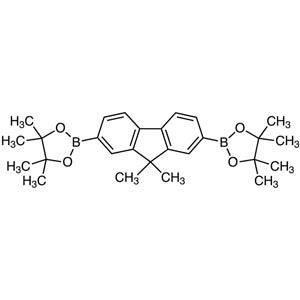
- TCI B5157 325129-69-9 2,7-Bis(4,4,5,5-tetramethyl-1,3,2-dioxaborolan-2-yl)-9,9-dimethylfluorene
- TCI B5656 728911-52-2 2,7-Bis(4,4,5,5-tetramethyl-1,3,2-dioxaborolan-2-yl)-9,9'-spirobi[9H-fluorene]
- Used in the synthesis of heterocyclic compounds due to its reactivity and structural versatility, enabling the formation of complex molecular frameworks.
- Applied in pharmaceutical research for the development of drug molecules, as its boronic acid groups facilitate coupling reactions essential for drug synthesis.
- Employed in material science for the creation of advanced polymers and organic materials, where precise chemical control is required.
- Utilized in organic synthesis workflows requiring high reactivity and selectivity, particularly in cross-coupling reactions like Suzuki and Kumada.
- Integrated into research projects focused on functionalized compounds, where its structural features support the design of novel chemical entities.
| Brand | TCI |
|---|---|
| CAS number | 871696-12-7 |
| Molecular formula | — |
| Purity | — |
| Category | Chemistry > Organometallic Reagents > Organoboron [Organometallic Reagents] |
| Pack sizes | Available in various quantities as per supplier specifications |
| Physical form | Solid or liquid, depending on the specific product variant |
| Storage | Store in a cool, dry place away from moisture and direct sunlight |
This compound should be stored in a cool, dry environment to maintain its chemical integrity and prevent degradation. It is recommended to use airtight containers to protect it from moisture and air exposure, which can affect its reactivity. Due to its organoboron nature, it is important to handle it with care, avoiding contact with incompatible substances. In laboratory settings, it should be kept in a well-ventilated area, and appropriate personal protective equipment should be worn when handling. Proper labeling and storage conditions ensure its stability and usability in research applications.
—
Product Categories
Produk Terkait
-
9-Phenyl-2,7-bis(4,4,5,5-tetramethyl-1,3,2-dioxaborolan-2-yl)-9H-carbazole TCI P2571
Regular price From Rp 1.724.100,00Regular price -
9-Hexyl-3,6-bis(4,4,5,5-tetramethyl-1,3,2-dioxaborolan-2-yl)-9H-carbazole TCI H1649
Regular price From Rp 1.510.950,00Regular price -
9-(2-Ethylhexyl)-3,6-bis(4,4,5,5-tetramethyl-1,3,2-dioxaborolan-2-yl)-9H-carbazole TCI E1325
Regular price From Rp 2.545.200,00Regular price -
9-(2-Ethylhexyl)-2,7-bis(4,4,5,5-tetramethyl-1,3,2-dioxaborolan-2-yl)-9H-carbazole TCI E1324
Regular price From Rp 3.100.650,00Regular price -
2,7-Bis(4,4,5,5-tetramethyl-1,3,2-dioxaborolan-2-yl)-9,9-dimethylfluorene TCI B5157
Regular price From Rp 2.809.800,00Regular price -
2,7-Bis(4,4,5,5-tetramethyl-1,3,2-dioxaborolan-2-yl)-9,9'-spirobi[9H-fluorene] TCI B5656
Regular price Rp 3.763.200,00Regular price -
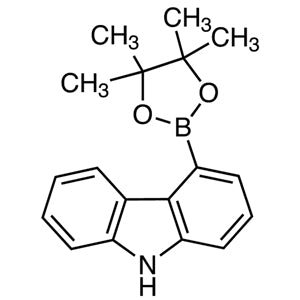
4-(4,4,5,5-Tetramethyl-1,3,2-dioxaborolan-2-yl)-9H-carbazole TCI T3747
Regular price Rp 5.194.350,00Regular price -
3-(4,4,5,5-Tetramethyl-1,3,2-dioxaborolan-2-yl)-9-(p-tolyl)-9H-carbazole TCI T3612
Regular price From Rp 1.060.500,00Regular price



![2,7-Bis(4,4,5,5-tetramethyl-1,3,2-dioxaborolan-2-yl)-9,9'-spirobi[9H-fluorene] (CAS 728911-52-2) - TCI B5656 - AMI Scientific](http://amiscientific.com/cdn/shop/files/TCI2510B5656.jpg?v=1768204431&width=533)