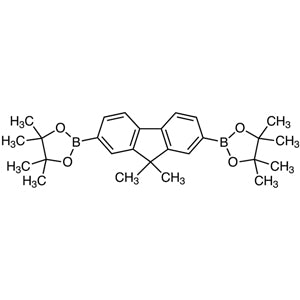
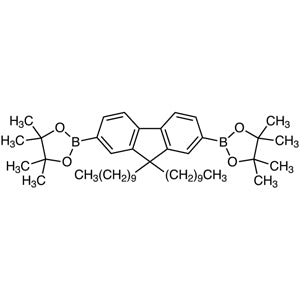
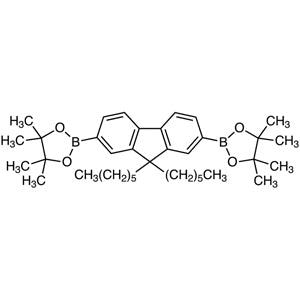
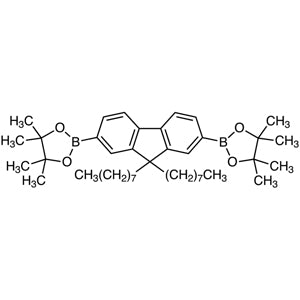
9,9-Bis(2-ethylhexyl)-2,7-bis(4,4,5,5-tetramethyl-1,3,2-dioxaborolan-2-yl)fluorene is a complex organoboron compound widely used in chemical research. This material plays a crucial role in the synthesis of advanced organic molecules, particularly in reactions requiring boron-based reactivity. Its unique structure makes it a valuable reagent in modern synthetic chemistry, supporting the development of new compounds with tailored properties. In Indonesian laboratories, it is a key component in various synthetic processes, enabling researchers to explore new chemical pathways and functional group transformations.
The compound’s reactivity and stability under controlled conditions make it a preferred choice for chemists. Its organoboron functionality allows for efficient coupling reactions, such as the Suzuki-Miyaura reaction, which is essential for constructing carbon-carbon bonds. The solubility in organic solvents further enhances its utility, as it facilitates easy incorporation into reaction mixtures. Additionally, its molecular structure provides high specificity, ensuring predictable and reproducible outcomes in chemical synthesis. These properties make it an essential tool for both academic and industrial research.
In Indonesian laboratories, this compound is commonly used in organic synthesis, particularly in the development of pharmaceuticals and advanced materials. Its application extends to research focused on creating complex molecular architectures and functionalized compounds. The compound's versatility and reliability have made it a standard reagent in many chemical laboratories across Indonesia, supporting a wide range of experimental needs.
TCI brochures (PDF)
- Fluorenes and Fluorenones 2026-04-15 · p. 4
- Boron Compounds 2025-10-07 · p. 15
- Building Blocks for Organic Semiconductor 2026-03-24 · p. 36
Related TCI products
- TCI E1325 448955-87-1 9-(2-Ethylhexyl)-3,6-bis(4,4,5,5-tetramethyl-1,3,2-dioxaborolan-2-yl)-9H-carbazole
- TCI E1324 476360-83-5 9-(2-Ethylhexyl)-2,7-bis(4,4,5,5-tetramethyl-1,3,2-dioxaborolan-2-yl)-9H-carbazole
- TCI B5656 728911-52-2 2,7-Bis(4,4,5,5-tetramethyl-1,3,2-dioxaborolan-2-yl)-9,9'-spirobi[9H-fluorene]
- TCI B5157 325129-69-9 2,7-Bis(4,4,5,5-tetramethyl-1,3,2-dioxaborolan-2-yl)-9,9-dimethylfluorene
- TCI B4588 711026-06-1 2,7-Bis(4,4,5,5-tetramethyl-1,3,2-dioxaborolan-2-yl)-9,9-didecylfluorene
- TCI B4029 254755-24-3 2,7-Bis(4,4,5,5-tetramethyl-1,3,2-dioxaborolan-2-yl)-9,9-dihexylfluorene
- Suzuki-Miyaura coupling reactions benefit from this compound’s reactivity and stability, enabling efficient cross-coupling of aryl halides with boronic acids.
- Organic synthesis projects often utilize this material to create complex molecules with precise functional group arrangements.
- Research in pharmaceutical chemistry leverages its properties for the development of novel drug compounds with specific molecular structures.
- Advanced material synthesis applications rely on its ability to participate in selective chemical transformations under controlled conditions.
- Molecular design studies benefit from its unique structure, allowing for the exploration of new chemical functionalities and reactivity patterns.
| Brand | TCI |
|---|---|
| CAS number | 357219-41-1 |
| Molecular formula | — |
| Purity | — |
| Category | Chemistry > Organometallic Reagents > Organoboron [Organometallic Reagents] |
| Pack sizes | Available in various quantities as per standard laboratory supply practices |
| Physical form | Solid, typically in powder or crystalline form |
| Storage | Store in a cool, dry place away from moisture and direct sunlight |
This compound should be stored in a cool, dry environment to maintain its chemical integrity and reactivity. It is recommended to use airtight containers to prevent exposure to moisture and air, which may affect its stability. Due to its reactivity, it should be handled in a well-ventilated area, preferably under a fume hood, to minimize any potential hazards. Laboratory personnel should wear appropriate personal protective equipment, such as gloves and safety goggles, when handling this material. Proper labeling of storage containers is essential to ensure safe access and prevent accidental misuse. Regular inspection of storage conditions is advised to maintain optimal performance and safety standards.
—
Produk Terkait
-
9-(2-Ethylhexyl)-3,6-bis(4,4,5,5-tetramethyl-1,3,2-dioxaborolan-2-yl)-9H-carbazole TCI E1325
Regular price From Rp 2.597.700,00Regular priceRp 1.832.250,00Sale price From Rp 2.597.700,00 -
9-(2-Ethylhexyl)-2,7-bis(4,4,5,5-tetramethyl-1,3,2-dioxaborolan-2-yl)-9H-carbazole TCI E1324
Regular price From Rp 3.153.150,00Regular priceRp 2.220.750,00Sale price From Rp 3.153.150,00 -
2,7-Bis(4,4,5,5-tetramethyl-1,3,2-dioxaborolan-2-yl)-9,9'-spirobi[9H-fluorene] TCI B5656
Regular price Rp 3.815.700,00Regular priceRp 2.683.800,00Sale price Rp 3.815.700,00 -
2,7-Bis(4,4,5,5-tetramethyl-1,3,2-dioxaborolan-2-yl)-9,9-dimethylfluorene TCI B5157
Regular price From Rp 2.862.300,00Regular priceRp 2.017.050,00Sale price From Rp 2.862.300,00 -
2,7-Bis(4,4,5,5-tetramethyl-1,3,2-dioxaborolan-2-yl)-9,9-didecylfluorene TCI B4588
Regular price Rp 9.514.050,00Regular priceRp 6.668.550,00Sale price Rp 9.514.050,00 -
2,7-Bis(4,4,5,5-tetramethyl-1,3,2-dioxaborolan-2-yl)-9,9-dihexylfluorene TCI B4029
Regular price Rp 7.924.350,00Regular priceRp 5.556.600,00Sale price Rp 7.924.350,00 -
2,7-Bis(4,4,5,5-tetramethyl-1,3,2-dioxaborolan-2-yl)-9,9-di-n-octylfluorene TCI B3582
Regular price Rp 3.603.600,00Regular priceRp 2.535.750,00Sale price Rp 3.603.600,00 -
5,5'-Bis(4,4,5,5-tetramethyl-1,3,2-dioxaborolan-2-yl)-2,2'-bithiophene TCI B3363
Regular price Rp 11.077.500,00Regular priceRp 7.761.600,00Sale price Rp 11.077.500,00