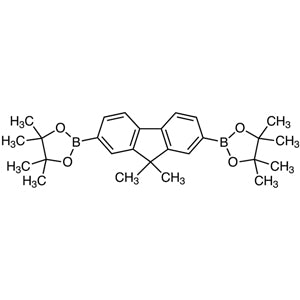
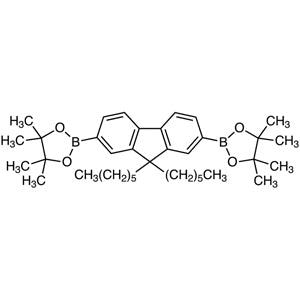
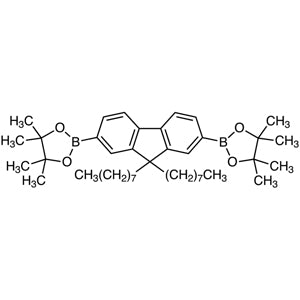
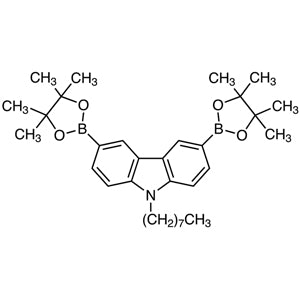
2,7-Bis(4,4,5,5-tetramethyl-1,3,2-dioxaborolan-2-yl)-9,9-didecylfluorene is a highly specialized organoboron compound used in advanced chemical synthesis, particularly in the development of complex molecular structures. This compound is a key reagent in coupling reactions, such as the Suzuki-Miyaura reaction, which is widely employed in organic chemistry for its efficiency and selectivity. Its unique structure combines a fluorene backbone with boronic acid functionalities, making it a versatile tool for synthetic chemists.
The compound’s organoboron functionality provides high reactivity under controlled conditions, enabling the formation of stable carbon-carbon bonds. Its chemical stability under specific conditions, combined with its sensitivity to moisture and oxidation, requires careful handling. These properties make it ideal for applications where precise control over reaction conditions is essential. The presence of boron groups also enhances its utility in substitution reactions and the synthesis of complex organic molecules.
In Indonesian laboratories, this compound is frequently used by chemists and researchers working in organic synthesis. Its availability supports ongoing research in pharmaceuticals, materials science, and catalysis. The compound’s role in developing new compounds and improving synthetic methodologies makes it a valuable resource for scientific innovation in the region.
TCI brochures (PDF)
- Fluorenes and Fluorenones 2026-04-15 · p. 5
- Boron Compounds 2025-10-07 · p. 15
- Building Blocks for Organic Semiconductor 2026-03-24 · p. 36
Related TCI products
- TCI B5157 325129-69-9 2,7-Bis(4,4,5,5-tetramethyl-1,3,2-dioxaborolan-2-yl)-9,9-dimethylfluorene
- TCI B4892 357219-41-1 9,9-Bis(2-ethylhexyl)-2,7-bis(4,4,5,5-tetramethyl-1,3,2-dioxaborolan-2-yl)fluorene
- TCI B4029 254755-24-3 2,7-Bis(4,4,5,5-tetramethyl-1,3,2-dioxaborolan-2-yl)-9,9-dihexylfluorene
- TCI B3582 196207-58-6 2,7-Bis(4,4,5,5-tetramethyl-1,3,2-dioxaborolan-2-yl)-9,9-di-n-octylfluorene
- TCI B3363 239075-02-6 5,5'-Bis(4,4,5,5-tetramethyl-1,3,2-dioxaborolan-2-yl)-2,2'-bithiophene
- TCI P2571 1035631-57-2 9-Phenyl-2,7-bis(4,4,5,5-tetramethyl-1,3,2-dioxaborolan-2-yl)-9H-carbazole
- Organic synthesis applications benefit from this compound’s ability to form stable carbon-carbon bonds through coupling reactions.
- Pharmaceutical research utilizes it for the development of complex drug molecules requiring precise synthetic pathways.
- Material science projects rely on its reactivity to create advanced polymers and functional materials.
- Catalytic processes leverage its organoboron functionality to enhance reaction efficiency and selectivity.
- Academic research in Indonesia uses it to explore new synthetic methodologies and chemical transformations.
| Brand | TCI |
|---|---|
| CAS number | 711026-06-1 |
| Molecular formula | — |
| Purity | — |
| Category | Chemistry > Organometallic Reagents > Organoboron [Organometallic Reagents] |
| Pack sizes | Available in various quantities as per supplier specifications |
| Physical form | Solid or powder, depending on packaging |
| Storage | Requires dry, cool, and well-ventilated conditions |
This compound should be stored in a dry, cool, and well-ventilated area away from moisture and oxidizing agents. It is recommended to use airtight containers made of glass or high-density polyethylene to prevent exposure to humidity. Due to its sensitivity to moisture and oxidation, it is essential to handle it with care, using appropriate personal protective equipment such as gloves and safety goggles. The compound should never be stored near heat sources or in direct sunlight. Regular monitoring of storage conditions is advised to ensure the compound remains chemically stable and suitable for use in laboratory applications.
—
Produk Terkait
-
2,7-Bis(4,4,5,5-tetramethyl-1,3,2-dioxaborolan-2-yl)-9,9-dimethylfluorene TCI B5157
Regular price From Rp 2.862.300,00Regular priceRp 2.017.050,00Sale price From Rp 2.862.300,00 -
9,9-Bis(2-ethylhexyl)-2,7-bis(4,4,5,5-tetramethyl-1,3,2-dioxaborolan-2-yl)fluorene TCI B4892
Regular price From Rp 3.207.750,00Regular priceRp 2.258.550,00Sale price From Rp 3.207.750,00 -
2,7-Bis(4,4,5,5-tetramethyl-1,3,2-dioxaborolan-2-yl)-9,9-dihexylfluorene TCI B4029
Regular price Rp 7.924.350,00Regular priceRp 5.556.600,00Sale price Rp 7.924.350,00 -
2,7-Bis(4,4,5,5-tetramethyl-1,3,2-dioxaborolan-2-yl)-9,9-di-n-octylfluorene TCI B3582
Regular price Rp 3.603.600,00Regular priceRp 2.535.750,00Sale price Rp 3.603.600,00 -
5,5'-Bis(4,4,5,5-tetramethyl-1,3,2-dioxaborolan-2-yl)-2,2'-bithiophene TCI B3363
Regular price Rp 11.077.500,00Regular priceRp 7.761.600,00Sale price Rp 11.077.500,00 -
9-Phenyl-2,7-bis(4,4,5,5-tetramethyl-1,3,2-dioxaborolan-2-yl)-9H-carbazole TCI P2571
Regular price From Rp 1.776.600,00Regular priceRp 1.257.900,00Sale price From Rp 1.776.600,00 -
9-Phenyl-3,6-bis(4,4,5,5-tetramethyl-1,3,2-dioxaborolan-2-yl)carbazole TCI P2350
Regular price From Rp 1.220.100,00Regular priceRp 868.350,00Sale price From Rp 1.220.100,00 -
9-n-Octyl-3,6-bis(4,4,5,5-tetramethyl-1,3,2-dioxaborolan-2-yl)-9H-carbazole TCI O0497
Regular price From Rp 1.961.400,00Regular priceRp 1.387.050,00Sale price From Rp 1.961.400,00