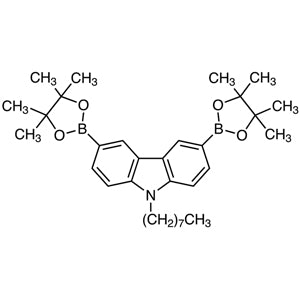
5,5'-Bis(4,4,5,5-tetramethyl-1,3,2-dioxaborolan-2-yl)-2,2'-bithiophene is a highly specialized organoboron compound used in advanced chemical research. This reagent plays a crucial role in organic synthesis, particularly in catalytic reactions that require precise control over molecular structure. Its unique chemical composition allows it to participate in a wide range of reactions, making it an essential tool for researchers working on complex molecular transformations. The compound is widely recognized for its stability and reactivity, which are key factors in its application across various synthetic pathways.
The compound's structure combines a bithiophene backbone with boronic acid functionalities, which contribute to its high reactivity and versatility. These properties make it a preferred choice for chemists seeking reliable and efficient reagents for synthetic processes. Its ability to interact with a variety of ligands enhances its utility in designing new compounds and functional materials. Additionally, its solid form and compatibility with different reaction conditions ensure ease of handling and consistent performance in laboratory settings.
In Indonesian laboratories, this compound is commonly used in organic chemistry research, particularly in the synthesis of heterocyclic compounds and pharmaceuticals. Its role in coupling reactions, such as the Suzuki-Miyaura reaction, has made it a staple in academic and industrial research. The compound's reliability and effectiveness in producing high-quality results make it a valuable asset for researchers focused on drug development and material science.
TCI brochures (PDF)
- Thiophenes 2026-06-29 · p. 15
- Suzuki-Miyaura Cross Coupling Reaction 2025-12-01 · p. 17
- Boron Compounds 2025-10-07 · p. 18
- Building Blocks for Organic Semiconductor 2026-03-24 · p. 36
Related TCI products
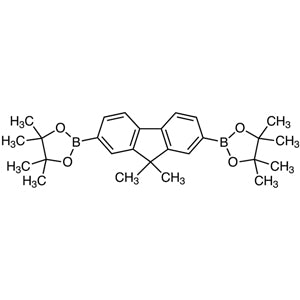
- TCI B5157 325129-69-9 2,7-Bis(4,4,5,5-tetramethyl-1,3,2-dioxaborolan-2-yl)-9,9-dimethylfluorene
- TCI B4892 357219-41-1 9,9-Bis(2-ethylhexyl)-2,7-bis(4,4,5,5-tetramethyl-1,3,2-dioxaborolan-2-yl)fluorene
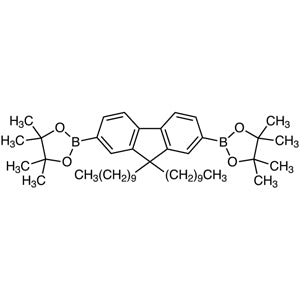
- TCI B4588 711026-06-1 2,7-Bis(4,4,5,5-tetramethyl-1,3,2-dioxaborolan-2-yl)-9,9-didecylfluorene
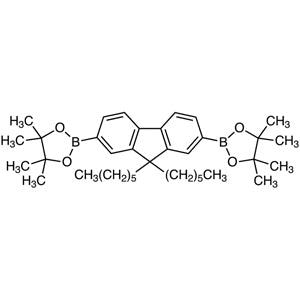
- TCI B4029 254755-24-3 2,7-Bis(4,4,5,5-tetramethyl-1,3,2-dioxaborolan-2-yl)-9,9-dihexylfluorene
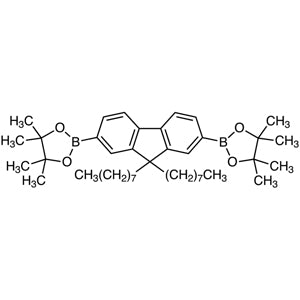
- TCI B3582 196207-58-6 2,7-Bis(4,4,5,5-tetramethyl-1,3,2-dioxaborolan-2-yl)-9,9-di-n-octylfluorene
- TCI P2571 1035631-57-2 9-Phenyl-2,7-bis(4,4,5,5-tetramethyl-1,3,2-dioxaborolan-2-yl)-9H-carbazole
- Organic synthesis for the preparation of heterocyclic compounds due to its reactivity in coupling reactions.
- Pharmaceutical research for the development of new drugs through complex molecular transformations.
- Catalytic processes in Suzuki-Miyaura reactions, where it acts as a key reagent for cross-coupling.
- Material science applications for the creation of advanced polymers and functional materials.
- Synthetic pathways requiring precise control over molecular structure and functional group introduction.
| Brand | TCI |
|---|---|
| CAS number | 239075-02-6 |
| Molecular formula | — |
| Purity | — |
| Category | Chemistry > Organometallic Reagents > Organoboron [Organometallic Reagents] |
| Pack sizes | Available in various quantities as per supplier specifications |
| Physical form | Solid |
| Storage | Store in a cool, dry place away from moisture and direct sunlight |
This compound should be stored in a cool, dry environment to maintain its chemical integrity and reactivity. It is recommended to keep it in a tightly sealed container to prevent exposure to moisture and air, which could affect its performance. Due to its solid form, it is typically stored in glass or plastic containers that are resistant to chemical degradation. Laboratory personnel should handle it with care, using appropriate personal protective equipment when necessary. Avoid prolonged exposure to high temperatures or direct sunlight to ensure optimal stability and effectiveness. Proper storage conditions are essential to maintain the compound’s quality and ensure its suitability for use in various synthetic applications.
—
Produk Terkait
-
2,7-Bis(4,4,5,5-tetramethyl-1,3,2-dioxaborolan-2-yl)-9,9-dimethylfluorene TCI B5157
Regular price From Rp 2.862.300,00Regular priceRp 2.017.050,00Sale price From Rp 2.862.300,00 -
9,9-Bis(2-ethylhexyl)-2,7-bis(4,4,5,5-tetramethyl-1,3,2-dioxaborolan-2-yl)fluorene TCI B4892
Regular price From Rp 3.207.750,00Regular priceRp 2.258.550,00Sale price From Rp 3.207.750,00 -
2,7-Bis(4,4,5,5-tetramethyl-1,3,2-dioxaborolan-2-yl)-9,9-didecylfluorene TCI B4588
Regular price Rp 9.514.050,00Regular priceRp 6.668.550,00Sale price Rp 9.514.050,00 -
2,7-Bis(4,4,5,5-tetramethyl-1,3,2-dioxaborolan-2-yl)-9,9-dihexylfluorene TCI B4029
Regular price Rp 7.924.350,00Regular priceRp 5.556.600,00Sale price Rp 7.924.350,00 -
2,7-Bis(4,4,5,5-tetramethyl-1,3,2-dioxaborolan-2-yl)-9,9-di-n-octylfluorene TCI B3582
Regular price Rp 3.603.600,00Regular priceRp 2.535.750,00Sale price Rp 3.603.600,00 -
9-Phenyl-2,7-bis(4,4,5,5-tetramethyl-1,3,2-dioxaborolan-2-yl)-9H-carbazole TCI P2571
Regular price From Rp 1.776.600,00Regular priceRp 1.257.900,00Sale price From Rp 1.776.600,00 -
9-Phenyl-3,6-bis(4,4,5,5-tetramethyl-1,3,2-dioxaborolan-2-yl)carbazole TCI P2350
Regular price From Rp 1.220.100,00Regular priceRp 868.350,00Sale price From Rp 1.220.100,00 -
9-n-Octyl-3,6-bis(4,4,5,5-tetramethyl-1,3,2-dioxaborolan-2-yl)-9H-carbazole TCI O0497
Regular price From Rp 1.961.400,00Regular priceRp 1.387.050,00Sale price From Rp 1.961.400,00