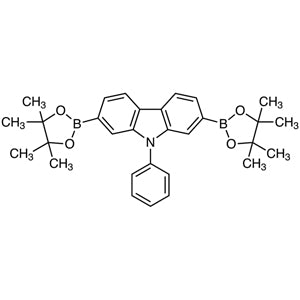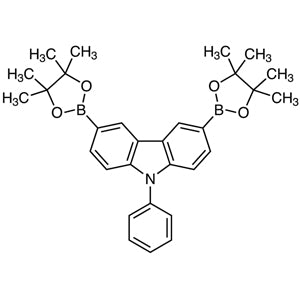
9-Phenyl-3,6-bis(4,4,5,5-tetramethyl-1,3,2-dioxaborolan-2-yl)carbazole is a complex organic compound widely used in laboratory settings for its versatility in chemical reactions. It plays a crucial role in the synthesis of heterocyclic compounds and conductive organic materials, making it an essential reagent for advanced chemical research. Its unique molecular structure, featuring a carbazole core with boronic acid groups, allows for precise chemical interactions that are vital in modern synthetic chemistry. This compound is particularly valuable for its ability to participate in various catalytic processes, contributing to the development of new materials and pharmaceuticals.
The compound's high reactivity and stability under specific conditions make it a preferred choice for researchers working on intricate chemical transformations. Its compatibility with reactions such as the Suzuki-Miyaura coupling enables the efficient synthesis of complex molecules with high selectivity. Additionally, its relatively low toxicity compared to other boron-based reagents enhances its safety profile in laboratory environments. These properties ensure that it remains a reliable and effective tool for chemists seeking precision and efficiency in their experiments.
In Indonesian laboratories, this compound is highly relevant for research in organic chemistry, electronic materials, and compound synthesis. Its application in academic and industrial research settings supports the development of new technologies and scientific advancements. The compound's utility in both teaching and applied research makes it a valuable asset for laboratories focused on innovation and discovery.
TCI brochures (PDF)
- Carbazoles 2025-06-27 · p. 5
- Boron Compounds 2025-10-07 · p. 19
- Building Blocks for Organic Semiconductor 2026-03-24 · p. 36
Related TCI products
- TCI P2571 1035631-57-2 9-Phenyl-2,7-bis(4,4,5,5-tetramethyl-1,3,2-dioxaborolan-2-yl)-9H-carbazole
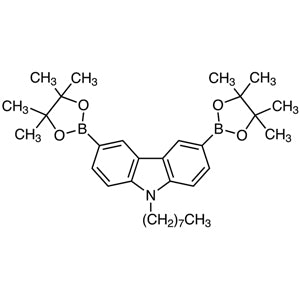
- TCI O0497 478706-06-8 9-n-Octyl-3,6-bis(4,4,5,5-tetramethyl-1,3,2-dioxaborolan-2-yl)-9H-carbazole
- TCI O0428 958261-51-3 9-(9-Heptadecanyl)-2,7-bis(4,4,5,5-tetramethyl-1,3,2-dioxaborolan-2-yl)carbazole
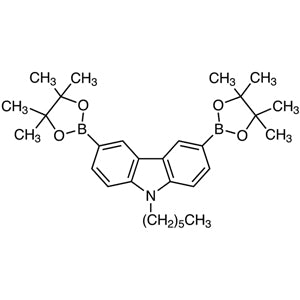
- TCI H1649 628336-95-8 9-Hexyl-3,6-bis(4,4,5,5-tetramethyl-1,3,2-dioxaborolan-2-yl)-9H-carbazole
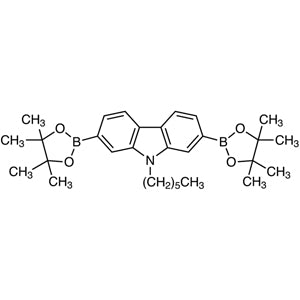
- TCI H1642 871696-12-7 9-Hexyl-2,7-bis(4,4,5,5-tetramethyl-1,3,2-dioxaborolan-2-yl)-9H-carbazole
- TCI E1325 448955-87-1 9-(2-Ethylhexyl)-3,6-bis(4,4,5,5-tetramethyl-1,3,2-dioxaborolan-2-yl)-9H-carbazole
- Used in the synthesis of heterocyclic compounds due to its ability to participate in selective chemical reactions.
- Applied in electronic material research for its role in creating conductive organic compounds.
- Utilized in Suzuki-Miyaura coupling reactions to form complex molecular structures efficiently.
- Employed in pharmaceutical research for the development of new drug molecules with specific functional groups.
- Integrated into material science projects to fabricate advanced electronic and optoelectronic devices.
| Brand | TCI |
|---|---|
| CAS number | 618442-57-2 |
| Molecular formula | — |
| Purity | — |
| Category | Chemistry > Organometallic Reagents > Organoboron [Organometallic Reagents] |
| Pack sizes | Available in various quantities as per standard laboratory reagent packaging |
| Physical form | Solid powder or liquid, depending on manufacturer specifications |
| Storage | Store in a cool, dry place away from moisture and direct sunlight |
This compound should be stored in a cool, dry environment to maintain its chemical stability and prevent degradation. It is recommended to keep it in airtight containers to minimize exposure to moisture and air, which can affect its reactivity. Due to its potential for chemical interaction, it should be handled with appropriate personal protective equipment, including gloves and safety goggles. In laboratory settings, it should be stored separately from strong oxidizing agents to avoid any unwanted reactions. Regular monitoring of storage conditions ensures the compound remains safe and effective for use in research applications. Proper labeling and organization of storage areas are essential to maintain a safe and efficient laboratory environment.
—
Produk Terkait
-
9-Phenyl-2,7-bis(4,4,5,5-tetramethyl-1,3,2-dioxaborolan-2-yl)-9H-carbazole TCI P2571
Regular price From Rp 1.724.100,00Regular price -
9-n-Octyl-3,6-bis(4,4,5,5-tetramethyl-1,3,2-dioxaborolan-2-yl)-9H-carbazole TCI O0497
Regular price From Rp 1.908.900,00Regular price -
9-(9-Heptadecanyl)-2,7-bis(4,4,5,5-tetramethyl-1,3,2-dioxaborolan-2-yl)carbazole TCI O0428
Regular price From Rp 2.625.000,00Regular price -
9-Hexyl-3,6-bis(4,4,5,5-tetramethyl-1,3,2-dioxaborolan-2-yl)-9H-carbazole TCI H1649
Regular price From Rp 1.510.950,00Regular price -
9-Hexyl-2,7-bis(4,4,5,5-tetramethyl-1,3,2-dioxaborolan-2-yl)-9H-carbazole TCI H1642
Regular price From Rp 1.485.750,00Regular price -
9-(2-Ethylhexyl)-3,6-bis(4,4,5,5-tetramethyl-1,3,2-dioxaborolan-2-yl)-9H-carbazole TCI E1325
Regular price From Rp 2.545.200,00Regular price -
9-(2-Ethylhexyl)-2,7-bis(4,4,5,5-tetramethyl-1,3,2-dioxaborolan-2-yl)-9H-carbazole TCI E1324
Regular price From Rp 3.100.650,00Regular price -
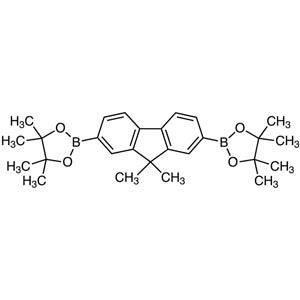
2,7-Bis(4,4,5,5-tetramethyl-1,3,2-dioxaborolan-2-yl)-9,9-dimethylfluorene TCI B5157
Regular price From Rp 2.809.800,00Regular price