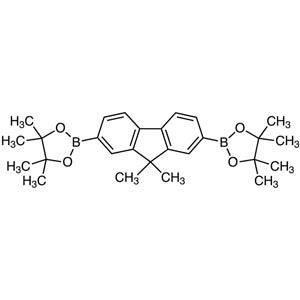
This compound, TCI O0428 958261-51-3 9-(9-Heptadecanyl)-2,7-bis(4,4,5,5-tetramethyl-1,3,2-dioxaborolan-2-yl)carbazole, is a complex organoboron reagent used extensively in organic chemistry laboratories. It is a key component in the synthesis of complex molecules, particularly those requiring high reactivity from boron groups. Its unique structure combines a carbazole core with boronic acid functionalities, making it highly versatile for various chemical transformations. This material is essential for researchers working on advanced synthetic pathways and molecular design.
The compound's organoboron functionality makes it a preferred choice for its reactivity and compatibility with a wide range of substrates. Its ability to participate in coupling reactions, such as Suzuki-Miyaura and Kumada-Corriu, ensures its utility in the synthesis of heterocyclic compounds and other complex structures. The stability of its molecular framework under various reaction conditions further enhances its reliability in laboratory settings. Its chemical properties can be fine-tuned through reaction conditions, allowing for flexibility in experimental design.
In Indonesian laboratories, this reagent is commonly used in research focused on organic synthesis and advanced chemical reactions. It is particularly favored in academic and industrial settings where the development of new compounds and materials is a priority. Its role in facilitating efficient and selective chemical transformations makes it a valuable tool for chemists working on innovative projects.
TCI brochures (PDF)
- Carbazoles 2025-06-27 · p. 4
- Boron Compounds 2025-10-07 · p. 19
- Building Blocks for Organic Semiconductor 2026-03-24 · p. 36
Related TCI products
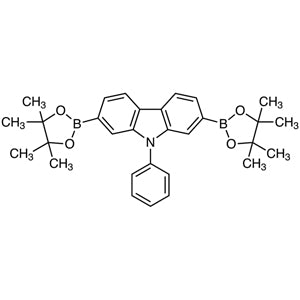
- TCI P2571 1035631-57-2 9-Phenyl-2,7-bis(4,4,5,5-tetramethyl-1,3,2-dioxaborolan-2-yl)-9H-carbazole
- TCI P2350 618442-57-2 9-Phenyl-3,6-bis(4,4,5,5-tetramethyl-1,3,2-dioxaborolan-2-yl)carbazole
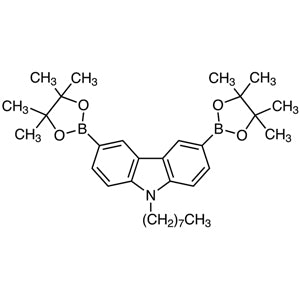
- TCI O0497 478706-06-8 9-n-Octyl-3,6-bis(4,4,5,5-tetramethyl-1,3,2-dioxaborolan-2-yl)-9H-carbazole
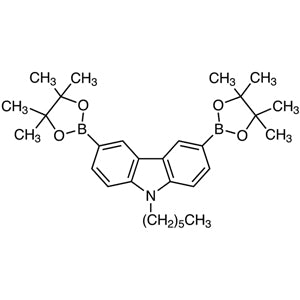
- TCI H1649 628336-95-8 9-Hexyl-3,6-bis(4,4,5,5-tetramethyl-1,3,2-dioxaborolan-2-yl)-9H-carbazole
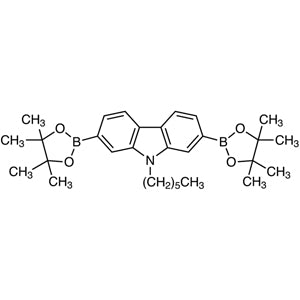
- TCI H1642 871696-12-7 9-Hexyl-2,7-bis(4,4,5,5-tetramethyl-1,3,2-dioxaborolan-2-yl)-9H-carbazole
- TCI E1325 448955-87-1 9-(2-Ethylhexyl)-3,6-bis(4,4,5,5-tetramethyl-1,3,2-dioxaborolan-2-yl)-9H-carbazole
- Used in Suzuki-Miyaura coupling reactions due to its high reactivity and compatibility with aromatic halides, enabling efficient cross-coupling in synthetic pathways.
- Applied in Kumada-Corriu reactions for the synthesis of complex heterocyclic compounds, leveraging its organoboron functionality for selective bond formation.
- Utilized in the development of new pharmaceutical compounds, as its structure supports the creation of bioactive molecules with tailored properties.
- Employed in polymer synthesis to create functionalized materials with enhanced chemical and physical properties.
- Valuable in academic research for exploring novel synthetic methods and understanding reaction mechanisms involving organoboron reagents.
| Brand | TCI |
|---|---|
| CAS number | 958261-51-3 |
| Molecular formula | — |
| Purity | — |
| Category | Chemistry > Organometallic Reagents > Organoboron [Organometallic Reagents] |
| Pack sizes | Available in various quantities suitable for both research and industrial applications. |
| Physical form | Solid, typically in powder or crystalline form depending on the packaging. |
| Storage | Store in a cool, dry place away from moisture and direct sunlight. |
This compound should be stored in a cool, dry environment, away from moisture and direct sunlight to maintain its chemical integrity. It is recommended to use airtight containers made of glass or high-density polyethylene to prevent exposure to air and humidity. Due to its reactivity, it should be handled with appropriate personal protective equipment, including gloves and safety goggles. Avoid contact with incompatible substances such as strong oxidizing agents. Proper ventilation is essential when working with this material to ensure safe laboratory practices. Always follow standard chemical handling procedures to minimize risks and ensure a safe working environment.
—
Produk Terkait
-
9-Phenyl-2,7-bis(4,4,5,5-tetramethyl-1,3,2-dioxaborolan-2-yl)-9H-carbazole TCI P2571
Regular price From Rp 1.724.100,00Regular price -
9-Phenyl-3,6-bis(4,4,5,5-tetramethyl-1,3,2-dioxaborolan-2-yl)carbazole TCI P2350
Regular price From Rp 1.167.600,00Regular price -
9-n-Octyl-3,6-bis(4,4,5,5-tetramethyl-1,3,2-dioxaborolan-2-yl)-9H-carbazole TCI O0497
Regular price From Rp 1.908.900,00Regular price -
9-Hexyl-3,6-bis(4,4,5,5-tetramethyl-1,3,2-dioxaborolan-2-yl)-9H-carbazole TCI H1649
Regular price From Rp 1.510.950,00Regular price -
9-Hexyl-2,7-bis(4,4,5,5-tetramethyl-1,3,2-dioxaborolan-2-yl)-9H-carbazole TCI H1642
Regular price From Rp 1.485.750,00Regular price -
9-(2-Ethylhexyl)-3,6-bis(4,4,5,5-tetramethyl-1,3,2-dioxaborolan-2-yl)-9H-carbazole TCI E1325
Regular price From Rp 2.545.200,00Regular price -
9-(2-Ethylhexyl)-2,7-bis(4,4,5,5-tetramethyl-1,3,2-dioxaborolan-2-yl)-9H-carbazole TCI E1324
Regular price From Rp 3.100.650,00Regular price -
2,7-Bis(4,4,5,5-tetramethyl-1,3,2-dioxaborolan-2-yl)-9,9-dimethylfluorene TCI B5157
Regular price From Rp 2.809.800,00Regular price