2,7-Bis(4,4,5,5-tetramethyl-1,3,2-dioxaborolan-2-yl)-9,9-dihexylfluorene is an organoboron compound widely used in chemical laboratories for its reactivity and versatility. It plays a crucial role in organic synthesis, particularly in coupling reactions that involve aromatic compounds and organoboron reagents. This compound is a key reagent in the Suzuki-Miyaura coupling reaction, which is essential for the formation of carbon-carbon bonds in complex molecule synthesis. Its presence in the laboratory enables chemists to develop new materials and compounds with specific structural properties.
The compound's unique molecular structure and high reactivity make it a preferred choice for synthetic chemists. It contains active boron groups that facilitate reactions with halides, alkoxides, and aromatic compounds. Its stability under controlled conditions allows for reliable performance in various experimental setups. Additionally, its compatibility with a wide range of reagents and solvents enhances its utility in diverse chemical applications. These properties make it a valuable tool for researchers working on advanced organic synthesis.
In Indonesian laboratories, this compound is commonly used in organic chemistry research, especially in the development of complex molecules and new materials. It is frequently employed in academic and research institutions for experiments involving coupling reactions and substitution reactions. Its role in creating novel compounds supports both fundamental and applied research in the field of chemistry.
TCI brochures (PDF)
- Fluorenes and Fluorenones 2026-04-15 · p. 4
- Boron Compounds 2025-10-07 · p. 15
- Building Blocks for Organic Semiconductor 2026-03-24 · p. 36
Related TCI products
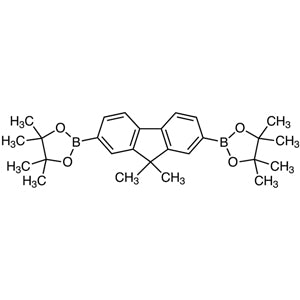
- TCI B5157 325129-69-9 2,7-Bis(4,4,5,5-tetramethyl-1,3,2-dioxaborolan-2-yl)-9,9-dimethylfluorene
- TCI B4892 357219-41-1 9,9-Bis(2-ethylhexyl)-2,7-bis(4,4,5,5-tetramethyl-1,3,2-dioxaborolan-2-yl)fluorene
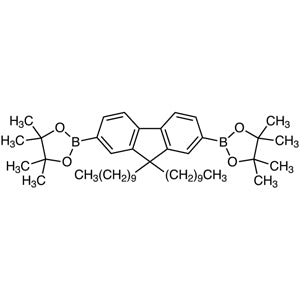
- TCI B4588 711026-06-1 2,7-Bis(4,4,5,5-tetramethyl-1,3,2-dioxaborolan-2-yl)-9,9-didecylfluorene
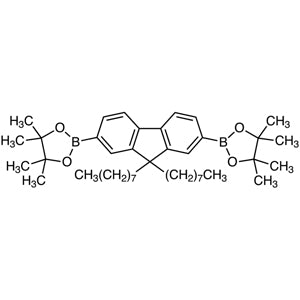
- TCI B3582 196207-58-6 2,7-Bis(4,4,5,5-tetramethyl-1,3,2-dioxaborolan-2-yl)-9,9-di-n-octylfluorene
- TCI B3363 239075-02-6 5,5'-Bis(4,4,5,5-tetramethyl-1,3,2-dioxaborolan-2-yl)-2,2'-bithiophene
- TCI P2571 1035631-57-2 9-Phenyl-2,7-bis(4,4,5,5-tetramethyl-1,3,2-dioxaborolan-2-yl)-9H-carbazole
- Organic synthesis reactions, especially in coupling processes where carbon-carbon bond formation is required, benefit from this compound's reactivity and compatibility with aromatic compounds.
- Development of new materials in polymer science and pharmaceutical research, where precise molecular structures are essential, utilizes its ability to form stable intermediates.
- Research in catalytic processes, where the compound serves as a key reagent in transition metal-catalyzed reactions, enhancing reaction efficiency and selectivity.
- Synthesis of complex organic molecules in academic laboratories, where its active boron groups enable selective and controlled chemical transformations.
- Experimental studies in green chemistry, where its low toxicity and reactivity contribute to the design of sustainable and efficient synthetic pathways.
| Brand | TCI |
|---|---|
| CAS number | 254755-24-3 |
| Molecular formula | — |
| Purity | — |
| Category | Chemistry > Organometallic Reagents > Organoboron [Organometallic Reagents] |
| Pack sizes | Available in various quantities as per standard laboratory supply |
| Physical form | Solid or liquid, depending on the specific formulation |
| Storage | Store in a cool, dry place away from moisture and direct sunlight |
This compound should be stored in a cool, dry environment to maintain its chemical stability and prevent degradation. It is recommended to use airtight containers to minimize exposure to moisture and air, which can affect its reactivity. Laboratory personnel should wear appropriate personal protective equipment, such as gloves and safety goggles, when handling this material. Due to its reactive nature, it should be kept away from incompatible substances like strong oxidizers. Proper ventilation is essential during handling to ensure a safe working environment. The compound is typically stored in a designated chemical storage cabinet, following standard safety protocols for reactive reagents.
—
Produk Terkait
-
2,7-Bis(4,4,5,5-tetramethyl-1,3,2-dioxaborolan-2-yl)-9,9-dimethylfluorene TCI B5157
Regular price From Rp 2.862.300,00Regular priceRp 2.017.050,00Sale price From Rp 2.862.300,00 -
9,9-Bis(2-ethylhexyl)-2,7-bis(4,4,5,5-tetramethyl-1,3,2-dioxaborolan-2-yl)fluorene TCI B4892
Regular price From Rp 3.207.750,00Regular priceRp 2.258.550,00Sale price From Rp 3.207.750,00 -
2,7-Bis(4,4,5,5-tetramethyl-1,3,2-dioxaborolan-2-yl)-9,9-didecylfluorene TCI B4588
Regular price Rp 9.514.050,00Regular priceRp 6.668.550,00Sale price Rp 9.514.050,00 -
2,7-Bis(4,4,5,5-tetramethyl-1,3,2-dioxaborolan-2-yl)-9,9-di-n-octylfluorene TCI B3582
Regular price Rp 3.603.600,00Regular priceRp 2.535.750,00Sale price Rp 3.603.600,00 -
5,5'-Bis(4,4,5,5-tetramethyl-1,3,2-dioxaborolan-2-yl)-2,2'-bithiophene TCI B3363
Regular price Rp 11.077.500,00Regular priceRp 7.761.600,00Sale price Rp 11.077.500,00 -
9-Phenyl-2,7-bis(4,4,5,5-tetramethyl-1,3,2-dioxaborolan-2-yl)-9H-carbazole TCI P2571
Regular price From Rp 1.776.600,00Regular priceRp 1.257.900,00Sale price From Rp 1.776.600,00 -
9-Phenyl-3,6-bis(4,4,5,5-tetramethyl-1,3,2-dioxaborolan-2-yl)carbazole TCI P2350
Regular price From Rp 1.220.100,00Regular priceRp 868.350,00Sale price From Rp 1.220.100,00 -
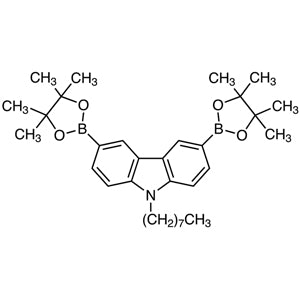
9-n-Octyl-3,6-bis(4,4,5,5-tetramethyl-1,3,2-dioxaborolan-2-yl)-9H-carbazole TCI O0497
Regular price From Rp 1.961.400,00Regular priceRp 1.387.050,00Sale price From Rp 1.961.400,00