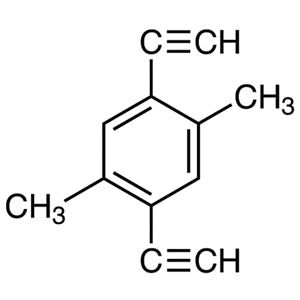
1,4-Diethynyl-2,5-dimethylbenzene is a chemical compound widely used in research applications within organic and biochemical laboratories. This compound plays a crucial role in conjugation chemistry and click chemistry due to its unique molecular structure and reactivity. It serves as a versatile building block for the synthesis of complex molecules, particularly in applications requiring high reactivity and specificity. Its presence in laboratory settings supports the development of novel compounds and materials, making it an essential tool for researchers in various scientific disciplines.
The compound's reactivity is primarily attributed to its two ethynyl groups, which are highly reactive and enable efficient chemical reactions. The symmetric structure of the molecule enhances its stability and usability in diverse experimental conditions. Additionally, the presence of methyl groups provides a degree of molecular stability, making it more resistant to degradation compared to more complex compounds. These properties collectively make 1,4-Diethynyl-2,5-dimethylbenzene a preferred choice for researchers seeking reliable and efficient chemical intermediates.
In Indonesian laboratories, this compound is commonly used in research focused on drug development, organic materials, and molecular biology. Its application extends to studies involving molecular modification and functional group chemistry. The compound's versatility and reactivity make it a valuable asset in both academic and industrial research environments, supporting a wide range of experimental needs.
- Drug development research benefits from this compound due to its reactivity and utility in synthesizing complex pharmaceutical molecules.
- Organic material synthesis relies on its ability to participate in click chemistry reactions, enabling the creation of novel polymers and functional materials.
- Molecular biology studies use it for modifying biomolecules through conjugation reactions, enhancing the functionality of biological systems.
- Chemical synthesis projects utilize its ethynyl groups for efficient cross-linking and functionalization of target molecules.
- Analytical chemistry applications take advantage of its stable structure for use in reference standards and reaction intermediates.
| Brand | TCI |
|---|---|
| CAS number | 75867-45-7 |
| Molecular formula | — |
| Purity | — |
| Category | Chemistry > Chemical Biology > Conjugation Chemistry/Click Chemistry |
| Pack sizes | Available in various quantities as per supplier specifications |
| Physical form | Solid, typically in crystalline or powder form |
| Storage | Store in a cool, dry place away from light and moisture |
This compound should be stored in a cool, dry environment, away from direct light and moisture to maintain its chemical integrity. It is recommended to use airtight containers made of materials such as glass or high-density polyethylene to prevent contamination and degradation. Due to its reactivity, it should be handled with care, ideally in a well-ventilated area or fume hood. Laboratory personnel should wear appropriate personal protective equipment, including gloves and safety goggles, to ensure safe handling. Proper labeling of storage containers is essential to prevent accidental exposure and ensure safe access. Regular monitoring of storage conditions is advised to maintain the compound's effectiveness and safety in laboratory settings.
—
Produk Terkait
-
9-([1,1'-Biphenyl]-4-yl)anthracene TCI B5717
Regular price From Rp 1.358.700,00Regular price -
4-(3-Buten-1-yl)-4'-methylbiphenyl TCI B5872
Regular price From Rp 2.333.100,00Regular price -
4,4'-Bis(trans-4-propylcyclohexyl)biphenyl TCI B5881
Regular price Rp 1.741.950,00Regular price -
Biphenylene TCI B6284
Regular price From Rp 3.099.600,00Regular price -
Benzo[k]fluoranthene TCI B6317
Regular price From Rp 3.541.650,00Regular price -
Benzo[j]fluoranthene TCI B6424
Regular price From Rp 3.246.600,00Regular price -
Benzo[c]phenanthrene TCI B6541
Regular price From Rp 2.038.050,00Regular price -
1-Benzyl-4-methylbenzene TCI B6623
Regular price From Rp 2.657.550,00Regular price
![9-([1,1'-Biphenyl]-4-yl)anthracene (CAS 323195-31-9) - TCI B5717 - AMI Scientific](http://amiscientific.com/cdn/shop/files/TCI2510B5717.jpg?v=1768815871&width=533)


![Benzo[k]fluoranthene (CAS 207-08-9) - TCI B6317 - AMI Scientific](http://amiscientific.com/cdn/shop/files/TCI2510B6317_9797284f-a326-4c13-8c48-43bc162551a1.jpg?v=1767865252&width=533)
![Benzo[j]fluoranthene (CAS 205-82-3) - TCI B6424 - AMI Scientific](http://amiscientific.com/cdn/shop/files/TCI2510B6424.jpg?v=1768193711&width=533)
![Benzo[c]phenanthrene (CAS 195-19-7) - TCI B6541 - AMI Scientific](http://amiscientific.com/cdn/shop/files/TCI2510B6541.jpg?v=1767093862&width=533)