


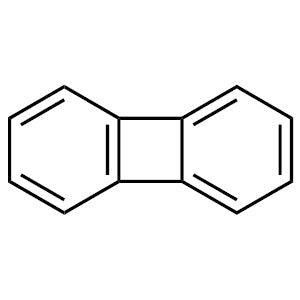
Biphenylene (CAS 259-79-0) is a polycyclic aromatic hydrocarbon supplied by TCI, widely utilized as a non-heterocyclic building block in organic synthesis. This compound features a distinctive structure of two benzene rings fused via a cyclobutadiene core, making it valuable for studying antiaromaticity and constructing extended π-conjugated systems. It is commonly applied in academic and industrial research involving carbon-based materials, organic electronics, and photophysical investigations.
Advantages (TCI brochure)
- Strained four-membered ring moiety can be cleaved by transition metal complexes.
- Available as a building block for condensed polycycles such as eight-membered ring compounds.
TCI brochures (PDF)
- Biphenylene:Condensed Polycyclic Building Block for Functional Materials 2025-03-31 · p. 1
- Building Blocks for Organic Semiconductor 2026-03-24 · p. 33
Related TCI products
- TCI T3267 217-59-4 Triphenylene (purified by sublimation)
- TCI T0513 217-59-4 Triphenylene
- TCI H1412 992-04-1 Hexaphenylbenzene
- TCI H1201 82632-80-2 2,3,6,7,10,11-Hexabromotriphenylene
- TCI T3322 890042-13-4 4,4,5,5-Tetramethyl-2-(triphenylen-2-yl)-1,3,2-dioxaborolane
- TCI T3304 96404-79-4 2-Triphenylenecarboxaldehyde
From the TCI brochure
- E-E' reaction giving ortho-disubstituted biaryl products (E, E' = H, B, Si, Ge, Sn)
- Reaction with an alkyne giving a fused polycyclic product (drawn)
- Reaction with an alkene giving a fused product containing a five-membered ring (drawn)
- Cross-coupling giving a bridged polycyclic product (drawn)
| Brand | — |
|---|---|
| CAS number | — |
| Molecular formula | — |
| Purity | — |
| Category | — |
| Pack sizes | — |
| Physical form | — |
| Storage | — |
Data from the TCI brochure
| Kemasan | 200 mg / 1 g |
|---|
Source: TCI brochure FF113 (2025-03-31)
—
—
Produk Terkait
-
Triphenylene(purifiedbysublimation) TCI T3267
Regular price From Rp 3.367.350,00Regular priceRp 2.354.100,00Sale price From Rp 3.367.350,00 -
Triphenylene TCI T0513
Regular price From Rp 848.400,00Regular priceRp 593.250,00Sale price From Rp 848.400,00 -
Hexaphenylbenzene TCI H1412
Regular price From Rp 1.749.300,00Regular priceRp 1.223.250,00Sale price From Rp 1.749.300,00 -
2,3,6,7,10,11-Hexabromotriphenylene TCI H1201
Regular price From Rp 1.273.650,00Regular priceRp 890.400,00Sale price From Rp 1.273.650,00 -
4,4,5,5-Tetramethyl-2-(triphenylen-2-yl)-1,3,2-dioxaborolane TCI T3322
Regular price From Rp 4.001.550,00Regular priceRp 2.814.000,00Sale price From Rp 4.001.550,00 -
2-Triphenylenecarboxaldehyde TCI T3304
Regular price From Rp 3.683.400,00Regular priceRp 2.575.650,00Sale price From Rp 3.683.400,00 -
4,4,5,5-Tetramethyl-2-[3-(triphenylen-2-yl)phenyl]-1,3,2-dioxaborolane TCI T3261
Regular price From Rp 2.093.700,00Regular priceRp 1.479.450,00Sale price From Rp 2.093.700,00 -
Triphenylethylene TCI T1834
Regular price Rp 1.724.100,00Regular priceRp 1.205.400,00Sale price Rp 1.724.100,00


