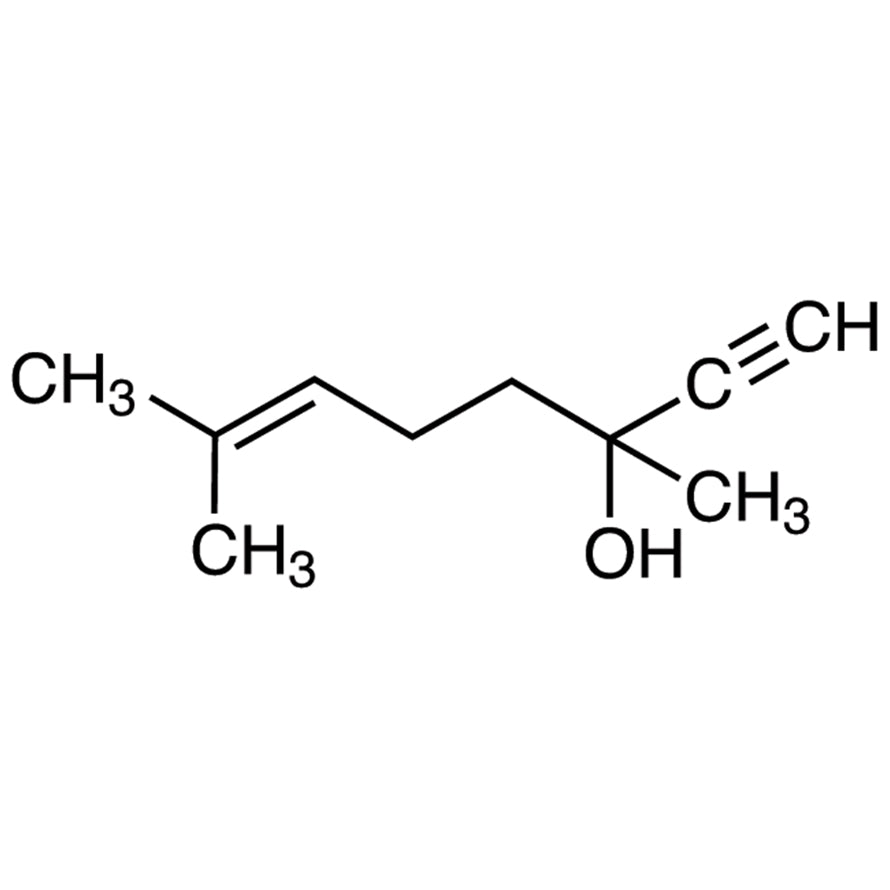
TCI D5752, CAS 29171-20-8, is (+/-)-Dehydrolinalool, an acetylenic tertiary alcohol built on a ten-carbon terpenoid skeleton that carries a terminal alkyne group together with a non-conjugated double bond. The material is supplied as the racemate, meaning a mixture of the two enantiomers in equal proportion. Within terpenoid chemistry, dehydrolinalool is recognised as an important intermediate on the route to linalool and to a range of other isoprenoid derivatives. In the laboratory it serves as a building block that presents three reactive sites at once: a tertiary hydroxyl group, a terminal triple bond, and a trisubstituted double bond.
The property that makes this compound especially valuable is the terminal alkyne group, which can be partially reduced to an alkene with controlled geometry using an appropriately chosen catalyst, or activated as an acetylide to form new carbon–carbon bonds. Terminal alkynes are also classical partners in azide–alkyne cycloaddition reactions and in transition-metal-catalysed cross-coupling reactions, so the compound is readily incorporated into modern synthetic sequences. The allylic tertiary hydroxyl group opens the way to Meyer–Schuster-type rearrangements, while the remaining trisubstituted double bond provides a further handle for selective transformation. This combination of orthogonal functionality in a single small molecule is what makes it a preferred starting point rather than a simple reagent.
In Indonesian laboratories, material of this type is typically used in university and institutional research groups working on organic synthesis, natural product chemistry, and fragrance or flavour chemistry, as well as in industrial research units developing isoprenoid derivatives. It is generally ordered in research quantities for methodology development, route-scouting experiments, and the preparation of reference intermediates, where a well-defined terpenoid building block is needed to support work that is later scaled up or published.
- Terpenoid synthesis — serves as a defined ten-carbon acetylenic intermediate on established routes toward linalool and related isoprenoid derivatives prepared in the laboratory.
- Partial alkyne reduction studies — the terminal triple bond can be reduced to an alkene with controlled geometry, making the compound a convenient substrate for catalyst screening.
- Carbon–carbon bond formation — the terminal alkyne is readily deprotonated to the corresponding acetylide, allowing new carbon skeletons to be assembled from a terpenoid framework.
- Click chemistry and cycloaddition work — as a classical terminal alkyne partner, it participates in azide–alkyne cycloaddition to build triazole-linked terpenoid conjugates.
- Rearrangement chemistry — the allylic tertiary hydroxyl group enables Meyer–Schuster-type rearrangements, giving researchers access to rearranged carbonyl products from a single building block.
| Brand | TCI |
|---|---|
| CAS number | 29171-20-8 |
| Molecular formula | — |
| Purity | — |
| Category | Chemistry > Building Blocks > Non-Heterocyclic Building Blocks |
| Pack sizes | research and laboratory pack sizes as listed by the manufacturer |
| Physical form | — |
| Storage | keep in the original tightly closed container in a cool, well-ventilated place |
- Chemical name: (+/-)-Dehydrolinalool; supplied as the racemate
Store the container tightly closed in a cool, dry and well-ventilated area, away from heat, direct sunlight, ignition sources and incompatible materials such as strong oxidising agents. Keep the product in its original manufacturer packaging wherever possible; if transfer is required, use clean, dry, chemically compatible glass containers with secure closures and clear labelling. Handle in a fume hood using safety glasses, gloves and a laboratory coat, avoid inhalation of vapour and contact with skin and eyes, and close the container promptly after use. Consult the manufacturer's safety data sheet before handling, and dispose of residues and contaminated materials through the laboratory's chemical waste procedures.
—
Produk Terkait
-
3,5-Dimethyl-1-hexyn-3-ol TCI D0737
Regular price From Rp 505.050,00Regular price -
2-Decyn-1-ol TCI D1264
Regular price From Rp 4.081.350,00Regular price -
3-Decyn-1-ol TCI D1275
Regular price Rp 2.518.950,00Regular price -
9-Decen-1-ol TCI D1892
Regular price From Rp 2.571.450,00Regular price -
2,4-Decadien-1-ol TCI D1935
Regular price Rp 4.240.950,00Regular price -
trans-2-Dodecenol TCI D1936
Regular price Rp 2.837.100,00Regular price -
cis-13-Docosenol TCI D2174
Regular price From Rp 1.644.300,00Regular price -
cis-4-Decen-1-ol TCI D2293
Regular price Rp 3.155.250,00Regular price