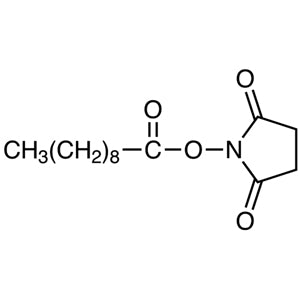
TCI D5833 N-Succinimidyl Decanoate is an active ester formed from decanoic acid (capric acid, a ten-carbon chain) and N-hydroxysuccinimide. As a member of the NHS ester family, it serves as a ready-to-use acylation reagent in the laboratory: the succinimidyl group acts as an effective leaving group, so the ester carbonyl is readily attacked by primary amines to form stable amide bonds. This makes the reagent a practical tool for attaching a medium-chain fatty acyl group to small molecules, peptides, proteins, and material surfaces bearing amino groups.
The properties that make this reagent a preferred choice begin with its selectivity toward amines under mild conditions, namely temperatures near ambient and neutral to slightly basic pH, with no need for an additional activating agent such as a carbodiimide. The only by-product is N-hydroxysuccinimide, which is easily separated, so product purification is simpler. The lipophilic decanoyl chain adds a measurable degree of hydrophobicity to the target molecule, which is very useful for tuning solubility, micellar aggregate formation, binding to lipid membranes, and the residence time of a compound in an assay system. Its solid form is also convenient to handle and weigh.
In Indonesian laboratories, a reagent of this type is typically used in university research groups, institutional chemistry and biochemistry laboratories, and industrial R&D units working on bioconjugation and surface modification. It fits routine bench workflows where amide coupling has to be performed on a small scale under mild conditions, without a dedicated activation step. Because it is supplied as a solid, it is straightforward to store, transport between facilities, and dispense in the small quantities that method development and repeated experimental runs require.
- Protein and peptide acylation: the NHS ester reacts selectively with primary amines on lysine side chains and N-termini under mild, near-neutral conditions that help preserve biomolecular integrity.
- Bioconjugation of small molecules: the reagent introduces a stable amide linkage to amine-bearing substrates without carbodiimide activation, simplifying reaction setup and reducing the number of handling steps.
- Hydrophobicity tuning of target compounds: the ten-carbon decanoyl chain adds a measurable lipophilic increment, allowing researchers to adjust solubility behaviour in a controlled and reproducible manner.
- Membrane and lipid interaction studies: attaching a medium-chain fatty acyl group promotes binding to lipid membranes and micellar aggregation, supporting investigations of amphiphilic behaviour in solution.
- Surface modification of amino-functionalised materials: the active ester couples decanoyl chains onto amine-bearing surfaces, giving modified materials with altered wetting and hydrophobic character for subsequent testing.
| Brand | TCI |
|---|---|
| CAS number | 22102-66-5 |
| Molecular formula | — |
| Purity | — |
| Category | Chemistry > Building Blocks > Non-Heterocyclic Building Blocks |
| Pack sizes | available in standard laboratory research pack sizes; please confirm the available packaging option when ordering |
| Physical form | solid, convenient to handle and weigh |
| Storage | keep in a cool, dry place in a tightly closed container, protected from moisture |
- Chemical class: NHS (N-hydroxysuccinimide) active ester of decanoic acid
Store the reagent in a cool, dry location inside a tightly closed original container, protected from moisture, since NHS esters are sensitive to hydrolysis and prolonged exposure to humid air will reduce their acylation performance. Use clean, dry glass or chemically compatible plastic vessels, and allow the container to warm to ambient temperature before opening to limit condensation on the solid. Weigh and dispense in a fume hood using dry spatulas, and prepare working solutions shortly before use rather than storing them for long periods. Handle with standard laboratory personal protective equipment, including a lab coat, safety glasses, and suitable gloves, avoiding contact with skin and eyes and inhalation of dust. Keep away from strong bases, amines, and other reactive materials, and dispose of residues according to your institution's chemical waste procedures. Always consult the manufacturer's safety data sheet before use.
—
Produk Terkait
-
6-[(tert-Butoxycarbonyl)amino]hexanoicAcidN-SuccinimidylEster TCI B5684
Regular price From Rp 2.244.900,00Regular price -
O-ButylhydroxylamineHydrochloride TCI B5686
Regular price From Rp 1.653.750,00Regular price -
4-Bromo-N-methoxy-N-methylbenzamide TCI B5728
Regular price From Rp 1.859.550,00Regular price -
Bis(3-sulfo-N-succinimidyl)GlutarateDisodiumSalt TCI B5778
Regular price From Rp 3.011.400,00Regular price -
Bis(3-sulfo-N-succinimidyl)SuberateDisodiumSalt TCI B5779
Regular price Rp 9.679.950,00Regular price -
(1R,8S,9s)-Bicyclo[6.1.0]non-4-yn-9-ylmethylSuccinimidylCarbonate(2mg*5) TCI B6215
Regular price Rp 6.729.450,00Regular price -
(1R,8S,9s)-Bicyclo[6.1.0]non-4-yn-9-ylmethylSuccinimidylCarbonate TCI B6275
Regular price From Rp 3.777.900,00Regular price -
Bifenazate TCI B6341
Regular price Rp 8.057.700,00Regular price
![6-[(tert-Butoxycarbonyl)amino]hexanoic Acid N-Succinimidyl Ester (CAS 51513-80-5) - TCI B5684 - AMI Scientific](http://amiscientific.com/cdn/shop/files/TCI2510B5684_4da5edc1-d6c1-4f1a-a6ac-02e24f2955ed.jpg?v=1767862910&width=533)


![(1R,8S,9s)-Bicyclo[6.1.0]non-4-yn-9-ylmethyl Succinimidyl Carbonate (2mg*5) (CAS 1426827-79-3) - TCI B6215 - AMI Scientific](http://amiscientific.com/cdn/shop/files/TCI2510B6215.jpg?v=1767093311&width=533)
![(1R,8S,9s)-Bicyclo[6.1.0]non-4-yn-9-ylmethyl Succinimidyl Carbonate (CAS 1426827-79-3) - TCI B6275 - AMI Scientific](http://amiscientific.com/cdn/shop/files/TCI2510B6275_60041335-470c-4221-9443-43d85645eb5d.jpg?v=1767865108&width=533)