

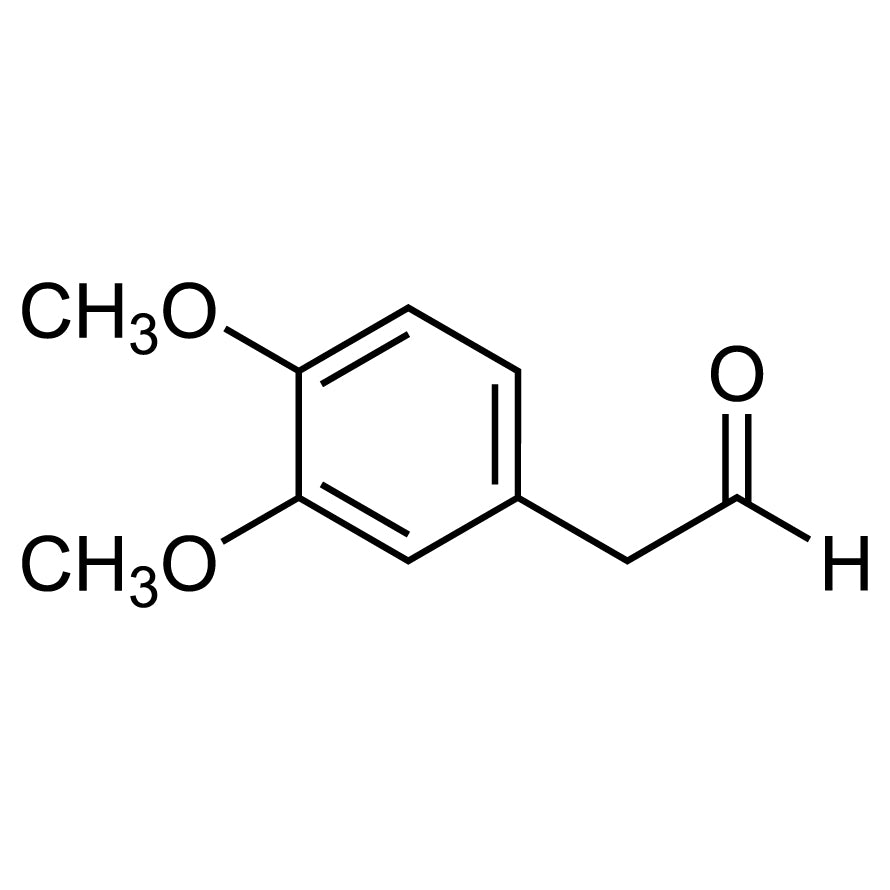
2-(3,4-Dimethoxyphenyl)acetaldehyde is a chemical compound widely used in organic synthesis reactions within laboratory settings. It serves as a versatile building block in the development of complex chemical structures, particularly in the synthesis of aromatic and heterocyclic compounds. This compound is commonly found in chemical laboratories as a foundational material for creating a variety of chemical products through various reaction mechanisms. Its role is essential in enabling researchers to explore new chemical pathways and develop innovative compounds.
The compound's molecular structure is stable, and it exhibits good reactivity, making it a preferred choice for chemical synthesis. Its aldehyde group allows it to participate in multiple reaction types, including condensation, hydration, and nucleophilic reactions. These properties make it a valuable tool in organic chemistry research. The compound's versatility and reactivity are key factors that contribute to its popularity among researchers working on complex molecule synthesis.
In Indonesian laboratories, 2-(3,4-Dimethoxyphenyl)acetaldehyde is utilized in organic chemistry research, pharmaceutical development, and industrial chemical production. Its reactivity and wide range of applications make it a favored choice for experiments requiring flexible and adaptable starting materials. Researchers in Indonesia rely on this compound for its ability to be modified through various chemical transformations, supporting a broad spectrum of scientific investigations.
- Organic synthesis of aromatic and heterocyclic compounds due to its versatile reactivity and structural adaptability.
- Pharmaceutical development as a building block for synthesizing complex drug molecules and active pharmaceutical ingredients.
- Industrial chemical production for the creation of specialty chemicals and intermediate compounds.
- Research in chemical modification and functional group transformation due to its aldehyde group participation in various reactions.
- Educational and experimental use in academic institutions for teaching and demonstrating organic chemistry principles.
| Brand | TCI |
|---|---|
| CAS number | 5703-21-9 |
| Molecular formula | — |
| Purity | — |
| Category | Chemistry > Building Blocks > Non-Heterocyclic Building Blocks |
| Pack sizes | Available in various quantities as per standard laboratory supply formats |
| Physical form | Solid or liquid, depending on the specific product variant |
| Storage | Store in a cool, dry place away from direct sunlight and moisture |
This compound should be stored in a cool, dry environment, away from direct sunlight and moisture to maintain its stability and reactivity. It is recommended to use airtight containers to prevent exposure to air and potential oxidation. Laboratory personnel should handle the compound with appropriate personal protective equipment, such as gloves and safety goggles, to ensure safety during handling. It is important to avoid contact with incompatible substances and to follow standard laboratory safety protocols. Proper labeling and storage conditions are essential to ensure the compound remains suitable for use in chemical synthesis and research applications.
—
Produk Terkait
-
3-(Benzyloxy)propanal TCI B6389
Regular price Rp 5.047.350,00Regular price -
5-(tert-Butyl)-2-hydroxybenzaldehyde TCI B6598
Regular price From Rp 3.807.300,00Regular price -
2-Chloro-3,4-dimethoxybenzaldehyde TCI C1997
Regular price From Rp 1.063.650,00Regular price -
3,4-Diethoxybenzaldehyde TCI D0451
Regular price Rp 1.329.300,00Regular price -
3,4-Dimethoxybenzaldehyde TCI D0507
Regular price From Rp 532.350,00Regular price -
2,4-Dihydroxybenzaldehyde TCI D0564
Regular price From Rp 1.329.300,00Regular price -
2,5-Dihydroxybenzaldehyde TCI D0565
Regular price From Rp 1.593.900,00Regular price -
3,4-Dihydroxybenzaldehyde TCI D0566
Regular price From Rp 2.923.200,00Regular price


