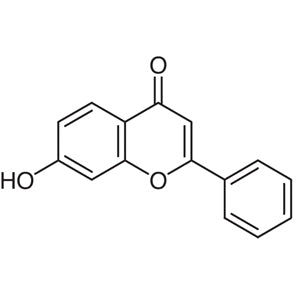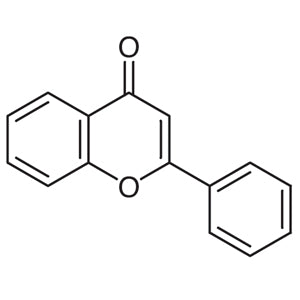
Flavone supplied by TCI under catalogue code F0015 is the parent compound of the large flavonoid family, built on a chromone skeleton bearing a phenyl group at the second position. This structure serves as the blueprint for the thousands of flavonoid derivatives distributed widely throughout the plant kingdom. In the laboratory, flavone plays a dual role: as a reference compound for understanding the spectroscopic and chromatographic behaviour of the flavonoid class, and as a heterocyclic building block that can be modified through substitution to generate new derivatives with the biological or optical properties a researcher is targeting.
The characteristic that makes flavone a frequent choice is its conjugated aromatic framework, which is stable and yet reactive at specific positions. The conjugated carbonyl system on the pyranone ring gives a distinctive ultraviolet absorption, so the compound is readily detected with a UV detector in liquid chromatography and equally straightforward to analyse by spectrophotometry. Its aromatic rings are open to electrophilic substitution reactions, while the carbonyl group can serve as a starting point for a variety of transformations. Its moderate polarity means it dissolves well in common organic solvents, which simplifies the preparation of stock solutions.
In Indonesian laboratories, flavone is typically found in natural product chemistry groups, phytochemistry laboratories, and synthetic organic chemistry units at universities and research institutes. It is commonly used as a reference standard when analysing plant extracts, as a teaching material in heterocyclic chemistry practicals, and as a starting material in synthesis projects that aim to build modified flavonoid structures. Its modest pack sizes suit the scale of most academic and institutional research work.
TCI brochures (PDF)
- Polyphenols 2024-12-05 · p. 1
- Phytochemicals 2025-12-17 · p. 10
- Reference standard in flavonoid analysis: flavone provides a well-defined parent structure against which the retention behaviour and UV absorption of unknown flavonoids in plant extracts can be compared.
- Heterocyclic synthesis building block: the chromone core with its reactive aromatic positions and carbonyl group allows chemists to construct substituted derivatives with targeted biological or optical characteristics.
- Method development in liquid chromatography: the distinctive ultraviolet absorption from the conjugated carbonyl system makes flavone convenient for calibrating UV detectors and establishing separation conditions for flavonoid work.
- Spectrophotometric study of conjugated systems: the stable conjugated aromatic framework gives reproducible absorption behaviour, making flavone suitable for teaching and investigating structure-absorption relationships in aromatic heterocycles.
- Phytochemistry teaching and practical work: as the parent compound of the flavonoid family, flavone gives students a concrete structural starting point for understanding how plant-derived flavonoid derivatives are related.
| Brand | TCI (Tokyo Chemical Industry) |
|---|---|
| CAS number | 525-82-6 |
| Molecular formula | — |
| Purity | — |
| Category | Chemistry > Building Blocks > Heterocyclic Building Blocks |
| Pack sizes | available in the standard research-scale pack sizes listed for this catalogue item |
| Physical form | — |
| Storage | store in a tightly closed container in a cool, dry place away from light |
- Catalogue code: F0015
Store flavone in its original tightly closed container in a cool, dry place, protected from direct light and away from sources of heat or ignition. Amber glass bottles or the manufacturer's original packaging are suitable, and containers should be resealed promptly after each use to limit exposure to moisture and air. Handle the material in a well-ventilated area or fume hood, wearing safety glasses, gloves, and a laboratory coat. Avoid generating dust when weighing the solid, and avoid contact with skin and eyes. Prepared stock solutions in organic solvents should be clearly labelled with the solvent, concentration, and date, and stored according to the solvent's own requirements. Consult the manufacturer's safety data sheet before first use and follow your institution's chemical waste disposal procedures.
—
Produk Terkait
-
4',6,7-Trihydroxyisoflavone TCI T3473
Regular price From Rp 3.127.950,00Regular priceRp 2.202.900,00Sale price From Rp 3.127.950,00 -
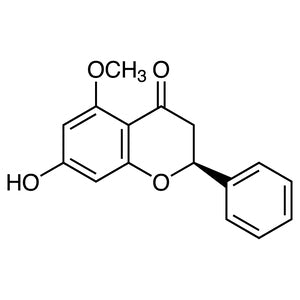
Alpinetin TCI A3577
Regular price Rp 7.949.550,00Regular priceRp 5.574.450,00Sale price Rp 7.949.550,00 -
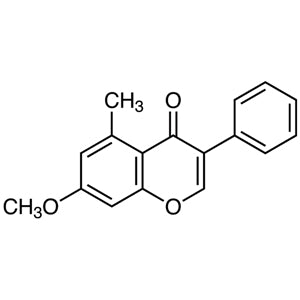
7-Methoxy-5-methylisoflavone TCI M3190
Regular price From Rp 1.140.300,00Regular priceRp 812.700,00Sale price From Rp 1.140.300,00 -
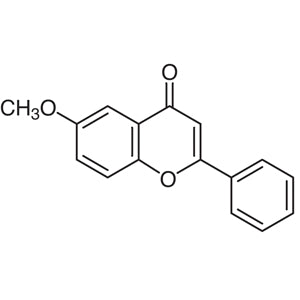
6-Methoxyflavone TCI M1346
Regular price From Rp 1.272.600,00Regular priceRp 905.100,00Sale price From Rp 1.272.600,00 -
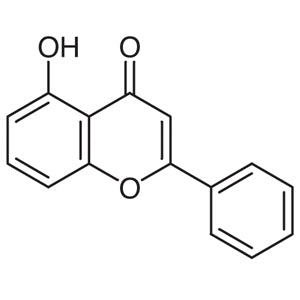
5-Hydroxyflavone TCI H1238
Regular price Rp 5.141.850,00Regular priceRp 3.610.950,00Sale price Rp 5.141.850,00 -
6-Hydroxyflavanone TCI H1027
Regular price From Rp 1.351.350,00Regular priceRp 960.750,00Sale price From Rp 1.351.350,00 -
7-Hydroxyflavanone TCI H1006
Regular price Rp 1.829.100,00Regular priceRp 1.294.650,00Sale price Rp 1.829.100,00 -
7-Hydroxyflavone TCI H0852
Regular price From Rp 955.500,00Regular priceRp 683.550,00Sale price From Rp 955.500,00