

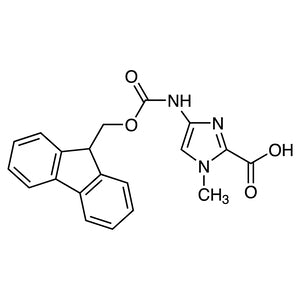
4-(Fmoc-amino)-1-methyl-1H-imidazole-2-carboxylic Acid is a key chemical compound widely used in laboratory settings for the synthesis of complex molecules, particularly in organic and biochemical research. This compound serves as a building block in the creation of peptides, where its Fmoc (9-fluorenylmethyloxycarbonyl) group plays a crucial role in protecting amino functionalities during multi-step synthesis. Its ability to undergo selective deprotection makes it indispensable in controlled chemical reactions. This compound is especially valuable in laboratories that require precision and specificity in molecular design.
The compound is favored for its chemical stability under controlled conditions, allowing for reliable performance in synthetic processes. The presence of the Fmoc group acts as a chemical barrier, enabling targeted and controlled reactions, which is essential for the synthesis of complex structures. Its sensitivity to moisture and air necessitates careful handling, but this also ensures that the compound remains highly reactive when needed. These properties make it a preferred choice for researchers aiming to achieve high precision in their experiments.
In Indonesian laboratories, this compound is commonly used in biochemical, pharmacological, and organic chemistry research. It is a staple in academic and industrial settings where the synthesis of complex and specific molecular structures is required. Its reliability and versatility make it a go-to material for both students and experienced researchers working on advanced chemical projects.
- Peptide Synthesis: This compound is ideal for peptide synthesis due to its Fmoc group, which allows for selective deprotection during solid-phase peptide synthesis.
- Organic Chemistry Research: It is widely used in organic chemistry for constructing complex molecular frameworks with high specificity.
- Biochemical Studies: Its role in protecting amino groups makes it essential for biochemical experiments requiring controlled chemical reactivity.
- Drug Development: The compound is frequently employed in drug development to create molecules with precise structural and functional properties.
- Academic Research: It supports advanced research in universities and research institutions focusing on molecular design and chemical synthesis.
| Brand | TCI |
|---|---|
| CAS number | 252206-28-3 |
| Molecular formula | — |
| Purity | — |
| Category | Chemistry > Building Blocks > Heterocyclic Building Blocks |
| Pack sizes | Available in various quantities as per supplier specifications |
| Physical form | Solid |
| Storage | Store in a dry, cool place away from moisture and air exposure |
This compound should be stored in a dry, cool environment to prevent degradation due to moisture and air exposure. It is recommended to use airtight containers to maintain its chemical integrity. Due to its sensitivity, it should be handled in a controlled laboratory setting with proper ventilation. Avoid direct contact with skin and eyes, and ensure that it is stored away from incompatible substances. Regular monitoring of storage conditions is advised to ensure optimal performance and safety during use.
—
Produk Terkait
-
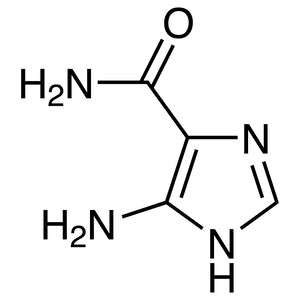
5-Amino-1H-imidazole-4-carboxamide TCI A3078
Regular price From Rp 1.618.050,00Regular price -
2-Amino-4,5-dicyano-1H-imidazole TCI A1292
Regular price Rp 3.870.300,00Regular price -
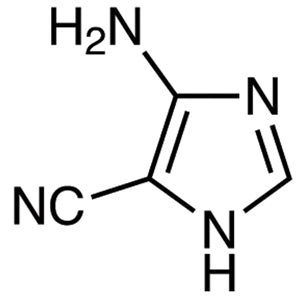
4-Amino-1H-imidazole-5-carbonitrile TCI A1282
Regular price From Rp 6.970.950,00Regular price -
5(4)-Amino-4(5)-(aminocarbonyl)imidazoleHydrochloride TCI A1175
Regular price From Rp 557.550,00Regular price -
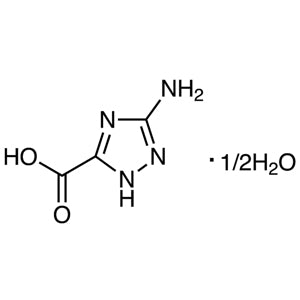
3-Amino-1,2,4-triazole-5-carboxylicAcidHemihydrate TCI A1256
Regular price Rp 2.491.650,00Regular price -
4-(Fmoc-amino)-1-methyl-1H-pyrrole-2-carboxylicAcid TCI F1314
Regular price From Rp 1.856.400,00Regular price -
2-[(tert-Butoxycarbonyl)amino]thiazole-4-carboxylicAcid TCI B6144
Regular price From Rp 1.458.450,00Regular price -
Imidazole-2-carboxaldehyde TCI I0809
Regular price From Rp 769.650,00Regular price



![2-[(tert-Butoxycarbonyl)amino]thiazole-4-carboxylic Acid (CAS 83673-98-7) - TCI B6144 - AMI Scientific](http://amiscientific.com/cdn/shop/files/TCI2510B6144_30b774b8-53f0-43f4-a45f-a11d6bda12b0.jpg?v=1767864684&width=533)
