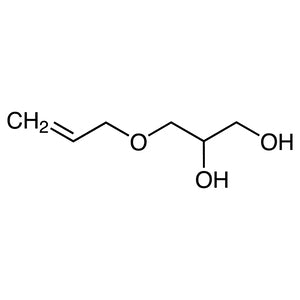
3-Allyloxy-1,2-propanediol, referred to in much of the literature as glyceryl allyl ether, is a bifunctional organic compound designed to serve as a starting point for building polymer chains. Its molecular structure combines one unsaturated allyl group at one end with two adjacent hydroxyl groups on a propanediol backbone at the other end. This combination places it squarely within the category of monomers and macromolecular reagents, because a single molecule already carries two distinct types of reactive site that can be addressed separately or in sequence within one laboratory synthesis route.
The characteristic that makes this material a frequent choice is its orthogonal reactivity. The allyl group is open to radical addition, thiol-ene coupling, hydrosilylation and epoxidation, while the pair of hydroxyl groups is ready to enter esterification, etherification, acetal formation and addition with isocyanates along polyurethane routes. That diol character also gives the molecule an affinity for polar solvents, so handling it in aqueous or alcoholic systems is comparatively straightforward. Researchers can employ it as a functionality-donating comonomer or as a linking unit between segments that would otherwise be difficult to join.
In Indonesian laboratories, this reagent is typically encountered in university polymer chemistry groups, materials research centres and industrial development units working on coatings, adhesives and specialty resins. It supports bench-scale exploratory synthesis as well as the preparation of modified surfaces and crosslinked networks. Because it is supplied by TCI in standard laboratory packaging, it fits readily into routine research workflows where reproducible reagent quality across repeated experiments is required.
TCI brochures (PDF)
- Biomaterials Research Reagents 2025-02-19 · p. 15
- Monomers 2025-05-28 · p. 16
- Polymer synthesis as a functional comonomer, where the allyl group participates in chain growth while the two hydroxyl groups remain available for later modification of the finished polymer.
- Polyurethane and polyester preparation, in which the vicinal diol reacts with isocyanates or acid derivatives to build chains that still carry a pendant unsaturated allyl handle.
- Thiol-ene click chemistry studies, because the terminal allyl group undergoes efficient radical-mediated addition with thiols under mild conditions suited to bench-scale work.
- Surface modification and grafting work, where hydrosilylation of the allyl group anchors the molecule to a substrate and leaves hydroxyl functionality exposed at the interface.
- Crosslinker and network-former development, since a single molecule offers reactive sites of two different chemistries that can be engaged sequentially to build controlled three-dimensional architectures.
| Brand | TCI |
|---|---|
| CAS number | 123-34-2 |
| Molecular formula | — |
| Purity | — |
| Category | Materials Science > Polymer/Macromolecule Reagents > Monomers |
| Pack sizes | available in standard TCI laboratory research pack sizes; please confirm the size required when ordering. |
| Physical form | — |
| Storage | store according to the conditions stated on the manufacturer's label and safety data sheet. |
- Product code: G0189
Store this reagent in a cool, dry and well-ventilated area, kept tightly closed in its original supplier container and away from direct sunlight, heat sources and ignition sources. Because the compound carries an unsaturated allyl group, prolonged exposure to air, light or elevated temperature should be avoided. Use chemically compatible containers and transfer equipment, and keep the container sealed when not in use to limit moisture uptake by the hydroxyl-bearing portion of the molecule. All handling should take place in a fume hood with appropriate personal protective equipment, including safety goggles, chemical-resistant gloves and a laboratory coat. Consult the manufacturer's safety data sheet before use, and follow local institutional procedures for waste collection and disposal.
—
Produk Terkait
-
3-[(Allyloxy)methyl]-3-ethyloxetane TCI A3362
Regular price From Rp 980.700,00Regular priceRp 701.400,00Sale price From Rp 980.700,00 -
4-Allyloxy-2-hydroxybenzophenone TCI A2342
Regular price Rp 1.298.850,00Regular priceRp 924.000,00Sale price Rp 1.298.850,00 -
AllylPhenylEther TCI A0234
Regular price From Rp 1.140.300,00Regular priceRp 796.950,00Sale price From Rp 1.140.300,00 -
2-Allylphenol TCI A0233
Regular price From Rp 769.650,00Regular priceRp 553.350,00Sale price From Rp 769.650,00 -
AllylGlycidylEther TCI A0221
Regular price From Rp 477.750,00Regular priceRp 333.900,00Sale price From Rp 477.750,00 -
AllylAcetate TCI A0020
Regular price From Rp 505.050,00Regular priceRp 352.800,00Sale price From Rp 505.050,00 -
AllylBenzoate TCI B2041
Regular price Rp 2.702.700,00Regular priceRp 1.905.750,00Sale price Rp 2.702.700,00 -
2-Butyl-2-ethyl-1,3-propanediol TCI B0922
Regular price From Rp 530.250,00Regular priceRp 386.400,00Sale price From Rp 530.250,00
![TCI A3362 3207-04-3 3-[(Allyloxy)methyl]-3-ethyloxetane — struktur kimia](http://amiscientific.com/cdn/shop/files/TCI2510A3362-struktur.jpg?v=1791525227&width=533)