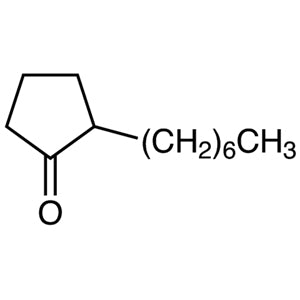
TCI H0569 2-Heptylcyclopentanone is a five-membered cyclic ketone carrying a long heptyl chain at the alpha position relative to the carbonyl group. This structural motif is the characteristic skeleton found among jasmine-type aroma compounds, which is why the material is widely used both as a building block and as a reference compound in flavor and fragrance research. In the laboratory, this compound helps researchers understand the relationship between side-chain length, carbonyl group position, and the aroma character produced by a substituted cyclopentanone molecule.
The characteristic that makes it a preferred choice is the presence of an active alpha position adjacent to the carbonyl, so the compound readily undergoes deprotonation and further reaction through alkylation, aldol, or condensation pathways to form cyclopentenone derivatives. Its five-membered ring provides conformational rigidity that helps direct the stereochemistry of reactions, while the heptyl chain confers high lipophilicity and good solubility in nonpolar organic solvents. This combination yields a material that is stable under normal storage, easy to extract, and gives clear spectroscopic signals for structural tracing.
In Indonesian laboratories, this material is typically handled in university research groups, flavor and fragrance development units, and synthetic chemistry laboratories that build non-heterocyclic frameworks. It is commonly used in small-scale preparative work, as a reference standard for chromatographic and spectroscopic identification, and in method development where a well-defined substituted cyclopentanone is needed as a starting point or comparison compound.
Related TCI products
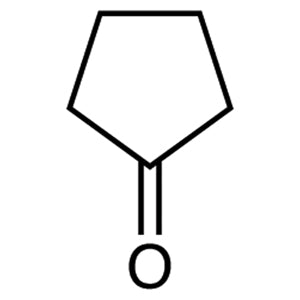
- TCI C0510 120-92-3 Cyclopentanone
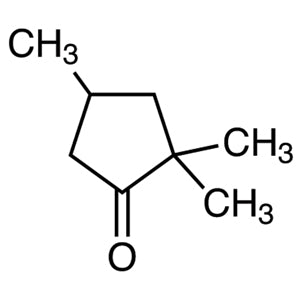
- TCI T1719 28056-54-4 2,2,4-Trimethylcyclopentanone
- TCI D5988 4541-32-6 2,2-Dimethylcyclopentanone
- TCI A0869 1670-46-8 2-Acetylcyclopentanone
- TCI C0931 4884-24-6 2-Cyclopentylcyclopentanone
- TCI T2827 54458-61-6 2,3,4,5-Tetramethylcyclopent-2-en-1-one (cis- and trans- mixture)
- Flavor and fragrance research: the jasmine-type cyclopentanone skeleton makes it a directly relevant model compound for studying how structure relates to aroma character.
- Organic synthesis building block: the reactive alpha position next to the carbonyl allows alkylation, aldol, and condensation routes toward cyclopentenone and other substituted derivatives.
- Structure-activity relationship studies: varying side-chain length around this core lets researchers correlate lipophilicity and chain geometry with observed molecular properties.
- Analytical reference compound: its clear spectroscopic signals make it useful as an identification and comparison standard in chromatographic and spectroscopic method development.
- Stereochemistry-directed reaction work: the conformational rigidity of the five-membered ring helps orient approaching reagents and supports controlled stereochemical outcomes in laboratory-scale transformations.
| Brand | TCI (Tokyo Chemical Industry) |
|---|---|
| CAS number | 137-03-1 |
| Molecular formula | — |
| Purity | — |
| Category | Chemistry > Building Blocks > Non-Heterocyclic Building Blocks |
| Pack sizes | available in standard laboratory research pack sizes as supplied by the manufacturer |
| Physical form | — |
| Storage | stable under normal laboratory storage conditions in a tightly closed container |
- Product code: H0569
Store the container tightly closed in a cool, dry, and well-ventilated area, away from heat sources, open flame, and direct sunlight. Keep the material in its original manufacturer packaging or in a compatible chemically resistant container, and keep it separated from strong oxidizing agents and strong bases that may react with the carbonyl group or the active alpha position. Handle inside a fume hood while wearing safety goggles, gloves, and a laboratory coat. Because the compound is lipophilic and easily extracted into organic solvents, avoid skin contact and clean spills promptly with appropriate absorbent material. Always consult the manufacturer's safety data sheet before use.
—
Produk Terkait
-
Cyclopentanone TCI C0510
Regular price From Rp 477.750,00Regular price -
2,2,4-Trimethylcyclopentanone TCI T1719
Regular price Rp 7.261.800,00Regular price -
2,2-Dimethylcyclopentanone TCI D5988
Regular price From Rp 1.988.700,00Regular price -
2-Acetylcyclopentanone TCI A0869
Regular price From Rp 980.700,00Regular price -
2-Cyclopentylcyclopentanone TCI C0931
Regular price From Rp 769.650,00Regular price -
2,3,4,5-Tetramethylcyclopent-2-en-1-one(cis-andtrans-mixture) TCI T2827
Regular price Rp 3.630.900,00Regular price -
3,4-Dimethylcyclopent-2-en-1-one TCI D6225
Regular price Rp 9.011.100,00Regular price -
1-MethylcyclopentylAcrylate(stabilizedwithMEHQ) TCI M3261
Regular price From Rp 1.696.800,00Regular price