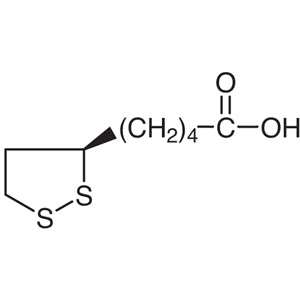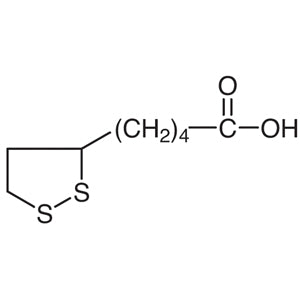
DL-alpha-Lipoic Acid, also known as thioctic acid, is an organosulfur compound that carries a dithiolane ring at one end of its fatty acid chain. The DL designation indicates that this product is a racemic mixture of both enantiomers. In nature, the compound serves as an essential cofactor for dehydrogenase enzyme complexes within the mitochondria. In the laboratory, the presence of both a dithiolane group and a carboxylic acid group within a single molecule makes it a highly useful bifunctional linker for conjugation chemistry and surface modification work.
The property that makes this compound so widely chosen is the ability of its dithiolane ring to open into a pair of free thiols through reduction, and then close again through oxidation. This redox cycle gives the compound strong antioxidant character while also making it a robust anchor on gold surfaces and metal nanoparticles, because two sulfur atoms bind far more tightly than a single thiol does. The carboxylic acid group at the other end remains available for activation and coupling to amines, forming a stable molecular bridge between the metal surface and biomolecules.
In Indonesia, this compound is used in research groups working on nanomaterials, biosensors, and bioconjugate chemistry, where a dependable bifunctional linker is needed to join metal surfaces to biological molecules. It is typically handled in university and institutional laboratories as part of surface functionalisation and antioxidant studies, supplied by AMI Scientific to researchers who require TCI material for reproducible work.
- Gold surface functionalisation: the dithiolane ring provides a bidentate sulfur anchor that binds gold far more tightly than a single thiol, giving more durable monolayers.
- Metal nanoparticle capping: the compound stabilises nanoparticle surfaces through its two sulfur atoms while leaving the carboxylic acid end free for further chemistry.
- Bioconjugation and amine coupling: the terminal carboxylic acid can be activated and coupled to amines, forming a stable bridge from a metal surface to biomolecules.
- Biosensor construction: as a bifunctional linker it joins the metal transducer surface to the biological recognition element, which is the central requirement in sensor assembly.
- Antioxidant and redox studies: the reversible opening and closing of the dithiolane ring under reduction and oxidation supports investigation of redox cycling behaviour.
| Brand | TCI |
|---|---|
| CAS number | 1077-28-7 |
| Molecular formula | — |
| Purity | — |
| Category | Chemistry > Chemical Biology > Linkers and Crosslinkers |
| Pack sizes | available in the pack sizes listed on this product page |
| Physical form | — |
| Storage | refer to the storage guidance below and to the manufacturer label |
- Product code: L0058
Store the container tightly closed in a cool, dry place away from direct sunlight and from strong oxidising agents, since the dithiolane ring is redox active and can be altered by oxidation. Keep the material in its original supplier container or in a well sealed amber glass vessel, and allow refrigerated stock to reach room temperature before opening so that moisture does not condense inside. Handle in a well ventilated area or fume hood using gloves, safety glasses, and a laboratory coat, and follow the manufacturer safety data sheet for the specific grade supplied.
—
Produk Terkait
-
(R)-alpha-LipoicAcid TCI L0207
Regular price From Rp 2.279.550,00Regular price -
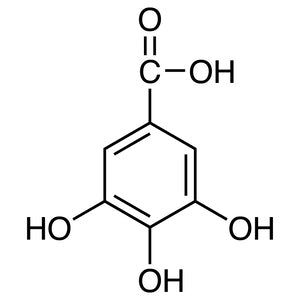
GallicAcid TCI G0011
Regular price From Rp 505.050,00Regular price -
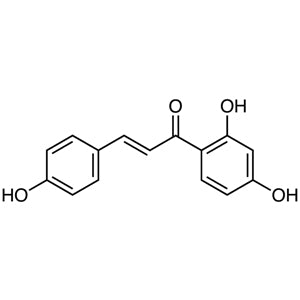
Isoliquiritigenin TCI I0822
Regular price From Rp 1.035.300,00Regular price -
Idebenone TCI I0848
Regular price From Rp 2.809.800,00Regular price -
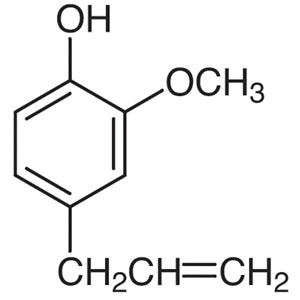
Eugenol TCI A0232
Regular price From Rp 505.050,00Regular price -
UricAcid TCI U0018
Regular price From Rp 1.008.000,00Regular price -
Tetrahydrocurcumin TCI T3587
Regular price From Rp 2.386.650,00Regular price -
3',4',5,7-Tetrahydroxyflavone TCI T2682
Regular price From Rp 1.565.550,00Regular price