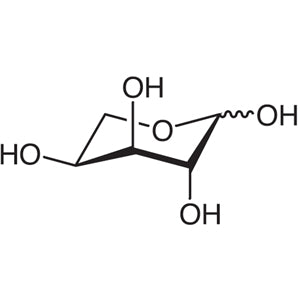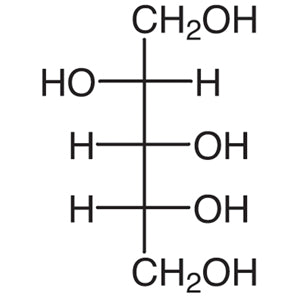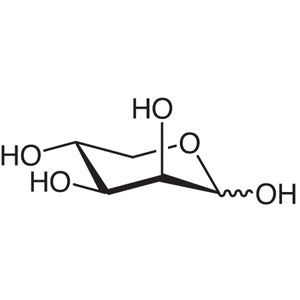
D-(-)-Lyxose is one of the aldopentoses, a simple sugar built on five carbon atoms and bearing an aldehyde group. Together with arabinose, ribose, and xylose, lyxose completes the family of aldopentoses, yet its occurrence in nature is far less common, which is why it is frequently classified among the rare sugars. In the laboratory, this compound holds considerable value both as a chiral starting material and as a research tool in glycoscience, because it supplies a stereochemical pattern that cannot be obtained from the cheaper and more abundant common sugars.
The property that makes D-(-)-Lyxose particularly attractive is the distinctive arrangement of its stereochemistry across three consecutive chiral centres. Its hydroxyl group pattern differs from that of both xylose and arabinose, so the molecule yields derivatives with conformations and reactivities that differ accordingly. As a crystalline solid with good solubility in water, the compound is straightforward to weigh out and dissolve for synthetic work as well as for bioassays. Its reducing aldehyde group permits reductive amination, glycoside formation, and derivatisation for chromatographic analysis.
In Indonesia, this compound is generally used by carbohydrate chemistry research groups in universities, where it supports the preparation of chiral intermediates, the study of stereochemical relationships among pentoses, and glycoscience investigations that call for a rare sugar rather than a commonplace one. It is handled in the same way as other reducing monosaccharides on the bench, dissolved in aqueous media for reaction and analysis.
- Chiral building block synthesis, where the three consecutive stereocentres provide a defined stereochemical template that cannot be sourced from the cheaper, more abundant common sugars.
- Glycoscience research, where lyxose serves as a rare-sugar reference and reagent for studies of pentose structure and behaviour that ordinary sugars cannot represent.
- Reductive amination chemistry, in which the reducing aldehyde group reacts with amines to generate amino sugar derivatives for further synthetic elaboration in the laboratory.
- Glycoside preparation, since the aldehyde and hydroxyl functionality allow the formation of glycosidic linkages that carry the distinctive lyxose configuration into larger target molecules.
- Chromatographic analysis work, where the compound is derivatised to produce detectable species and used as a comparison standard alongside arabinose, ribose, and xylose.
| Brand | TCI |
|---|---|
| CAS number | 1114-34-7 |
| Molecular formula | — |
| Purity | — |
| Category | Chemistry > Chemical Biology > Glycoscience |
| Pack sizes | available in the standard catalogue pack sizes offered for this item |
| Physical form | crystalline solid, readily soluble in water |
| Storage | keep in a tightly closed container in a cool, dry place away from moisture |
Store D-(-)-Lyxose in a cool, dry place inside a tightly closed container, since reducing sugars of this type readily take up atmospheric moisture and may cake or lose their free-flowing character. Amber or opaque glass bottles with well-sealing caps are suitable, and a desiccator provides added protection for material that is opened frequently. Weigh the solid in a clean, dry area using dedicated spatulas to avoid cross-contamination, and prepare aqueous solutions fresh where reaction or assay results depend on the state of the reducing group. Wear a laboratory coat, safety glasses, and gloves when handling the powder, work so that dust generation is kept to a minimum, and return the container promptly to its designated storage location after use.
—
Produk Terkait
-
L-(+)-Lyxose TCI L0153
Regular price From Rp 2.279.550,00Regular price -
D-(-)-Arabinose TCI A0513
Regular price From Rp 1.140.300,00Regular price -
L-(+)-Arabinose TCI A0515
Regular price From Rp 1.115.100,00Regular price -
D-(+)-Arabitol TCI A0516
Regular price Rp 717.150,00Regular price -
L-(-)-Arabitol TCI A0518
Regular price From Rp 557.550,00Regular price -
N-Acetyl-D-glucosamine TCI A0092
Regular price From Rp 928.200,00Regular price -
L-(-)-Xylose TCI X0021
Regular price From Rp 1.458.450,00Regular price -
D-(+)-Xylose TCI X0019
Regular price From Rp 452.550,00Regular price