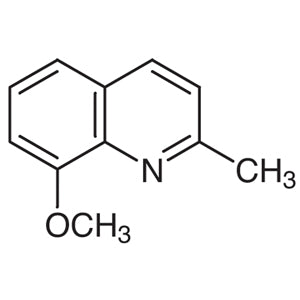
TCI M1088 8-Methoxy-2-methylquinoline is a quinoline derivative carrying a methoxy group at the eight position — the position directly adjacent to the ring nitrogen atom — together with a methyl group at the two position. The placement of the methoxy group in the peri position relative to nitrogen is what makes this compound distinctive, because the two heteroatoms sit at exactly the right distance to cooperate in clamping a single metal center. In the laboratory, this material serves as a heterocyclic building block and at the same time as a direct precursor to the family of quinoline ligands that are very well known in coordination chemistry.
The characteristic that makes it a researcher's preferred choice is its ability to play a dual role, functioning both as a synthetic framework and as a metal-binding framework. The methoxy group at the eight position can be demethylated into a hydroxy group, producing the classical bidentate chelate system that binds metal ions strongly and frequently gives rise to luminescent behaviour. Meanwhile, the methyl group at the two position is sufficiently acidic because of its position next to nitrogen, so it can be condensed with aldehydes to form long conjugated systems. These two independent modification routes give the chemist considerable flexibility from a single starting material.
In Indonesian laboratories, this building block is typically found in university and institutional research groups working on synthetic organic chemistry, coordination chemistry, and functional materials. It is normally kept as a shared stock chemical in the reagent store, drawn on in small portions for multi-step syntheses, ligand preparation, and the exploratory work of graduate and postgraduate research projects rather than being consumed in bulk routine testing.
- Heterocyclic building block synthesis: the intact quinoline core provides a ready-made nitrogen heterocycle, sparing the chemist the lengthy ring-construction steps normally required to reach this scaffold.
- Ligand precursor preparation for coordination chemistry: demethylation of the eight-position methoxy group delivers the classical bidentate chelating system directly, without redesigning the underlying molecular framework.
- Metal complex research: the nitrogen and oxygen heteroatoms are positioned at the correct distance to clamp a single metal center cooperatively, making complex formation predictable and reproducible.
- Luminescent material investigations: the chelate system generated from this compound binds metal ions strongly and frequently gives rise to luminescent behaviour useful in functional materials studies.
- Conjugated system construction: the acidic two-position methyl group condenses readily with aldehydes, allowing researchers to extend conjugation and build longer chromophoric systems from one starting material.
| Brand | TCI |
|---|---|
| CAS number | 3033-80-5 |
| Molecular formula | — |
| Purity | — |
| Category | Chemistry > Building Blocks > Heterocyclic Building Blocks |
| Pack sizes | available in the standard research-scale pack sizes offered by the manufacturer for this catalogue item |
| Physical form | — |
| Storage | store in a closed container in a cool, dry place away from light; refer to the manufacturer's label and safety data sheet for the definitive storage requirement |
- Chemical name: 8-Methoxy-2-methylquinoline
Store this reagent in its original tightly closed container, kept in a cool, dry and well-ventilated chemical store away from direct sunlight and from sources of heat or ignition. Amber glass or the supplied manufacturer packaging is appropriate, since light exposure should be limited. Handle the material inside a fume hood while wearing a laboratory coat, chemical-resistant gloves and safety glasses, and avoid generating dust or inhaling vapour. Keep the container closed when not in use, weigh out only the quantity required for the work in hand, and separate the material from strong oxidising agents. Always consult the manufacturer's safety data sheet before first use and follow your institution's chemical waste procedures for disposal of residues.
—
Produk Terkait
-
6-Methoxy-2-methylquinoline TCI M1414
Regular price From Rp 2.254.350,00Regular price -
6-Methoxy-4-methylquinoline TCI M1087
Regular price From Rp 5.565.000,00Regular price -
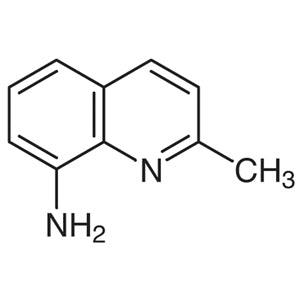
8-Amino-2-methylquinoline TCI A0416
Regular price From Rp 1.273.650,00Regular price -
4,6,8-Trimethylquinoline TCI T1409
Regular price Rp 5.644.800,00Regular price -
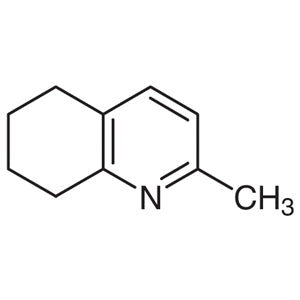
5,6,7,8-Tetrahydro-2-methylquinoline TCI T1408
Regular price Rp 2.016.000,00Regular price -
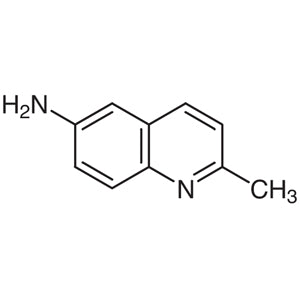
6-Amino-2-methylquinoline TCI A1047
Regular price Rp 3.976.350,00Regular price -
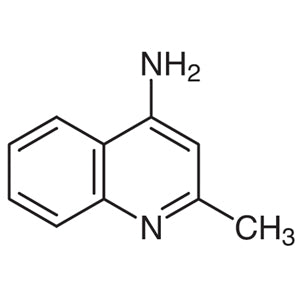
4-Amino-2-methylquinoline TCI A0415
Regular price Rp 3.207.750,00Regular price -
2-Methylquinoline TCI Q0005
Regular price From Rp 452.550,00Regular price