

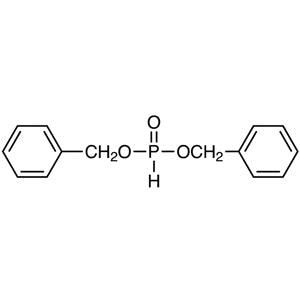
Dibenzyl Phosphite from TCI (product code P1016) is a dialkyl H-phosphonate with two benzyl groups bonded to the phosphorus atom through oxygen. In synthetic laboratories it is known as a versatile phosphorus source for making phosphate esters, phosphonates and phosphoramidates. It plays a key role in phosphorylation chemistry because the products it forms carry benzyl groups. These groups can later be removed under mild conditions to give the free phosphoric or phosphonic acid, so the reagent is a dependable starting point for many phosphorus-containing target molecules.
The main advantage of this reagent is its benzyl groups, which can be removed by catalytic hydrogenolysis under neutral, mild conditions. Researchers can therefore add phosphate groups to sensitive molecules without relying on harsh acidic or basic hydrolysis that could damage other parts of the structure. The P–H bond in Dibenzyl Phosphite is also reactive in the Atherton–Todd, Pudovik and Kabachnik–Fields reactions. This means one reagent can be used to form P–O, P–N and P–C bonds, which reduces the number of different phosphorus reagents a laboratory needs to keep in stock.
In Indonesia, Dibenzyl Phosphite is useful for organic chemistry, biochemistry and pharmaceutical laboratories that study bioactive phosphates, nucleotide analogues, phosphorylated sugars or phosphonate-based enzyme inhibitors. University research groups working on synthetic methodology, and pharmaceutical development teams preparing phosphorylated intermediates or prodrug candidates, can use it as a standard building block. Because it is a TCI product, laboratories get a consistent, well-documented reagent that supports reproducible synthetic work across repeated experiments and projects.
- Synthesis of phosphate esters: the reagent provides a benzyl-protected phosphorus center that can be built into target molecules and later deprotected to give free phosphate groups.
- Phosphorylation of sensitive substrates: the benzyl groups come off by mild, neutral catalytic hydrogenolysis, so delicate molecules avoid harsh acid or base hydrolysis during deprotection.
- Atherton–Todd reactions for P–N and P–O bonds: the reactive P–H bond allows phosphoramidates and phosphate triesters to be made directly from amines or alcohols.
- Pudovik and Kabachnik–Fields reactions for P–C bonds: the H-phosphonate adds to carbonyls and imines, giving access to hydroxyphosphonates and aminophosphonates used in enzyme inhibitor research.
- Preparation of nucleotide analogues and phosphorylated sugars: protected phosphorus is installed on carbohydrate and nucleoside scaffolds and then released cleanly in biochemical and pharmaceutical research programs.
| Brand | TCI (product code P1016) |
|---|---|
| CAS number | 17176-77-1 |
| Molecular formula | — |
| Purity | — |
| Category | Chemistry > Building Blocks > Non-Heterocyclic Building Blocks |
| Pack sizes | available in several TCI pack sizes; please ask about current options |
| Physical form | see the TCI product documentation and Certificate of Analysis |
| Storage | follow the conditions on the TCI label and Safety Data Sheet (SDS) |
Store Dibenzyl Phosphite in its original, tightly closed manufacturer container in a cool, dry, well-ventilated area. Keep it away from moisture, strong oxidizing agents, heat and direct sunlight, and follow the specific storage conditions on the TCI label and Safety Data Sheet. After each use, reseal the container promptly to keep the reagent in good condition. Handle the material in a fume hood and wear suitable personal protective equipment, including chemical-resistant gloves, safety glasses and a lab coat. Avoid inhaling vapors and avoid contact with skin and eyes. Dispose of waste and contaminated materials according to institutional procedures and local regulations.
—
Produk Terkait
-
DibenzylPhosphate TCI P1120
Regular price From Rp 1.749.300,00Regular price -
Dibenzyl(Chloromethyl)Phosphate TCI D5828
Regular price Rp 9.698.850,00Regular price -
TrimethylolpropanePhosphite TCI T0816
Regular price From Rp 3.710.700,00Regular price -
TributylPhosphite TCI T0362
Regular price From Rp 903.000,00Regular price -
TrihexylPhosphite TCI P1260
Regular price From Rp 1.378.650,00Regular price -
DiisopropylPhosphite TCI P0629
Regular price From Rp 1.590.750,00Regular price -
Tris(2-chloroethyl)Phosphite TCI P0277
Regular price Rp 4.320.750,00Regular price -
DiisobutylPhosphite TCI D3417
Regular price Rp 1.298.850,00Regular price


