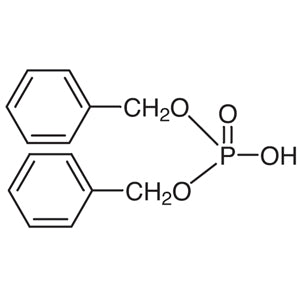
Dibenzyl phosphate is a chemical compound widely used in laboratory settings as a building block for various organic synthesis reactions. It serves as a versatile reagent in chemical processes, particularly in the creation of complex organic molecules. Its unique structure, consisting of two benzyl groups attached to a phosphorus atom, provides it with high reactivity and functional versatility. This makes it an essential material for chemists working on synthetic pathways that require precise control over reaction conditions. Its ability to participate in multiple types of chemical transformations enhances its value in both research and industrial applications.
The compound’s stability under normal conditions, combined with its reactivity toward specific reagents and functional groups, makes it a preferred choice for many laboratory applications. Its ability to form phosphodiester bonds and its compatibility with a wide range of functional groups, such as hydroxyl, amine, and carbonyl groups, further contribute to its popularity. These properties allow it to be used in a variety of synthetic strategies, making it a valuable tool for chemists aiming to develop new compounds or optimize existing synthesis routes.
In Indonesian laboratories, Dibenzyl phosphate is commonly used in both academic and applied research settings. It plays a key role in the development of new chemical materials, pharmaceutical compounds, and analytical methods. Its relevance in the chemical industry and research institutions in Indonesia underscores its importance as a fundamental reagent in modern chemical experimentation.
- Organic synthesis is a key application where Dibenzyl phosphate is used to create complex molecules by participating in substitution and esterification reactions.
- Pharmaceutical research benefits from its ability to form phosphodiester bonds, which are crucial in the development of new drug compounds.
- Analytical chemistry utilizes its reactivity to detect and quantify specific functional groups in various samples.
- Polymer science applies it as a building block in the synthesis of phosphorus-containing polymers with unique properties.
- Biochemical studies use it to modify biomolecules, enabling the study of enzyme mechanisms and molecular interactions.
| Brand | TCI |
|---|---|
| CAS number | 1623-08-1 |
| Molecular formula | — |
| Purity | — |
| Category | Chemistry > Building Blocks > Non-Heterocyclic Building Blocks |
| Pack sizes | 100g, 500g, 1kg |
| Physical form | White crystalline solid |
| Storage | Store in a cool, dry place away from moisture and direct sunlight |
Dibenzyl phosphate should be stored in a cool, dry environment to maintain its chemical stability. It is recommended to keep it in a sealed container to prevent exposure to moisture, which can affect its reactivity. Due to its high reactivity, it should be handled with care, using appropriate personal protective equipment such as gloves and safety goggles. It is advisable to store it in a well-ventilated area to minimize any potential fumes. Avoid contact with incompatible substances, and ensure that it is kept away from heat sources. Proper labeling and storage conditions are essential to ensure safety and maintain the integrity of the compound in a laboratory setting.
—
Produk Terkait
-
TCI B5774 5,10-Bis(4,4,5,5-tetramethyl-1,3,2-dioxaborolan-2-yl)naphtho[1,2-c:5,6-c']bis([1,2,5]oxadiazole)
Regular price Rp 10.255.350,00Regular price -
Dihydroiodide TCI B6569
Regular price From Rp 1.936.200,00Regular price -
Trifluoromethanesulfonate TCI B7003
Regular price From Rp 1.936.200,00Regular price
![5,10-Bis(4,4,5,5-tetramethyl-1,3,2-dioxaborolan-2-yl)naphtho[1,2-c:5,6-c']bis([1,2,5]oxadiazole) - TCI B5774 - AMI Scientific](http://amiscientific.com/cdn/shop/files/TCI2510B5774.jpg?v=1769180228&width=533)