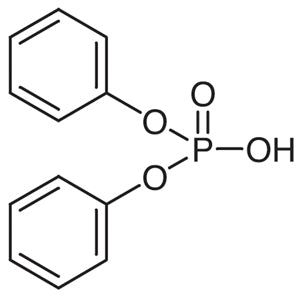
Diphenyl phosphate is a chemical compound widely used in laboratory settings as a foundational reagent for various organic reactions. It serves as a key building block in the synthesis of complex organic molecules, particularly in reactions involving substitution, esterification, and phosphorus bond formation. Due to its structural composition of two phenyl groups attached to a phosphate group, it exhibits high reactivity and versatility in chemical transformations. This compound is essential for researchers aiming to develop new synthetic pathways and functional materials.
The chemical properties of Diphenyl phosphate make it a preferred choice in laboratory applications. It is chemically stable under specific conditions, yet retains high reactivity towards various substrates. Its purity and consistent chemical behavior ensure reliable results in experimental processes. The compound’s ability to participate in multiple reaction types, combined with its stability, makes it a valuable asset in both academic and industrial research environments. Its non-colored nature and solid or liquid form, depending on storage conditions, further enhance its usability in diverse laboratory settings.
In Indonesian laboratories, Diphenyl phosphate is extensively used in organic chemistry research and pharmaceutical development. It plays a crucial role in the synthesis of pharmaceutical compounds and other complex molecules. Its availability and performance make it a preferred material for laboratories seeking precision and quality in their chemical experiments. The compound’s reliability and effectiveness contribute to its widespread use in both academic and industrial sectors across Indonesia.
- Organic synthesis reactions benefit from Diphenyl phosphate due to its reactivity and role in phosphorus bond formation.
- Esterification processes utilize this compound for its ability to form ester linkages efficiently in controlled environments.
- Catalytic processes in chemical reactions rely on Diphenyl phosphate for its stability and participation in multiple reaction pathways.
- Pharmaceutical compound development uses Diphenyl phosphate as a building block for synthesizing complex drug molecules.
- Research in phosphorus chemistry leverages this compound for its structural versatility and reactivity in various synthetic strategies.
| Brand | TCI |
|---|---|
| CAS number | 838-85-7 |
| Molecular formula | — |
| Purity | — |
| Category | Chemistry > Building Blocks > Non-Heterocyclic Building Blocks |
| Pack sizes | Available in standard laboratory quantities |
| Physical form | Solid or liquid depending on storage conditions |
| Storage | — |
Diphenyl phosphate should be stored in a cool, dry place away from direct sunlight and sources of heat. It is recommended to keep the compound in a sealed container to prevent moisture absorption and contamination. Due to its chemical reactivity, it should be handled in a well-ventilated area, ideally with appropriate personal protective equipment. Avoid exposure to incompatible materials such as strong acids or bases. The compound should be stored in airtight containers made of materials resistant to chemical degradation, such as glass or high-density polyethylene. Regular monitoring of storage conditions ensures the compound remains stable and suitable for use in laboratory applications.
—
Produk Terkait
-
TCI B5774 5,10-Bis(4,4,5,5-tetramethyl-1,3,2-dioxaborolan-2-yl)naphtho[1,2-c:5,6-c']bis([1,2,5]oxadiazole)
Regular price Rp 10.255.350,00Regular price -
Dihydroiodide TCI B6569
Regular price From Rp 1.936.200,00Regular price -
Trifluoromethanesulfonate TCI B7003
Regular price From Rp 1.936.200,00Regular price
![5,10-Bis(4,4,5,5-tetramethyl-1,3,2-dioxaborolan-2-yl)naphtho[1,2-c:5,6-c']bis([1,2,5]oxadiazole) - TCI B5774 - AMI Scientific](http://amiscientific.com/cdn/shop/files/TCI2510B5774.jpg?v=1769180228&width=533)