


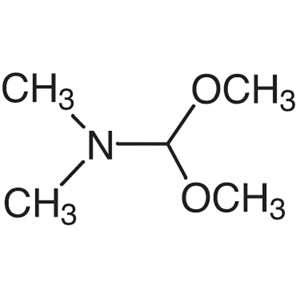
TCI D1293 N,N-Dimethylformamide Dimethyl Acetal, commonly abbreviated as DMF-DMA, is a versatile organic synthesis reagent built on a formamide framework bearing two methoxy groups on the acetal carbon atom. It belongs to the family of non-heterocyclic building blocks and is widely recognised as a key reagent for introducing a one-carbon unit into a target molecule. In synthetic laboratories, DMF-DMA is highly valued for its ability to convert compounds containing active hydrogen into enaminones or amidines — intermediates that serve as gateways to the construction of the many heterocyclic ring systems that matter in medicinal chemistry.
The properties that make this reagent such a frequent choice are its high yet well-directed reactivity, together with the ease of using it without requiring a complicated catalyst system. DMF-DMA acts both as a source of the dimethylaminomethylene group and as a mild methylating agent for carboxylic acid functionalities, so a single reagent can serve several distinct classes of transformation. This dual capability simplifies reagent inventories and shortens route planning, since one bottle covers formylation-equivalent chemistry, amidine formation and gentle ester preparation within the same workflow.
The reagent is supplied as a liquid that is highly sensitive to moisture; contact with water hydrolyses it and reduces reaction effectiveness. For this reason, the quality of the results obtained depends strongly on moisture-free handling technique. In Indonesian laboratories this makes DMF-DMA a reagent typically reserved for synthetic and medicinal chemistry groups equipped for anhydrous work, where it is dispensed under inert conditions in university research laboratories, pharmaceutical R&D units and contract synthesis facilities carrying out heterocycle construction.
TCI brochures (PDF)
- Nucleic Acid Medicine Synthesis Research Reagents 2024-11-07 · p. 2
- Nucleosides, Nucleotides, Nucleic Acids and Related Reagents 2026-03-23 · p. 13
- Reagents for Biological Research 2025-03-11 · p. 61
Related TCI products
- TCI D2071 4637-24-5 N,N-Dimethylformamide Dimethyl Acetal [for Esterification]
- TCI D1595 4909-78-8 N,N-Dimethylformamide Dineopentyl Acetal [for Esterification]
- TCI D1332 4637-24-5 N,N-Dimethylformamide Dimethyl Acetal [for Esterification] (0.5mL*10)
- TCI D1303 36805-97-7 N,N-Dimethylformamide Di-tert-butyl Acetal [for Esterification]
- TCI D1302 18503-90-7 N,N-Dimethylformamide Dibutyl Acetal [for Esterification]
- TCI D1301 6006-65-1 N,N-Dimethylformamide Dipropyl Acetal [for Esterification]
- Enaminone synthesis — DMF-DMA converts substrates bearing active methylene or active hydrogen centres into enaminones cleanly, giving reliable access to versatile intermediates without complicated catalyst systems.
- Heterocyclic ring construction — the enaminone and amidine intermediates generated by this reagent act as direct precursors to the many heterocyclic scaffolds required throughout medicinal chemistry programmes.
- Amidine formation — the reagent transfers its dimethylaminomethylene unit to suitable nitrogen-containing substrates, delivering amidine products through a single, well-directed and readily controlled transformation step.
- One-carbon unit introduction — DMF-DMA serves as a dependable source of a single carbon atom for building block elaboration, extending molecular frameworks in non-heterocyclic building block chemistry.
- Mild esterification of carboxylic acids — acting as a gentle methylating agent, the reagent converts carboxylic acid groups without the harsh conditions that more aggressive methylating reagents demand.
| Brand | TCI |
|---|---|
| CAS number | 4637-24-5 |
| Molecular formula | — |
| Purity | — |
| Category | Chemistry > Building Blocks > Non-Heterocyclic Building Blocks |
| Pack sizes | available in the standard TCI catalogue pack sizes for this item |
| Physical form | liquid |
| Storage | highly moisture sensitive; store under strictly anhydrous conditions |
- Product code: D1293
Store the reagent in its original tightly sealed container, kept in a cool, dry and well-ventilated area away from sources of ignition and from any incompatible materials. Because DMF-DMA hydrolyses on contact with water, the container should be protected from atmospheric moisture at all times; an inert gas blanket and a desiccated storage cabinet are appropriate. Dispense using dry glassware and dry syringe or cannula technique, and reseal immediately after use to limit air ingress. Handle inside a functioning fume hood while wearing safety glasses, chemically resistant gloves and a laboratory coat. Consult the manufacturer's safety data sheet before first use and follow institutional waste disposal procedures.
—
Product Categories
- Building BlocksNon-Heterocyclic Building BlocksOxygen Compounds [Non-Heterocyclic Building Blocks]
- Chemical BiologyNucleic Acid ChemistryProtecting Agents for Hydroxy and Amino Groups [Nucleic Acid Synthesis]
- Pharmaceutical Development and Drug Discovery Research ReagentsNucleic Acid ChemistryProtecting Agents for Hydroxy and Amino Groups [Nucleic Acid Synthesis]
Produk Terkait
-
N,N-DimethylformamideDimethylAcetal[forEsterification] TCI D2071
Regular price Rp 1.908.900,00Regular priceRp 1.350.300,00Sale price Rp 1.908.900,00 -
N,N-DimethylformamideDineopentylAcetal[forEsterification] TCI D1595
Regular price From Rp 1.192.800,00Regular priceRp 849.450,00Sale price From Rp 1.192.800,00 -
N,N-DimethylformamideDimethylAcetal[forEsterification](0.5mL*10) TCI D1332
Regular price Rp 2.121.000,00Regular priceRp 1.498.350,00Sale price Rp 2.121.000,00 -
N,N-DimethylformamideDi-tert-butylAcetal[forEsterification] TCI D1303
Regular price From Rp 3.895.500,00Regular priceRp 2.739.450,00Sale price From Rp 3.895.500,00 -
N,N-DimethylformamideDibutylAcetal[forEsterification] TCI D1302
Regular price From Rp 1.431.150,00Regular priceRp 1.016.400,00Sale price From Rp 1.431.150,00 -
N,N-DimethylformamideDipropylAcetal[forEsterification] TCI D1301
Regular price From Rp 1.087.800,00Regular priceRp 775.950,00Sale price From Rp 1.087.800,00 -
N,N-DimethylformamideDiethylAcetal[forEsterification] TCI D1294
Regular price From Rp 1.113.000,00Regular priceRp 793.800,00Sale price From Rp 1.113.000,00 -
3-BromopropionaldehydeDimethylAcetal TCI B1901
Regular price From Rp 2.359.350,00Regular priceRp 1.649.550,00Sale price From Rp 2.359.350,00
![TCI D2071 4637-24-5 N,N-Dimethylformamide Dimethyl Acetal [for Esterification]](http://amiscientific.com/cdn/shop/files/TCI2510D2071_4dbe9011-4484-4d53-8742-8c4f373e1807.jpg?v=1792637573&width=533)
![N,N-Dimethylformamide Dimethyl Acetal [for Esterification] (CAS 4637-24-5) - TCI D2071 - AMI Scientific](http://amiscientific.com/cdn/shop/files/TCI2510D2071.jpg?v=1767104141&width=533)
![TCI D1595 4909-78-8 N,N-Dimethylformamide Dineopentyl Acetal [for Esterification]](http://amiscientific.com/cdn/shop/files/TCI2510D1595_b443f15f-5f3e-4d32-9ce1-e0824bc0b1da.jpg?v=1792637138&width=533)
![N,N-Dimethylformamide Dineopentyl Acetal [for Esterification] (CAS 4909-78-8) - TCI D1595 - AMI Scientific](http://amiscientific.com/cdn/shop/files/TCI2510D1595.jpg?v=1767103306&width=533)
![TCI D1332 4637-24-5 N,N-Dimethylformamide Dimethyl Acetal [for Esterification] (0.5mL*10)](http://amiscientific.com/cdn/shop/files/TCI2510D1332_19e382b6-f647-40b0-8dd1-654e74ca543e.jpg?v=1792636937&width=533)
![N,N-Dimethylformamide Dimethyl Acetal [for Esterification] (0.5mL*10) (CAS 4637-24-5) - TCI D1332 - AMI Scientific](http://amiscientific.com/cdn/shop/files/TCI2510D1332.jpg?v=1767102920&width=533)
![TCI D1303 36805-97-7 N,N-Dimethylformamide Di-tert-butyl Acetal [for Esterification]](http://amiscientific.com/cdn/shop/files/TCI2510D1303_78b6d684-4f4a-40d5-9223-24dce614594d.jpg?v=1792636898&width=533)
![N,N-Dimethylformamide Di-tert-butyl Acetal [for Esterification] (CAS 36805-97-7) - TCI D1303 - AMI Scientific](http://amiscientific.com/cdn/shop/files/TCI2510D1303.jpg?v=1767102858&width=533)
![TCI D1302 18503-90-7 N,N-Dimethylformamide Dibutyl Acetal [for Esterification]](http://amiscientific.com/cdn/shop/files/TCI2510D1302_8027a39b-178f-415e-834a-be26e223d3d4.jpg?v=1792636896&width=533)
![N,N-Dimethylformamide Dibutyl Acetal [for Esterification] (CAS 18503-90-7) - TCI D1302 - AMI Scientific](http://amiscientific.com/cdn/shop/files/TCI2510D1302.jpg?v=1767102854&width=533)
![TCI D1301 6006-65-1 N,N-Dimethylformamide Dipropyl Acetal [for Esterification]](http://amiscientific.com/cdn/shop/files/TCI2510D1301_a0a374c8-7b56-49d2-b647-fc0dde725e8f.jpg?v=1792636893&width=533)
![N,N-Dimethylformamide Dipropyl Acetal [for Esterification] (CAS 6006-65-1) - TCI D1301 - AMI Scientific](http://amiscientific.com/cdn/shop/files/TCI2510D1301.jpg?v=1767102850&width=533)
![TCI D1294 1188-33-6 N,N-Dimethylformamide Diethyl Acetal [for Esterification]](http://amiscientific.com/cdn/shop/files/TCI2510D1294_a12d25e5-66ea-4634-a39f-d45a9caa8396.jpg?v=1792636887&width=533)
![N,N-Dimethylformamide Diethyl Acetal [for Esterification] (CAS 1188-33-6) - TCI D1294 - AMI Scientific](http://amiscientific.com/cdn/shop/files/TCI2510D1294.jpg?v=1767102837&width=533)

