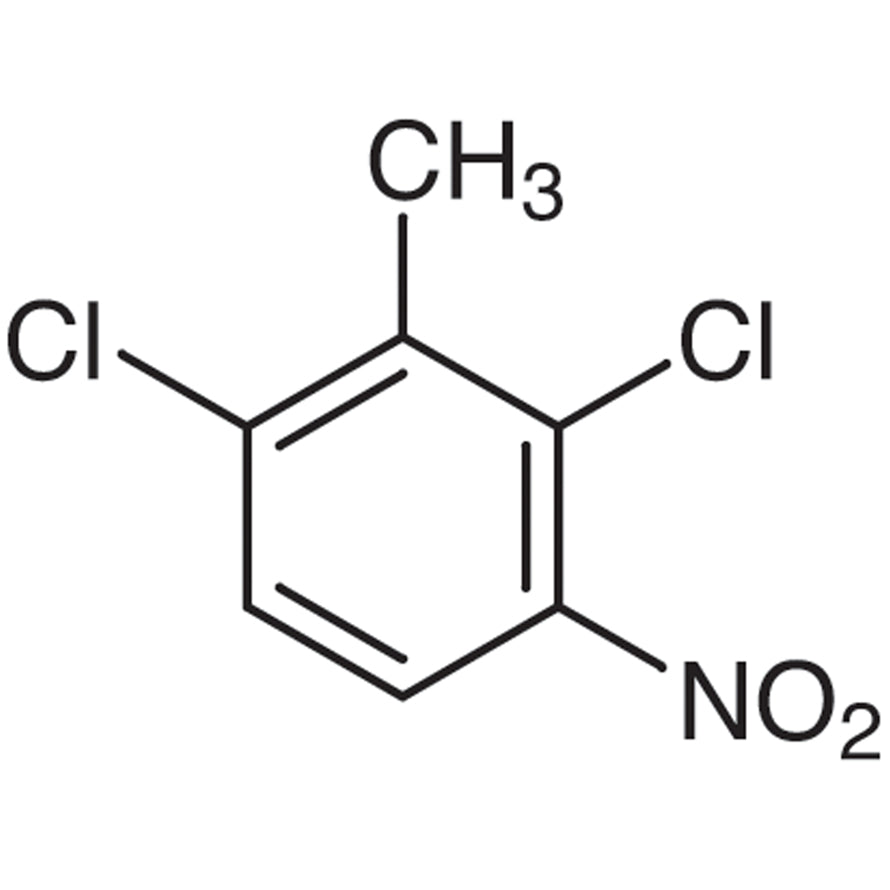
TCI D2106 2,6-Dichloro-3-nitrotoluene is a substituted aromatic compound carrying a methyl group, two chlorine atoms, and one nitro group on a benzene ring. In organic synthesis laboratories, this solid material serves as an aromatic intermediate with a substitution pattern that has already been carefully arranged. Assembling three different types of substituents at the correct positions through stepwise nitration and chlorination is demanding work that requires strict control of regioselectivity, so having this ready-to-use material available saves many steps while avoiding the tedious separation of isomer mixtures.
The property that makes this compound a preferred choice is the wealth of reaction points it offers within a single molecule. The nitro group is strongly electron-withdrawing, activating the ring toward nucleophilic aromatic substitution at the adjacent chlorine positions, and at the same time it can be reduced to an aromatic amine that becomes the entry point toward diazonium salts, amides, sulfonamides, or fused heterocyclic cores. The methyl group can be oxidized to a carboxylic acid or halogenated on the side chain through free-radical reactions. This combination gives researchers many directions for structural development.
In Indonesian laboratories, this material is typically used in university and institutional research settings where multi-step aromatic synthesis is carried out, as well as in development work that requires a reliable, well-defined starting point. Because building the substitution pattern in-house would consume considerable time and reagents, procuring the compound ready-made allows research groups to move directly to the transformation steps that matter to their project and to keep results reproducible between batches of work.
- Nucleophilic aromatic substitution studies, where the strongly electron-withdrawing nitro group activates the neighbouring chlorine positions and allows controlled displacement by a chosen nucleophile.
- Aromatic amine preparation, in which the nitro group is reduced to an amine that then opens routes toward diazonium salts, amides, and sulfonamide derivatives.
- Heterocyclic synthesis, since the reduced amine together with the remaining halogen positions provides the reactive handles needed to close fused heterocyclic ring systems.
- Side-chain functionalization work, where the methyl group is oxidized to a carboxylic acid or halogenated through free-radical reactions to extend the molecular framework.
- Multi-step intermediate supply for research programs, because the pre-arranged three-substituent pattern removes several nitration and chlorination steps and the isomer separations they require.
| Brand | TCI |
|---|---|
| CAS number | 29682-46-0 |
| Molecular formula | — |
| Purity | — |
| Category | TCI |
| Pack sizes | available in the packaging options offered by the manufacturer |
| Physical form | solid |
| Storage | keep in a tightly closed container in a cool, dry, well-ventilated place |
- Chemical name: 2,6-Dichloro-3-nitrotoluene
Store the material in its original tightly closed container, in a cool, dry and well-ventilated area away from direct sunlight, heat sources, and incompatible substances such as strong oxidizing and reducing agents. Glass or other chemically resistant containers with secure closures are appropriate for transfer and short-term working quantities. Handle the solid inside a fume hood to limit inhalation of dust, and wear standard laboratory personal protective equipment including a lab coat, chemical-resistant gloves, and safety goggles. Avoid contact with skin and eyes, weigh carefully to minimize dust generation, close containers immediately after use, and consult the manufacturer's safety data sheet before handling or disposal.
—
Produk Terkait
-
TCI B5774 5,10-Bis(4,4,5,5-tetramethyl-1,3,2-dioxaborolan-2-yl)naphtho[1,2-c:5,6-c']bis([1,2,5]oxadiazole)
Regular price Rp 11.420.850,00Regular price -
3-Bromo-5-methylaniline TCI B6015
Regular price From Rp 3.927.000,00Regular price -
TCI B6321 2,6-Bis(acetamido)-2,6-dideoxy-D-mannose
Regular price Rp 4.044.600,00Regular price -
BTP3-Neu5AcNa TCI B6529
Regular price Rp 4.251.450,00Regular price -
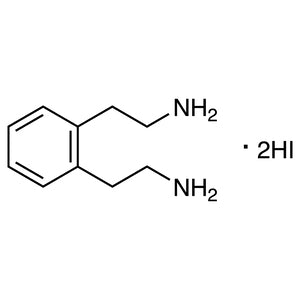
Dihydroiodide TCI B6569
Regular price From Rp 2.155.650,00Regular price -
Biotin-PEG3-Dz TCI B6572
Regular price From Rp 5.904.150,00Regular price -
Biotin-PEG3-PhN3 TCI B6585
Regular price From Rp 5.371.800,00Regular price -
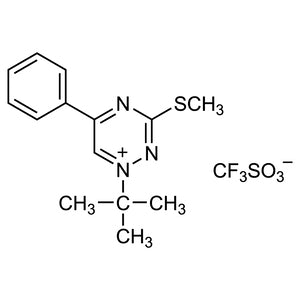
Trifluoromethanesulfonate TCI B7003
Regular price From Rp 2.155.650,00Regular price
![5,10-Bis(4,4,5,5-tetramethyl-1,3,2-dioxaborolan-2-yl)naphtho[1,2-c:5,6-c']bis([1,2,5]oxadiazole) - TCI B5774 - AMI Scientific](http://amiscientific.com/cdn/shop/files/TCI2510B5774.jpg?v=1769180228&width=533)