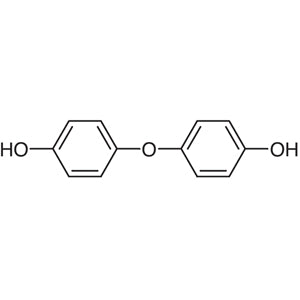
TCI D2121 4,4'-Dihydroxydiphenyl Ether is a diphenyl ether compound carrying a hydroxyl group at both para positions, which makes it a bisphenol built around a central oxygen bridge. It is supplied as a non-heterocyclic building block and is frequently used as a monomer or as a difunctional reagent in laboratory synthesis work. Its role matters because the two opposing hydroxyl groups allow polymer chains to be formed through polycondensation, while at the same time giving researchers an entry point for installing new functional groups at both ends of the molecule, either symmetrically or in a stepwise manner.
The property that makes this compound a frequent choice is the combination of the thermal stability of the aromatic ether bridge and the reactivity of the phenolic groups. The diphenyl ether linkage is known to resist heat and is relatively resistant to hydrolysis, so polymers built from it tend to show good thermal endurance. The phenolic hydroxyl groups, meanwhile, are readily handled through etherification, esterification, alkylation, or deprotonation to the reactive phenoxide. The non-linear angle of the ether bridge also lends flexibility to the polymer chain, so mechanical properties and solubility can be adjusted.
In Indonesian laboratories, this material is typically used in academic and industrial research settings where synthetic and polymer chemistry work is carried out — university research groups, government research institutes, and corporate R&D units. It is normally ordered as a catalogue building block for bench-scale synthesis and method development rather than production volumes, and it is handled by researchers who need a reliable, well-defined difunctional aromatic starting material for multi-step preparative routes.
TCI brochures (PDF)
- Monomers 2025-05-28 · p. 24
- Polycondensation monomer for high-performance polymers — the two para hydroxyl groups act as symmetric reactive sites, letting researchers build chains whose aromatic ether backbone contributes good thermal endurance.
- Bench-scale organic synthesis as a difunctional reagent — both ends of the molecule can be derivatised, so it serves as a convenient scaffold when a symmetric or stepwise substitution pattern is required.
- Etherification and esterification studies — the phenolic hydroxyl groups are readily converted under standard conditions, making this compound a practical substrate for exploring and optimising these reactions.
- Phenoxide-based alkylation chemistry — deprotonation gives a reactive phenoxide species, which allows researchers to introduce new alkyl or aryl fragments onto the aromatic core.
- Structure–property investigations in polymer research — the non-linear ether bridge introduces chain flexibility, so the material helps researchers examine how backbone geometry influences mechanical behaviour and solubility.
| Brand | TCI (Tokyo Chemical Industry) |
|---|---|
| CAS number | 1965-09-9 |
| Molecular formula | — |
| Purity | — |
| Category | Chemistry > Building Blocks > Non-Heterocyclic Building Blocks |
| Pack sizes | available in the standard TCI catalogue research pack sizes; please confirm the currently offered pack option when ordering |
| Physical form | — |
| Storage | store in a tightly closed original container, in a cool, dry and well-ventilated place away from heat and light |
- Catalogue code: D2121
Keep the compound in its original tightly closed container in a cool, dry, well-ventilated area, protected from direct sunlight, heat sources and incompatible chemicals. Amber glass or the supplier's original packaging is suitable for storage; label any secondary container clearly with the compound name and CAS number. Handle the solid in a fume hood or a well-ventilated workspace to limit dust formation and inhalation, and wear standard laboratory personal protective equipment including a lab coat, chemical-resistant gloves and safety goggles. Avoid contact with skin and eyes, keep the container closed when not in use to prevent moisture uptake, and wash hands thoroughly after handling. Consult the manufacturer's safety data sheet before use and follow institutional procedures for chemical waste disposal.
—
Produk Terkait
-
2,2'-DihydroxydiphenylEther TCI D2150
Regular price Rp 5.326.650,00Regular priceRp 3.740.100,00Sale price Rp 5.326.650,00 -
2,2'-Bis(hydroxymethyl)diphenylEther TCI B1643
Regular price From Rp 3.815.700,00Regular priceRp 2.683.800,00Sale price From Rp 3.815.700,00 -
AllylPhenylEther TCI A0234
Regular price From Rp 1.140.300,00Regular priceRp 796.950,00Sale price From Rp 1.140.300,00 -
AllylGlycidylEther TCI A0221
Regular price From Rp 477.750,00Regular priceRp 333.900,00Sale price From Rp 477.750,00 -
BenzylGlycidylEther TCI B2108
Regular price From Rp 1.510.950,00Regular priceRp 1.056.300,00Sale price From Rp 1.510.950,00 -
Allylp-TolylEther TCI A1287
Regular price From Rp 2.147.250,00Regular priceRp 1.501.500,00Sale price From Rp 2.147.250,00 -
Allylo-TolylEther TCI A1286
Regular price Rp 9.778.650,00Regular priceRp 6.837.600,00Sale price Rp 9.778.650,00 -
GlycidylPropargylEther TCI G0445
Regular price From Rp 980.700,00Regular priceRp 685.650,00Sale price From Rp 980.700,00