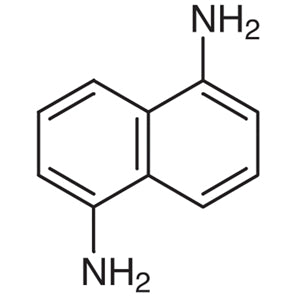
TCI D2160 1,6-Diaminopyrene is a pyrene derivative carrying two amino groups at positions 1 and 6 of the four-ring fused aromatic framework. The compound belongs to the class of material building blocks for small molecule semiconductors, meaning starting materials designed specifically for constructing functional materials in organic electronics and photonics research. The pyrene core is widely recognised as an electron-rich chromophore with strong luminescent behaviour, while the two symmetrically positioned amino groups provide reactive handles for the formation of amides, imines, polyimides, and porous covalent frameworks.
The property that makes this compound stand out is the combination of an extended pi-conjugated system with amino groups that act as electron donors. This combination yields materials with attractive charge-transfer character, the ability to absorb and emit light across the visible range, and a tendency toward molecular ordering through pi-stacking interactions that assist charge transport in the solid state. The symmetric 1,6-substitution pattern also imparts a directional geometry, making the molecule well suited for use as a linking node in the construction of polymers or three-dimensional networks.
In Indonesian laboratories, this building block is typically used within university and institutional research groups working on organic electronics, photonics, and advanced functional materials. It is generally handled at the synthetic bench during the preparation of conjugated monomers and framework precursors, then passed on to characterisation work involving optical and photoluminescence measurements. Because it is a specialised research-grade building block rather than a routine reagent, it is normally ordered for defined project stages and stored under controlled conditions between synthetic campaigns.
TCI brochures (PDF)
- Monomers 2025-05-28 · p. 31
- Building Blocks for Organic Semiconductor 2026-03-24 · p. 12
Related TCI products
- Conjugated polymer synthesis: the two symmetric amino groups act as difunctional linking points, allowing the electron-rich pyrene unit to be incorporated directly into extended polymer backbones for organic electronic research.
- Covalent organic framework construction: the directional 1,6-geometry makes this molecule suitable as a rigid node for building porous covalent networks with defined pore architecture and conjugated walls.
- Polyimide preparation: the diamine functionality reacts in the standard imide-forming route, introducing a rigid luminescent pyrene segment into high-performance polymer films for photonic and electronic studies.
- Fluorescent probe and chromophore development: the strongly luminescent, electron-rich pyrene core combined with donor amino groups supports visible-range absorption and emission for optical and sensing material studies.
- Small molecule semiconductor development: pi-stacking of the fused aromatic core promotes ordered solid-state packing that assists charge transport in thin-film organic semiconductor device research.
| Brand | TCI |
|---|---|
| CAS number | 14923-84-3 |
| Molecular formula | — |
| Purity | — |
| Category | Materials Science > Material Building Blocks > Small Molecule Semiconductor Building Blocks |
| Pack sizes | available in the manufacturer's standard research-scale packaging; please confirm the required size when ordering |
| Physical form | — |
| Storage | keep in a cool, dry, well-ventilated area, protected from light and air |
- Chemical class: pyrene derivative bearing two amino groups at the 1 and 6 positions
Store the material in its original tightly closed container, kept in a cool, dry, and well-ventilated place away from direct sunlight and sources of ignition. Amber glass or the supplier's original packaging is preferred, since aromatic amines are generally sensitive to light and prolonged air exposure; an inert atmosphere is advisable for opened containers. Handle only in a functioning fume hood, wearing nitrile gloves, safety goggles, and a laboratory coat, and avoid generating or inhaling dust. Keep the compound separate from strong oxidising agents and strong acids. Always consult the manufacturer's safety data sheet before use, and dispose of residues and contaminated materials through the laboratory's chemical waste procedure.
—
Product Categories
Produk Terkait
-
1,3-Diaminopyrene TCI D2167
Regular price Rp 7.949.550,00Regular priceRp 5.574.450,00Sale price Rp 7.949.550,00 -
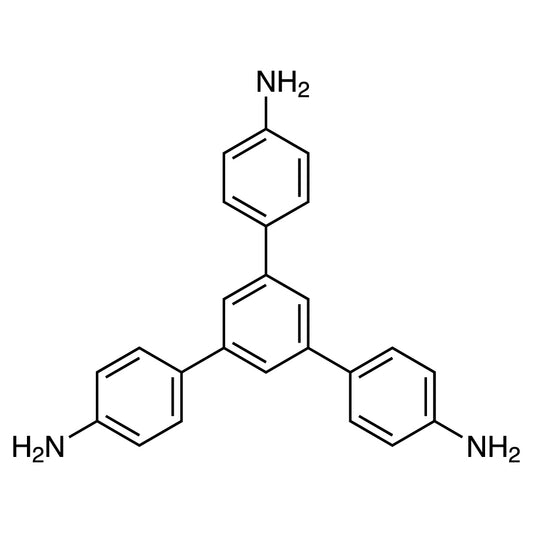
1,3,5-Tris(4-aminophenyl)benzene TCI T2728
Regular price From Rp 6.465.900,00Regular priceRp 4.537.050,00Sale price From Rp 6.465.900,00 -
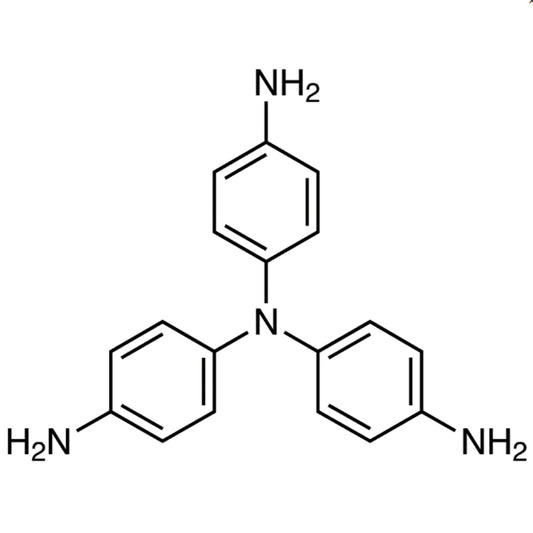
Tris(4-aminophenyl)amine TCI T2332
Regular price From Rp 3.127.950,00Regular priceRp 2.202.900,00Sale price From Rp 3.127.950,00 -
1,5-Diaminonaphthalene(purifiedbysublimation) TCI D5689
Regular price From Rp 1.881.600,00Regular priceRp 1.331.400,00Sale price From Rp 1.881.600,00 -
4,4''-Diamino-p-terphenyl TCI D3390
Regular price From Rp 3.232.950,00Regular priceRp 2.276.400,00Sale price From Rp 3.232.950,00 -
2,6-Diaminoanthraquinone TCI D3180
Regular price Rp 2.068.500,00Regular priceRp 1.461.600,00Sale price Rp 2.068.500,00 -
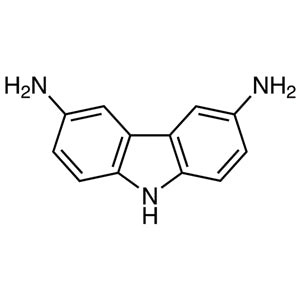
3,6-Diaminocarbazole TCI D2116
Regular price From Rp 6.413.400,00Regular priceRp 4.500.300,00Sale price From Rp 6.413.400,00 -
1,5-Diaminonaphthalene TCI D0101
Regular price From Rp 1.351.350,00Regular priceRp 960.750,00Sale price From Rp 1.351.350,00