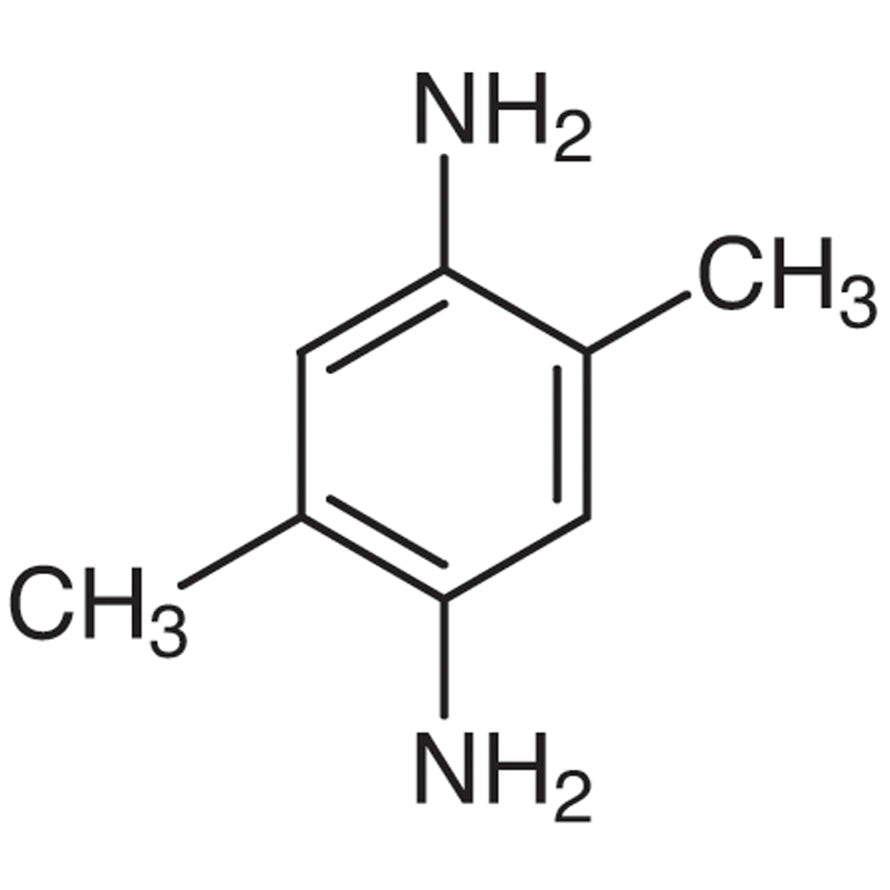
TCI D2183 2,5-Dimethyl-1,4-phenylenediamine is a bifunctional aromatic diamine supplied by TCI and classified specifically as a linker for the construction of Covalent Organic Frameworks (COFs). Its two amino groups sit in the para position, which makes the molecule an ideal linear connector for reaction with polyfunctional aldehydes to form ordered, porous imine-linked networks. In materials science laboratories, this compound serves as a building block for porous crystalline structures studied for gas adsorption, molecular separation, heterogeneous catalysis, and energy storage, while remaining useful as a conventional aromatic polymer monomer.
The properties that make this diamine a preferred choice begin with the linear geometry of its two amino groups, which gives predictable directionality to network growth during framework assembly. Added to this is the presence of two methyl substituents, which contribute controlled steric and electronic effects. These methyl groups help regulate interlayer stacking in layered COFs, influence the solubility of the precursor in the reaction medium, and can improve the crystalline order of the synthesized product. As an aromatic amine, its reactivity toward aldehyde groups is high, so imine bond formation proceeds efficiently under the solvothermal conditions commonly used in framework synthesis.
In Indonesian laboratories, this material is typically used in university and institutional materials science research groups working on porous crystalline solids. It is weighed out in small quantities for solvothermal condensation reactions with polyfunctional aldehyde partners, then the resulting framework is characterized for porosity and crystallinity. Because it is supplied in solid form, it is convenient to handle on an analytical balance and to store between experiments, which suits research programs that run reactions in repeated small batches rather than continuously.
- Covalent Organic Framework synthesis — the para-oriented amino groups act as a linear linker that condenses with polyfunctional aldehydes to build ordered, porous imine-linked networks with predictable growth directionality.
- Gas adsorption studies — frameworks constructed from this linker are investigated as porous crystalline sorbents, and the methyl-modulated interlayer stacking influences the pore environment available for uptake.
- Molecular separation research — the ordered porosity of the resulting COF materials is examined for size- and affinity-based separation, with the linker defining the geometry of the network channels.
- Heterogeneous catalysis development — porous frameworks derived from this diamine provide crystalline scaffolds whose accessible pore structure is studied as a support environment for catalytic transformations.
- Aromatic polymer chemistry — beyond framework work, the compound remains useful as a conventional aromatic diamine monomer in polymerization with complementary difunctional partners.
| Brand | TCI |
|---|---|
| CAS number | 6393-01-7 |
| Molecular formula | — |
| Purity | — |
| Category | Materials Science > Material Building Blocks > Covalent Organic Frameworks (COFs) Linkers |
| Pack sizes | available in the pack sizes listed on this product page |
| Physical form | solid |
| Storage | store according to the conditions stated on the manufacturer's label |
- Product code: D2183
Store this aromatic diamine in its original tightly closed container, kept in a cool, dry, and well-ventilated place away from direct sunlight and heat sources, and follow any specific storage conditions stated on the manufacturer's label. Amber glass or the supplier's original packaging is suitable for keeping the solid protected from light and moisture, and containers should be resealed promptly after each weighing to limit exposure to air and humidity. Handle the powder in a fume hood using gloves, safety glasses, and a laboratory coat, avoiding inhalation of dust and direct skin contact. Keep it separated from strong oxidizing agents and acids, weigh it out with clean dry spatulas to prevent cross-contamination, and dispose of residues and contaminated materials through the laboratory's chemical waste procedures.
—
Produk Terkait
-
N,N'-Bis[4-di(m-tolyl)aminophenyl]-N,N'-diphenylbenzidine TCI B5634
Regular price From Rp 2.677.500,00Regular price -
N,N-Bis(4'-diphenylamino-4-biphenylyl)amine TCI B5676
Regular price From Rp 1.590.750,00Regular price -
1,4-Bis[4-(N,N-diphenylamino)styryl]benzene TCI B5820
Regular price Rp 2.889.600,00Regular price -
(1R,2R)-1,2-Bis(2,4,6-trimethylphenyl)ethylenediamineDihydrochloride TCI B5914
Regular price Rp 2.199.750,00Regular price -
(1R,2R)-1,2-Bis(4-methylphenyl)ethylenediamineDihydrochloride TCI B6240
Regular price Rp 2.174.550,00Regular price -
(1S,2S)-N~1~,N~2~-Dibenzylcyclohexane-1,2-diamineDihydrochloride TCI B6390
Regular price From Rp 3.605.700,00Regular price -
(1R,2R)-N1,N2-Dibenzylcyclohexane-1,2-diamineDihydrochloride TCI B6393
Regular price From Rp 3.605.700,00Regular price -
1,4-BenzenediethanamineDihydroiodide TCI B6570
Regular price From Rp 2.068.500,00Regular price
![N,N'-Bis[4-di(m-tolyl)aminophenyl]-N,N'-diphenylbenzidine (CAS 199121-98-7) - TCI B5634 - AMI Scientific](http://amiscientific.com/cdn/shop/files/TCI2510B5634.jpg?v=1771058153&width=533)

![1,4-Bis[4-(N,N-diphenylamino)styryl]benzene (CAS 55035-42-2) - TCI B5820 - AMI Scientific](http://amiscientific.com/cdn/shop/files/TCI2510B5820.jpg?v=1771057994&width=533)