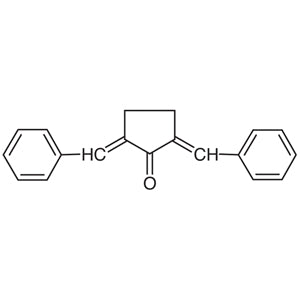
2,5-Dibenzylidenecyclopentanone is a conjugated cyclic ketone formed through the double condensation of cyclopentanone with benzaldehyde, producing two benzylidene groups attached symmetrically to the cyclopentanone framework. In synthetic laboratories, this compound is recognized as a non-heterocyclic building block of the bis-enone type, or as a cyclic chalcone analogue. Its role is significant because it supplies two conjugated double bonds at once within a single rigid molecule, which is highly useful for constructing larger π systems or for studying addition reactions at unsaturated carbon centres.
The properties that make this compound a frequent choice are found in its extended cross-conjugated system, which spans two aromatic rings, two C=C double bonds, and one carbonyl group. This conjugation gives the material its characteristic yellowish colour together with light-absorption behaviour that is of interest for optical materials research. The enone groups on both sides are electrophilic at the β position, so they react readily with nucleophiles through Michael addition, or serve as dienophiles and acceptors in various cyclisation reactions. The symmetrical framework also simplifies the interpretation of NMR data and makes purification of the product more straightforward.
In Indonesian laboratories, this building block is typically ordered by university and institutional research groups working on organic synthesis, medicinal chemistry scaffolds, and optical materials studies. It is commonly used at bench scale for method development, for teaching and demonstrating conjugate addition chemistry, and as a starting material in postgraduate research projects where a symmetrical, well-defined bis-enone is required as the entry point to a larger target molecule.
- Michael addition studies — the β positions of both enone groups are electrophilic, allowing researchers to explore nucleophilic conjugate addition with amines, thiols, and carbon nucleophiles under controlled conditions.
- Cyclisation and annulation reactions — the compound functions as a dienophile or Michael acceptor, providing a reliable two-site substrate for building fused and larger ring systems.
- Construction of extended π systems — its two conjugated double bonds within one rigid molecule give synthetic chemists a compact entry point toward larger conjugated architectures.
- Optical materials research — the long cross-conjugated system covering two aromatic rings, two C=C bonds, and a carbonyl produces light-absorption behaviour of interest in materials studies.
- Analytical and teaching reference material — the symmetrical framework yields simplified NMR spectra, making it suitable for demonstrating structure elucidation and for validating purification techniques.
| Brand | TCI (Tokyo Chemical Industry), catalogue reference D3597 |
|---|---|
| CAS number | 895-80-7 |
| Molecular formula | — |
| Purity | — |
| Category | Chemistry > Building Blocks > Non-Heterocyclic Building Blocks |
| Pack sizes | available in standard laboratory research pack sizes as offered by the manufacturer |
| Physical form | solid material with a characteristic yellowish colour arising from its conjugated system |
| Storage | keep in the tightly closed original container, protected from light and moisture |
Store the container tightly closed in a cool, dry, well-ventilated area, away from direct sunlight and sources of heat or ignition. Because the conjugated system is light-absorbing, amber glass or opaque secondary packaging is preferred, and the original manufacturer container should be retained wherever possible. Handle the solid in a fume hood to avoid dust formation and inhalation, and wear safety goggles, nitrile gloves, and a laboratory coat during weighing and transfer. Keep the material separated from strong oxidising agents and strong nucleophiles or bases, since the enone groups are chemically reactive. Always consult the manufacturer's safety data sheet before use, and dispose of residues and contaminated materials in accordance with institutional chemical waste procedures.
—
Produk Terkait
-
7H-Benzo[c]fluoren-7-one TCI B6180
Regular price Rp 4.752.300,00Regular price -
3-Acetylbiphenyl TCI B6396
Regular price Rp 2.509.500,00Regular price -
1-[[1,1'-Biphenyl]-2-yl]ethan-1-one TCI B6399
Regular price From Rp 3.158.400,00Regular price -
4'-tert-Butylacetophenone TCI B6460
Regular price From Rp 1.712.550,00Regular price -
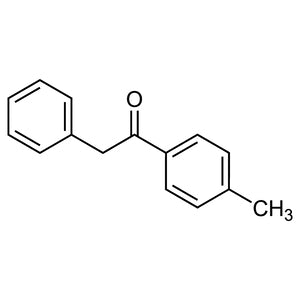
2-Phenyl-1-(p-tolyl)ethan-1-one TCI B6747
Regular price From Rp 2.215.500,00Regular price -
 Sold out
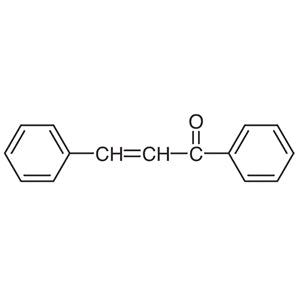
Chalcone TCI C0071
Regular price Rp 1.034.250,00Regular price -
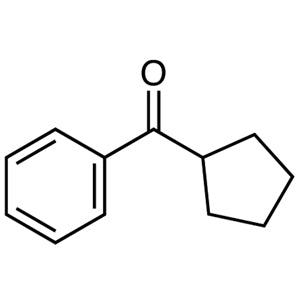
CyclopentylPhenylKetone TCI C0882
Regular price Rp 2.362.500,00Regular price -
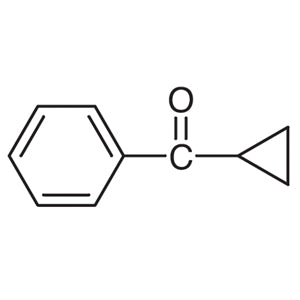
CyclopropylPhenylKetone TCI C0987
Regular price Rp 3.571.050,00Regular price
![7H-Benzo[c]fluoren-7-one (CAS 6051-98-5) - TCI B6180 - AMI Scientific](http://amiscientific.com/cdn/shop/files/TCI2510B6180.jpg?v=1767093271&width=533)

![1-[[1,1'-Biphenyl]-2-yl]ethan-1-one (CAS 2142-66-7) - TCI B6399 - AMI Scientific](http://amiscientific.com/cdn/shop/files/TCI2510B6399_818e0b4b-44d8-4a5d-9de0-9302722e319f.jpg?v=1767865638&width=533)