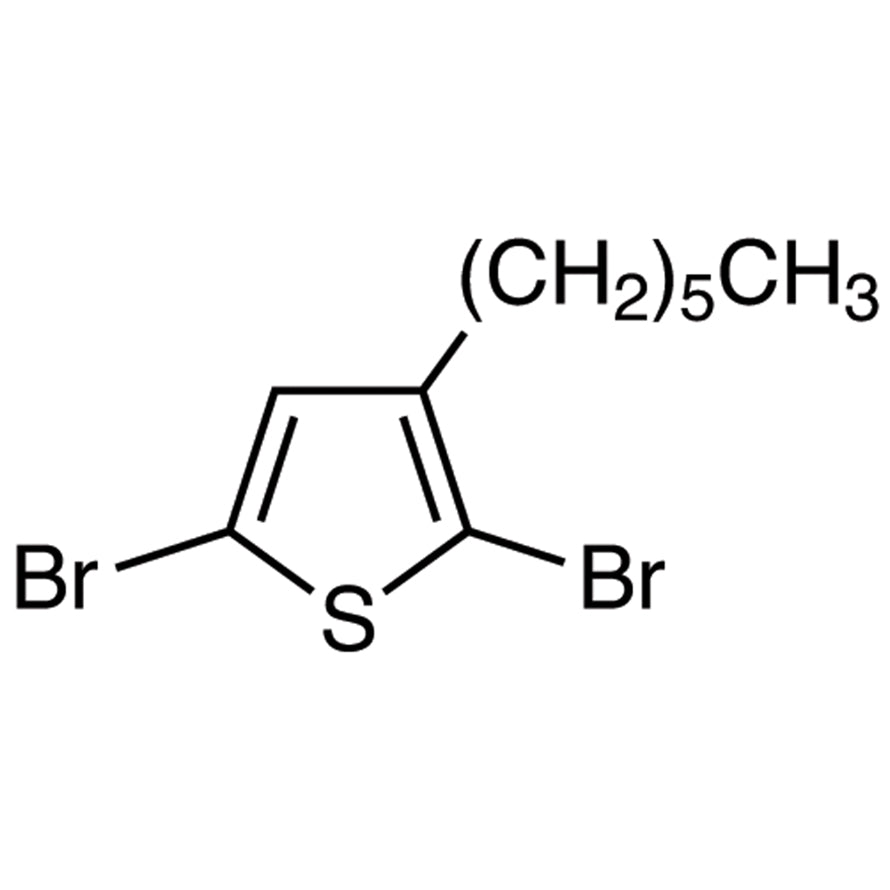
TCI D3896 2,5-Dibromo-3-hexylthiophene is a substituted thiophene monomer that carries a hexyl chain at the 3-position together with two bromine atoms at the 2- and 5-positions. The compound is the classic starting material for the preparation of poly(3-hexylthiophene), commonly abbreviated as P3HT, which is one of the most extensively studied semiconducting polymers in the field of organic electronics. In materials laboratories this monomer is activated through halogen–metal exchange and subsequently polymerised by Kumada catalyst-transfer polycondensation, producing conjugated polymer chains with a high degree of regioregularity.
The properties that lead researchers to select this monomer are the combination of reactivity and processability that it offers. The two bromine atoms at the alpha positions of the thiophene ring provide clean and controllable coupling points, so that the polymerisation can proceed in a quasi-living manner with a narrow chain-length distribution. The hexyl chain at the beta position renders the resulting polymer soluble in common organic solvents such as chloroform, chlorobenzene or toluene, an absolute requirement for the fabrication of thin films by spin coating or by solution printing. The head-to-tail regularity that is obtained strongly determines the degree of crystallinity of the final material.
In Indonesian laboratories this monomer is typically found in university and institutional research groups working on organic electronics and functional polymer materials. It is used on a research scale for the synthesis of P3HT batches that are then characterised and processed into thin films, supporting graduate and postgraduate projects as well as collaborative work between materials chemistry and applied physics groups. Supply is generally arranged in research-scale quantities to match the small batch sizes used in synthetic work.
- Synthesis of poly(3-hexylthiophene) (P3HT): the two alpha-bromine substituents give clean, controllable coupling points that allow the polymer backbone to be built reproducibly from a well-defined monomer.
- Kumada catalyst-transfer polycondensation studies: the monomer is activated by halogen–metal exchange and polymerises in a quasi-living manner, which makes it well suited to investigations of controlled chain growth.
- Preparation of regioregular conjugated polymers: the 3-hexyl substitution pattern promotes head-to-tail ordering along the chain, which in turn governs the crystallinity of the resulting semiconducting material.
- Solution-processed thin film fabrication: the hexyl chain makes the polymer product soluble in chloroform, chlorobenzene or toluene, so films can be deposited by spin coating or by solution printing methods.
- Organic electronics research and teaching: as the classic building block for one of the most studied semiconducting polymers, it supports method development and comparison against widely published P3HT synthetic procedures.
| Brand | TCI |
|---|---|
| CAS number | 116971-11-0 |
| Molecular formula | — |
| Purity | — |
| Category | Materials Science > Material Building Blocks > Polymer/Macromolecule Semiconductor Building Blocks |
| Pack sizes | available in the research-scale pack sizes offered by TCI for this catalogue item; please confirm the currently available packaging when ordering. |
| Physical form | — |
| Storage | — |
- Product code: D3896
- Chemical name: 2,5-Dibromo-3-hexylthiophene
Store the monomer in its original tightly closed container, protected from light and kept in a cool, dry place away from heat sources, ignition sources and incompatible reagents. Because the material is intended for use in moisture-sensitive organometallic chemistry, containers should be kept well sealed and, where the experimental protocol requires it, handled under an inert atmosphere to preserve reagent quality. All handling should be carried out in a fume hood by trained personnel wearing appropriate personal protective equipment, including safety glasses, chemically resistant gloves and a laboratory coat. Follow the manufacturer's safety data sheet and institutional chemical waste procedures for disposal of residues and contaminated materials.
—
Produk Terkait
-
2,5-Dibromo-3-cyclohexylthiophene TCI D5247
Regular price Rp 6.679.050,00Regular price -
9-Benzyl-2,7-dibromo-9H-carbazole TCI B5462
Regular price From Rp 2.862.300,00Regular price -
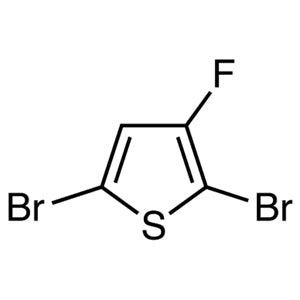
2,5-Dibromo-3-fluorothiophene TCI D5729
Regular price From Rp 3.896.550,00Regular price -
2,7-Dibromo-9-phenyl-9H-fluoren-9-ol TCI D5448
Regular price From Rp 1.749.300,00Regular price -
3,6-Dibromo-9-(m-tolyl)-9H-carbazole TCI D5424
Regular price Rp 2.466.450,00Regular price -
3,6-Dibromo-9-(3,5-dimethylphenyl)-9H-carbazole TCI D5421
Regular price From Rp 1.060.500,00Regular price -
3,6-Dibromo-9-(3,4-dimethylphenyl)-9H-carbazole TCI D5420
Regular price Rp 3.525.900,00Regular price -
3,6-Dibromo-9-(2,4-dimethylphenyl)-9H-carbazole TCI D5419
Regular price Rp 4.056.150,00Regular price