

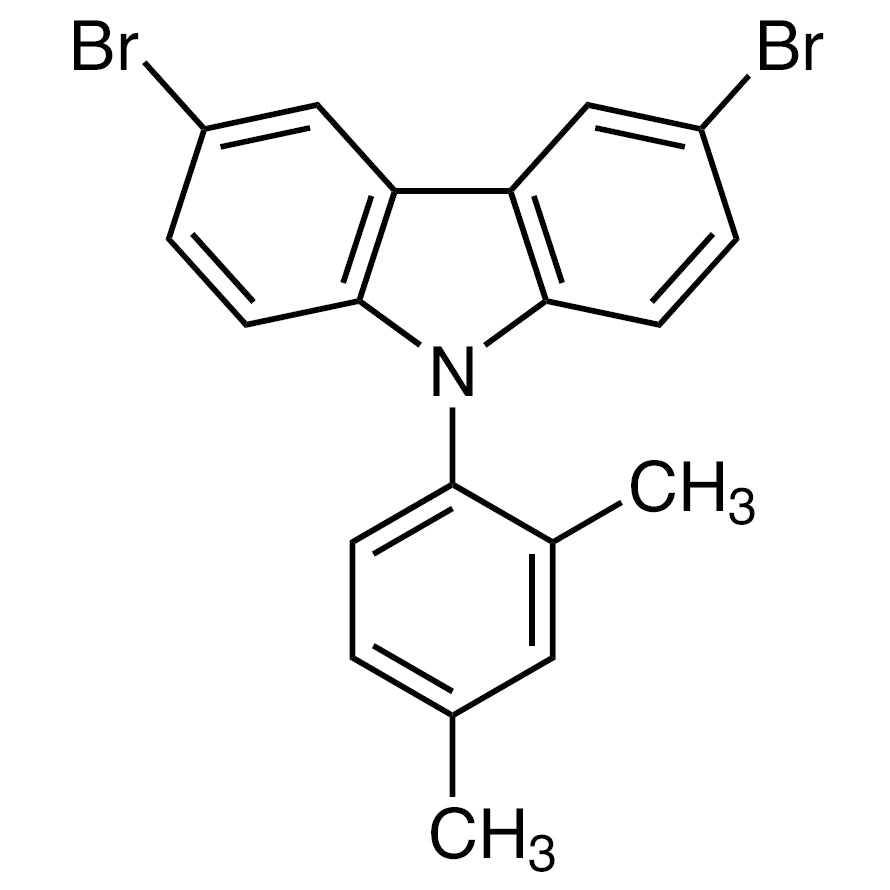
TCI D5419, also known as 3,6-Dibromo-9-(2,4-dimethylphenyl)-9H-carbazole (CAS 1873362-96-9), is a carbazole derivative carrying two bromine atoms at the 3 and 6 positions together with a 2,4-dimethylphenyl group attached to the nitrogen atom. The compound is prepared as a building block for the synthesis of polymer- and macromolecule-based semiconductor materials. In the laboratory, a material of this kind serves as a very valuable starting point because its substitution pattern is already fixed from the outset, allowing researchers to move directly into the cross-coupling stage without first working through a selective bromination step that is difficult to control and frequently yields isomer mixtures.
The distinguishing feature of this compound lies in the placement of the methyl groups on its phenyl ring. One methyl group sits at the ortho position relative to the N-aryl bond, creating steric hindrance that forces the phenyl ring to rotate out of the plane of the carbazole core. This twist reduces the tendency of the molecules to stack too closely together, helps suppress the aggregation that can quench luminescence, and is often exploited to keep thin-film morphology amorphous. At the same time, the two bromine atoms continue to provide clear, well-defined reactive sites for Suzuki coupling, Stille coupling, and Yamamoto polymerisation.
In Indonesian laboratories, this material is typically encountered in university and institutional research groups working on organic electronics and functional polymer chemistry. It is normally handled in synthesis laboratories equipped for inert-atmosphere work, where the dibromide is carried forward into coupling reactions and the resulting polymers or macromolecules are characterised and processed into thin films for further study.
TCI brochures (PDF)
- Building Blocks for Organic Semiconductor 2026-03-24 · p. 21
Related TCI products
- TCI D5421 1873364-08-9 3,6-Dibromo-9-(3,5-dimethylphenyl)-9H-carbazole
- TCI D5420 1786404-06-5 3,6-Dibromo-9-(3,4-dimethylphenyl)-9H-carbazole
- TCI B5462 1384281-49-5 9-Benzyl-2,7-dibromo-9H-carbazole
- TCI D5424 890653-54-0 3,6-Dibromo-9-(m-tolyl)-9H-carbazole
- TCI D5410 150623-72-6 3,6-Dibromo-9-hexyl-9H-carbazole
- TCI D5342 946491-48-1 3,6-Dibromo-9-[4-(2-ethylhexyloxy)phenyl]-9H-carbazole
- Suzuki cross-coupling polymerisation: the two bromine atoms at the 3 and 6 positions act as clearly defined reactive handles, letting researchers build carbazole-containing conjugated polymers with predictable connectivity and without competing isomeric linkages.
- Stille coupling synthesis: the same dibromide functionality reacts with organostannane partners, enabling the preparation of donor–acceptor copolymer backbones in which the carbazole unit is incorporated at a controlled, symmetric position.
- Yamamoto polymerisation: the symmetric 3,6-dibromo substitution pattern suits nickel-mediated homocoupling routes, giving polycarbazole chains in which every repeat unit carries the same twisted N-aryl substituent.
- Amorphous thin-film material development: the ortho methyl group twists the phenyl ring out of plane, discouraging close molecular stacking and helping researchers maintain amorphous film morphology during deposition and annealing studies.
- Luminescent material research: because the steric twist suppresses aggregation that can quench emission, this building block is useful when preparing macromolecular semiconductors whose optical behaviour is being evaluated.
| Brand | TCI |
|---|---|
| CAS number | 1873362-96-9 |
| Molecular formula | — |
| Purity | — |
| Category | Materials Science > Material Building Blocks > Polymer/Macromolecule Semiconductor Building Blocks |
| Pack sizes | available in standard TCI research-scale packaging; please confirm the required size when ordering |
| Physical form | — |
| Storage | keep in the tightly closed original container, protected from light and moisture |
- Chemical name: 3,6-Dibromo-9-(2,4-dimethylphenyl)-9H-carbazole
Store the material in its original tightly closed container in a cool, dry place away from direct sunlight and sources of heat or ignition. Amber glass bottles or the supplier's original packaging are suitable, and the container should be resealed promptly after each use to limit exposure to moisture and air. Weigh and transfer the solid in a fume hood, wearing safety glasses, a laboratory coat, and chemically resistant gloves, and avoid generating or inhaling dust. Keep the compound separate from strong oxidising agents, label all secondary containers clearly, and consult the manufacturer's safety data sheet before use and before disposing of any residues or contaminated materials.
—
Product Categories
Produk Terkait
-
3,6-Dibromo-9-(3,5-dimethylphenyl)-9H-carbazole TCI D5421
Regular price From Rp 1.060.500,00Regular price -
3,6-Dibromo-9-(3,4-dimethylphenyl)-9H-carbazole TCI D5420
Regular price Rp 3.525.900,00Regular price -
9-Benzyl-2,7-dibromo-9H-carbazole TCI B5462
Regular price From Rp 2.862.300,00Regular price -
3,6-Dibromo-9-(m-tolyl)-9H-carbazole TCI D5424
Regular price Rp 2.466.450,00Regular price -
3,6-Dibromo-9-hexyl-9H-carbazole TCI D5410
Regular price From Rp 1.035.300,00Regular price -
3,6-Dibromo-9-[4-(2-ethylhexyloxy)phenyl]-9H-carbazole TCI D5342
Regular price From Rp 1.008.000,00Regular price -
3,6-Dibromo-9-(4-methoxyphenyl)-9H-carbazole TCI D5340
Regular price From Rp 2.147.250,00Regular price -
3,6-Dibromo-9-(p-tolyl)-9H-carbazole TCI D5001
Regular price From Rp 980.700,00Regular price


![3,6-Dibromo-9-[4-(2-ethylhexyloxy)phenyl]-9H-carbazole (CAS 946491-48-1) - TCI D5342 - AMI Scientific](http://amiscientific.com/cdn/shop/files/TCI2510D5342.jpg?v=1768818391&width=533)

