


3,6-Dibromo-9-hexyl-9H-carbazole is a chemical compound widely used in scientific research, particularly in the field of materials science. This compound serves as a fundamental building block for the synthesis of polymers and semiconductors, playing a crucial role in the development of advanced materials. Its molecular structure allows for versatile chemical interactions, making it a valuable tool in laboratory settings. Researchers rely on this compound to create functional materials with specific properties tailored for various applications.
The compound is known for its chemical stability, which ensures consistent performance during synthesis processes. Its ability to form stable bonds with a variety of molecules enhances its utility in complex chemical reactions. Additionally, its good solubility in organic solvents simplifies handling and integration into different experimental protocols. These properties collectively make it a preferred choice for scientists working on material synthesis and modification.
In Indonesian laboratories, 3,6-Dibromo-9-hexyl-9H-carbazole is commonly used in research projects focused on the development of new materials. It is particularly relevant in academic and research institutions where studies on organic electronics, energy materials, and advanced polymers are conducted. Its application extends to applied research in fields such as renewable energy and information technology, supporting innovation in material science.
TCI brochures (PDF)
- Building Blocks for Organic Semiconductor 2026-03-24 · p. 21
Related TCI products
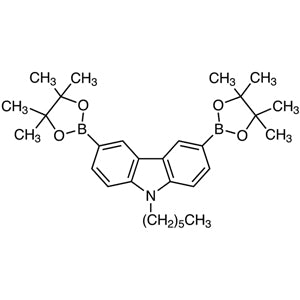
- TCI H1649 628336-95-8 9-Hexyl-3,6-bis(4,4,5,5-tetramethyl-1,3,2-dioxaborolan-2-yl)-9H-carbazole
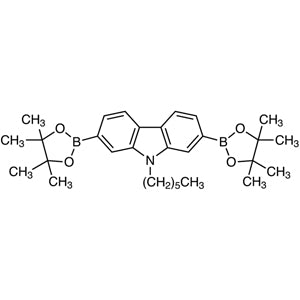
- TCI H1642 871696-12-7 9-Hexyl-2,7-bis(4,4,5,5-tetramethyl-1,3,2-dioxaborolan-2-yl)-9H-carbazole
- TCI B5462 1384281-49-5 9-Benzyl-2,7-dibromo-9H-carbazole
- TCI D5424 890653-54-0 3,6-Dibromo-9-(m-tolyl)-9H-carbazole
- TCI D5421 1873364-08-9 3,6-Dibromo-9-(3,5-dimethylphenyl)-9H-carbazole
- TCI D5420 1786404-06-5 3,6-Dibromo-9-(3,4-dimethylphenyl)-9H-carbazole
- Organic Electronics Research – This compound is ideal for synthesizing organic semiconductors used in flexible electronics and optoelectronic devices due to its structural versatility and chemical stability.
- Energy Material Development – It is frequently used in the creation of organic photovoltaic materials, contributing to the advancement of solar cell technologies.
- Polymer Synthesis – Its ability to form stable chemical bonds makes it suitable for the development of functional polymers with tailored properties.
- Semiconductor Fabrication – The compound supports the synthesis of semiconductor materials used in electronic components, enhancing device performance.
- Advanced Material Modification – Its molecular structure allows for chemical modifications, enabling the design of materials with specific functionalities for specialized applications.
| Brand | TCI |
|---|---|
| CAS number | 150623-72-6 |
| Molecular formula | — |
| Purity | — |
| Category | Materials Science > Material Building Blocks > Polymer/Macromolecule Semiconductor Building Blocks |
| Pack sizes | As per supplier specifications |
| Physical form | Solid (as per standard product description) |
| Storage | Store in a cool, dry place away from direct sunlight |
This compound should be stored in a cool, dry environment to maintain its chemical stability. It is recommended to keep it in a sealed container to prevent exposure to moisture and air. Due to its organic nature, it should be stored away from incompatible substances such as strong oxidizers. Proper ventilation is essential when handling the compound to minimize inhalation risks. Laboratory personnel should wear appropriate personal protective equipment, including gloves and safety goggles, to ensure safe handling. The compound should not be stored near heat sources or in areas with high humidity to avoid degradation. Regular inspection of storage conditions is advised to ensure the material remains in optimal condition for use.
—
Product Categories
Produk Terkait
-
9-Hexyl-3,6-bis(4,4,5,5-tetramethyl-1,3,2-dioxaborolan-2-yl)-9H-carbazole TCI H1649
Regular price From Rp 1.510.950,00Regular price -
9-Hexyl-2,7-bis(4,4,5,5-tetramethyl-1,3,2-dioxaborolan-2-yl)-9H-carbazole TCI H1642
Regular price From Rp 1.485.750,00Regular price -
9-Benzyl-2,7-dibromo-9H-carbazole TCI B5462
Regular price From Rp 2.862.300,00Regular price -
3,6-Dibromo-9-(m-tolyl)-9H-carbazole TCI D5424
Regular price Rp 2.466.450,00Regular price -
3,6-Dibromo-9-(3,5-dimethylphenyl)-9H-carbazole TCI D5421
Regular price From Rp 1.060.500,00Regular price -
3,6-Dibromo-9-(3,4-dimethylphenyl)-9H-carbazole TCI D5420
Regular price Rp 3.525.900,00Regular price -
3,6-Dibromo-9-(2,4-dimethylphenyl)-9H-carbazole TCI D5419
Regular price Rp 4.056.150,00Regular price -
3,6-Dibromo-9-[4-(2-ethylhexyloxy)phenyl]-9H-carbazole TCI D5342
Regular price From Rp 1.008.000,00Regular price


![3,6-Dibromo-9-[4-(2-ethylhexyloxy)phenyl]-9H-carbazole (CAS 946491-48-1) - TCI D5342 - AMI Scientific](http://amiscientific.com/cdn/shop/files/TCI2510D5342.jpg?v=1768818391&width=533)