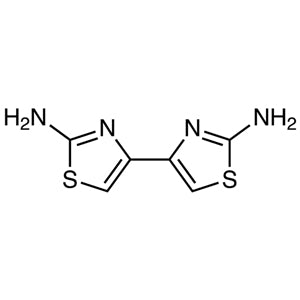
TCI D4273, CAS 58139-59-6, is 2,2'-Diamino-4,4'-bithiazole, a bi-heterocyclic compound built from two thiazole rings joined directly at their 4 and 4' positions, each ring carrying an amino group at position 2. This symmetrical architecture makes it an interesting molecule across several fields, ranging from coordination chemistry through materials science to biochemical research. In the laboratory, compounds containing two conjugated heterocyclic rings of this type are frequently employed as ligands, as molecular recognition cores, and as starting materials for the construction of larger conjugated systems.
The properties that make this compound a preferred choice begin with its ability to bind metal ions through the nitrogen and sulfur atoms of the thiazole rings, which together form bidentate or multidentate chelation sites depending on the geometry of the complex being formed. The bithiazole system is also planar and conjugated, so it exhibits light-absorption behaviour relevant to photophysical studies. The two amino groups at the 2 and 2' positions add further practical value, since they can be acylated, arylated, or condensed into more complex derivatives while simultaneously acting as hydrogen-bond donors.
In Indonesian laboratories, a symmetrical bi-heterocyclic building block of this kind is typically used in synthetic and coordination chemistry work at university research groups, government research institutes, and industrial R&D units. It is handled on a small research scale, weighed out for ligand preparation, derivatisation, or the assembly of larger conjugated frameworks, and supported by the documentation supplied with TCI reagents so that the material can be traced and used consistently across repeated experimental runs.
- Coordination chemistry and complex synthesis: the thiazole nitrogen and sulfur atoms provide chelation sites that bind metal ions in bidentate or multidentate fashion depending on the complex geometry formed.
- Ligand preparation for metal complexes: the symmetrical structure with two directly linked thiazole rings gives a defined donor arrangement suitable for building well-characterised coordination compounds in research work.
- Photophysical studies: the planar, conjugated bithiazole system shows light-absorption behaviour, making the compound relevant to investigations of the optical properties of heterocyclic and metal-containing systems.
- Synthesis of more complex derivatives: the two amino groups at positions 2 and 2' can be acylated, arylated, or condensed, giving convenient handles for further chemical elaboration.
- Molecular recognition and supramolecular research: the amino groups act as hydrogen-bond donors while the bi-heterocyclic core serves as a recognition motif in host–guest and materials science studies.
| Brand | TCI |
|---|---|
| CAS number | 58139-59-6 |
| Molecular formula | — |
| Purity | — |
| Category | TCI |
| Pack sizes | available in the research-scale pack sizes offered by TCI for this catalogue item (D4273) |
| Physical form | — |
| Storage | store according to the conditions stated on the manufacturer's label and safety data sheet |
- Chemical name: 2,2'-Diamino-4,4'-bithiazole
Store this reagent in its original tightly closed container, in a cool, dry, and well-ventilated place away from direct sunlight, moisture, and incompatible substances, following the storage conditions stated on the manufacturer's label and safety data sheet. Use chemically resistant containers and keep the container sealed when not in use to prevent contamination and moisture uptake. Handle the compound in a fume hood, wear a laboratory coat, safety goggles, and suitable chemical-resistant gloves, and avoid inhalation of dust as well as contact with skin and eyes. Weigh and transfer the solid using clean, dedicated spatulas and glassware, label all prepared solutions clearly, and dispose of residues and contaminated materials in accordance with applicable laboratory chemical waste procedures. Review the safety data sheet before first use.
—
Produk Terkait
-
TCI B5774 5,10-Bis(4,4,5,5-tetramethyl-1,3,2-dioxaborolan-2-yl)naphtho[1,2-c:5,6-c']bis([1,2,5]oxadiazole)
Regular price Rp 11.420.850,00Regular price -
3-Bromo-5-methylaniline TCI B6015
Regular price From Rp 3.927.000,00Regular price -
TCI B6321 2,6-Bis(acetamido)-2,6-dideoxy-D-mannose
Regular price Rp 4.044.600,00Regular price -
BTP3-Neu5AcNa TCI B6529
Regular price Rp 4.251.450,00Regular price -
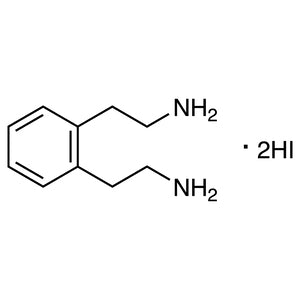
Dihydroiodide TCI B6569
Regular price From Rp 2.155.650,00Regular price -
Biotin-PEG3-Dz TCI B6572
Regular price From Rp 5.904.150,00Regular price -
Biotin-PEG3-PhN3 TCI B6585
Regular price From Rp 5.371.800,00Regular price -
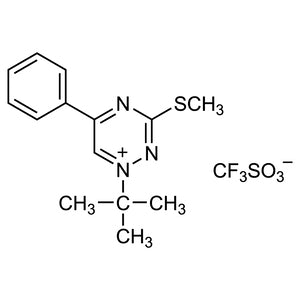
Trifluoromethanesulfonate TCI B7003
Regular price From Rp 2.155.650,00Regular price
![5,10-Bis(4,4,5,5-tetramethyl-1,3,2-dioxaborolan-2-yl)naphtho[1,2-c:5,6-c']bis([1,2,5]oxadiazole) - TCI B5774 - AMI Scientific](http://amiscientific.com/cdn/shop/files/TCI2510B5774.jpg?v=1769180228&width=533)