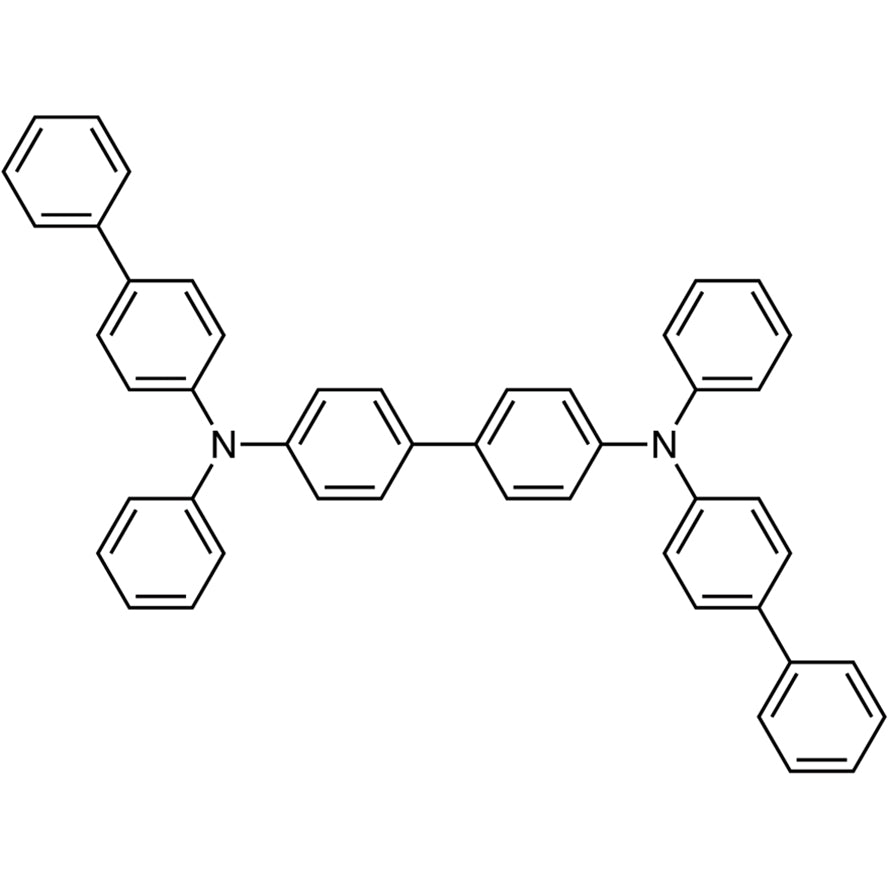
N,N’-Di(4-biphenylyl)-N,N’-diphenylbenzidine (TCI D4928) is an organic compound widely used in laboratory research, particularly in the development of organic light-emitting diodes (OLEDs). This material plays a crucial role in the fabrication of OLED devices, serving as an emissive layer that enables efficient light emission. Its molecular structure is designed to facilitate the recombination of electrons and holes, resulting in the generation of light. In the context of materials science, this compound is essential for exploring new optoelectronic properties and improving the performance of display technologies.
The compound is preferred due to its excellent electron conductivity and ability to emit light at specific wavelengths. These properties make it a key component in the development of high-performance OLEDs with improved brightness and color stability. Additionally, its thermal stability allows it to maintain functionality under elevated temperatures, which is vital for long-term device operation. The material’s compatibility with various fabrication techniques further enhances its appeal in both academic and industrial research settings.
In Indonesian laboratories, this compound is commonly used for research and development of OLED-based display technologies. Local researchers and institutions utilize it to test material performance under different environmental conditions and industrial applications. Its role in advancing optoelectronic materials makes it a valuable resource for both educational and applied research in the field of electronic materials.
- OLED device development for display technologies due to its efficient light-emitting properties and stability.
- Material characterization studies to evaluate optical and electronic behavior under various conditions.
- Research into organic semiconductors for use in flexible and transparent electronic devices.
- Testing of emissive layers in thin-film transistor (TFT) arrays for high-resolution displays.
- Development of next-generation lighting solutions with improved energy efficiency and color quality.
| Brand | TCI |
|---|---|
| CAS number | 134008-76-7 |
| Molecular formula | — |
| Purity | — |
| Category | Materials Science > Electronic Materials > Organic Light-Emitting Diode (OLED) Materials |
| Pack sizes | Available in various quantities as per standard laboratory supply |
| Physical form | Solid |
| Storage | Store in a cool, dry place away from light and moisture |
This compound should be stored in a cool, dry environment, away from direct light and moisture to maintain its stability and effectiveness. It is recommended to use airtight containers to prevent exposure to air and humidity. Due to its chemical nature, it is important to handle it with appropriate personal protective equipment, such as gloves and safety goggles, to ensure laboratory safety. Proper ventilation should be maintained in the workspace to minimize inhalation risks. Avoid contact with skin and eyes, and follow standard chemical handling protocols to prevent accidental exposure. Regular monitoring of storage conditions is advised to ensure the material remains in optimal condition for research applications.
—
Produk Terkait
-
N,N'-Bis[4-di(m-tolyl)aminophenyl]-N,N'-diphenylbenzidine TCI B5634
Regular price From Rp 2.982.000,00Regular price -
N,N-Bis(4'-diphenylamino-4-biphenylyl)amine TCI B5676
Regular price From Rp 1.771.350,00Regular price -
1,4-Bis[4-(N,N-diphenylamino)styryl]benzene TCI B5820
Regular price Rp 3.217.200,00Regular price -
(1R,2R)-1,2-Bis(2,4,6-trimethylphenyl)ethylenediamineDihydrochloride TCI B5914
Regular price Rp 2.450.700,00Regular price -
(1R,2R)-1,2-Bis(4-methylphenyl)ethylenediamineDihydrochloride TCI B6240
Regular price Rp 2.421.300,00Regular price -
(1S,2S)-N~1~,N~2~-Dibenzylcyclohexane-1,2-diamineDihydrochloride TCI B6390
Regular price From Rp 4.015.200,00Regular price -
(1R,2R)-N1,N2-Dibenzylcyclohexane-1,2-diamineDihydrochloride TCI B6393
Regular price From Rp 4.015.200,00Regular price -
1,4-BenzenediethanamineDihydroiodide TCI B6570
Regular price From Rp 2.303.700,00Regular price
![N,N'-Bis[4-di(m-tolyl)aminophenyl]-N,N'-diphenylbenzidine (CAS 199121-98-7) - TCI B5634 - AMI Scientific](http://amiscientific.com/cdn/shop/files/TCI2510B5634.jpg?v=1771058153&width=533)

![1,4-Bis[4-(N,N-diphenylamino)styryl]benzene (CAS 55035-42-2) - TCI B5820 - AMI Scientific](http://amiscientific.com/cdn/shop/files/TCI2510B5820.jpg?v=1771057994&width=533)