Pembayaran hanya melalui request quotation dan dilakukan setelah tim kami menghubungi Anda. Mohon cantumkan nomor WhatsApp aktif untuk konfirmasi pesanan & pembuatan invoice. Estimasi pengiriman 4-5 minggu setelah pembayaran.
Couldn't load pickup availability
Description
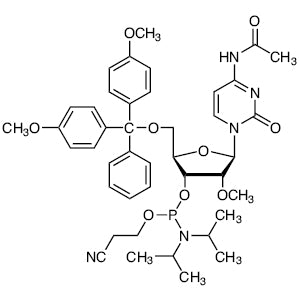
TCI D5703 DMT-2'-O-methyl-rC(Ac) Phosphoramidite is a phosphoramidite monomer used for the synthesis of modified RNA oligonucleotides. Structurally, it is a cytidine derivative carrying a methyl group at the 2'-O position of the ribose sugar, a dimethoxytrityl (DMT) group protecting the 5'-hydroxyl, an acetyl group protecting the exocyclic amine of the cytosine base, and a reactive phosphoramidite function at the 3' position. In the laboratory, this material is used to incorporate 2'-O-methyl residues into oligonucleotide strands — a modification that is extremely common in synthetic RNA design because it changes the properties of the strand without altering its ability to recognise complementary base-pairing sequences.
The 2'-O-methyl modification is the principal reason this monomer is selected. Replacing the 2'-hydroxyl group with a 2'-O-methyl group makes the resulting strand more resistant to nuclease attack, increases the stability of base pairing with the target RNA, and removes the need for the complicated 2' protecting groups required in conventional RNA synthesis. As a consequence, coupling cycles proceed in a manner much closer to DNA synthesis, which is comparatively efficient and simple. The acetyl protecting group on cytosine is chosen because it can be removed under the usual deprotection conditions and helps reduce the risk of unintended base modification during processing.
In Indonesian laboratories, this monomer is typically used by research groups and service facilities that operate automated oligonucleotide synthesisers for nucleic acid chemistry work. It is normally handled as one building block within a set of phosphoramidite monomers, dissolved in anhydrous solvent and installed on the synthesiser for the assembly of defined sequences. Because it is used cycle by cycle during automated coupling, it is generally kept ready as part of a laboratory's standing consumable stock for synthetic RNA and antisense-type sequence work.
Laboratory Applications
Modified RNA oligonucleotide synthesis: the monomer inserts a 2'-O-methyl cytidine residue directly during automated coupling cycles, giving controlled placement of the modification at any chosen position in the sequence.
Antisense and sequence-recognition oligonucleotide design: the 2'-O-methyl group raises binding stability toward the target RNA while leaving base-pairing specificity intact, which supports strands intended to recognise defined complementary sequences.
Nuclease-resistant strand preparation: because the 2'-O-methyl substitution protects the strand against nuclease attack, this monomer is used where oligonucleotides must survive longer in nuclease-containing environments.
Simplified RNA-type synthesis workflows: the absence of a conventional 2' protecting group lets coupling cycles run much like DNA synthesis, so laboratories obtain more efficient and simpler assembly of RNA-type sequences.
Chimeric and partially modified oligonucleotide assembly: the monomer can be combined with other phosphoramidites in the same synthesis run, allowing researchers to place 2'-O-methyl cytidine only at selected positions within a mixed strand.
Specifications
Brand: TCI (Tokyo Chemical Industry)
CAS Number: 199593-09-4
Category: Chemistry > Chemical Biology > Nucleic Acid Chemistry
Product Code: D5703
Pack Sizes: available in standard TCI catalogue pack sizes; please confirm the required size when ordering
Storage: keep in a tightly closed original container, protected from moisture, according to the manufacturer's label instructions
Handling and Storage
Phosphoramidite monomers are moisture-sensitive, so this material should be stored in its tightly closed original container in a cool, dry place and protected from humidity, following the storage conditions stated on the manufacturer's label and safety data sheet. Allow the container to reach room temperature before opening to avoid condensation on the solid, and reseal it promptly after weighing. Handle and dissolve the material in anhydrous solvent under dry conditions, ideally in a glove box or under an inert gas stream, using clean, dry glassware. Work in a well-ventilated area or fume hood, wear gloves, safety glasses, and a laboratory coat, and dispose of solvent residues and rinses as chemical waste in accordance with your institution's laboratory waste procedures.




![6-Bromobenzo[b]thiophene (CAS 17347-32-9) - TCI B5523 - AMI Scientific](http://amiscientific.com/cdn/shop/files/TCI2510B5523.jpg?v=1767092466&width=533)


![Benzo[b]benzo[4,5]thieno[2,3-d]thiophene (CAS 248-70-4) - TCI B5551 - AMI Scientific](http://amiscientific.com/cdn/shop/files/TCI2510B5551.jpg?v=1768815817&width=533)

