

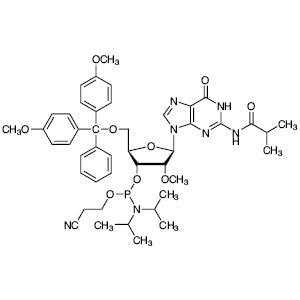
TCI D5710 DMT-2'-O-methyl-rG(Ib) Phosphoramidite is a guanosine monomer carrying a 2'-O-methyl group, designed for the synthesis of modified RNA oligonucleotides. The guanine base is protected as the isobutyryl amide, the 5'-hydroxyl is capped with a dimethoxytrityl group, and the 3' position bears the phosphoramidite function that serves as the coupling point during solid-phase synthesis. This monomer completes the set of four 2'-O-methyl monomers, so researchers can assemble a fully modified sequence or place the modification only at selected positions, according to the oligonucleotide design strategy under development.
What makes this monomer valuable is the combination of the stability of the isobutyryl protecting group and the structural advantages of the 2'-O-methyl group. Methylation at the 2' position drives the sugar toward an RNA-like conformation, so the duplex that forms is more compact and its affinity increases, while the loss of the free 2'-hydroxyl eliminates the principal route of degradation by ribonucleases. Because there is no bulky 2' protecting group, steric hindrance at the coupling step is lower than with conventional RNA monomers, giving higher cycle efficiency — particularly at guanosine positions, which are usually the most difficult in any given sequence.
In Indonesian laboratories, this monomer is used in academic and institutional groups that operate automated oligonucleotide synthesizers for antisense, siRNA, and aptamer work, as well as in facilities that prepare modified probes and primers in house. It is typically ordered alongside the other three 2'-O-methyl monomers so that a complete modified sequence can be built in a single synthesis campaign, and drawn on selectively when only certain positions in a construct need to carry the modification.
- Modified RNA oligonucleotide synthesis — the 3'-phosphoramidite group provides the coupling point for standard solid-phase cycles, letting the guanosine position be introduced without changing the established synthesis chemistry.
- Antisense oligonucleotide preparation — the absence of a free 2'-hydroxyl removes the main ribonuclease degradation pathway, so sequences built with this monomer resist enzymatic breakdown better than unmodified RNA.
- siRNA and duplex construct assembly — the RNA-like sugar conformation induced by 2'-O-methylation yields a more compact duplex with increased affinity for its complementary strand.
- Site-specific modification of existing sequences — because the full set of four 2'-O-methyl monomers is available, the modification can be placed only at chosen positions rather than throughout the sequence.
- Difficult guanosine-rich sequence synthesis — reduced steric hindrance compared with conventional RNA monomers raises coupling efficiency at guanosine, typically the hardest position in a sequence to incorporate cleanly.
| Brand | TCI |
|---|---|
| CAS number | 150780-67-9 |
| Molecular formula | — |
| Purity | — |
| Category | Chemistry > Chemical Biology > Nucleic Acid Chemistry |
| Pack sizes | available in the pack sizes listed for this catalogue item |
| Physical form | — |
| Storage | store under the conditions stated on the manufacturer's label |
- Product code: D5710
Phosphoramidite monomers are moisture-sensitive reagents and should be kept tightly closed in their original container, stored cold and dry as indicated on the manufacturer's label, and allowed to reach room temperature before opening so that condensation does not enter the vial. Handle and dispense under dry inert atmosphere wherever possible, using anhydrous solvents and dry glassware or septum-capped vials for transfer to the synthesizer. Work in a well-ventilated fume hood with gloves, safety glasses, and a laboratory coat, avoid contact with skin and eyes, keep the reagent away from water and moist air, and dispose of residues and contaminated solvents through the laboratory's chemical waste route in accordance with the safety data sheet.
—
Produk Terkait
-
5-Bromobenzoxazole TCI B5515
Regular price From Rp 1.888.950,00Regular price -
BMS-599626 TCI B5520
Regular price From Rp 3.927.000,00Regular price -
6-Bromobenzo[b]thiophene TCI B5523
Regular price Rp 3.777.900,00Regular price -
3-tert-Butyl4-Methyl(4R,5S)-2,2,5-Trimethyloxazolidine-3,4-dicarboxylate TCI B5538
Regular price Rp 3.306.450,00Regular price -
Biotin-PEG4-Azide TCI B5546
Regular price Rp 8.794.800,00Regular price -
Benzo[b]benzo[4,5]thieno[2,3-d]thiophene TCI B5551
Regular price From Rp 1.004.850,00Regular price -
2-Bromo-5-(4-hexylphenyl)thiophene TCI B5553
Regular price Rp 3.571.050,00Regular price -
Biotin-PEG4-Amine TCI B5560
Regular price From Rp 1.683.150,00Regular price


![6-Bromobenzo[b]thiophene (CAS 17347-32-9) - TCI B5523 - AMI Scientific](http://amiscientific.com/cdn/shop/files/TCI2510B5523.jpg?v=1767092466&width=533)


![Benzo[b]benzo[4,5]thieno[2,3-d]thiophene (CAS 248-70-4) - TCI B5551 - AMI Scientific](http://amiscientific.com/cdn/shop/files/TCI2510B5551.jpg?v=1768815817&width=533)

