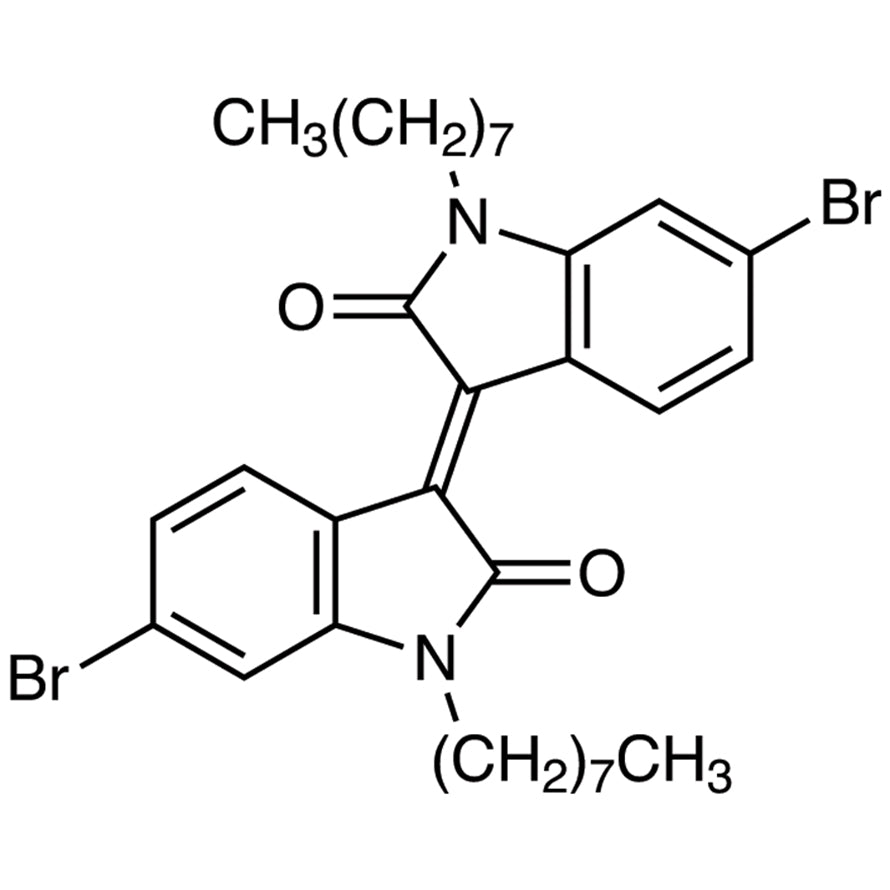
6,6'-Dibromo-1,1'-di(n-octyl)isoindigo is an organic semiconductor monomer built on the isoindigo framework, carrying two straight n-octyl chains attached to the lactam nitrogen atoms. As with other members of the isoindigo family, the molecular core is electron-deficient and therefore acts as a strong acceptor unit, while the two bromine atoms at the 6 and 6' positions provide symmetric connection points for palladium-catalysed cross-coupling reactions. In the laboratory, this material is used to assemble conjugated donor–acceptor polymers and oligomers that serve as the core materials in research on organic transistors, polymer solar cells, and long-wavelength light-absorbing materials.
The distinguishing feature of this variant is its linear and relatively short side chains. The n-octyl chains provide sufficient solubility for solution processing, yet they do not add as much steric bulk as branched chains, so the conjugated backbones can approach one another and stack more densely in thin films. This tight packing is generally associated with more effective charge-carrier transport pathways, although solubility remains more limited than in branched variants. For this reason, the monomer is frequently chosen when the research objective centres on backbone ordering and charge transport rather than on maximum processing latitude.
In Indonesian laboratories, this building block is typically handled in university and institutional research groups working on organic electronics and functional polymer materials. It is normally used at small synthetic scale within Schlenk-line or glovebox-supported cross-coupling work, followed by film deposition and device characterisation. Groups comparing linear against branched side-chain analogues often keep both variants on hand, since the packing behaviour described above is one of the key structural variables under study in polymer semiconductor research.
- Donor–acceptor conjugated polymer synthesis — the symmetric 6,6'-dibromo substitution allows the isoindigo acceptor to be polymerised with donor comonomers through palladium-catalysed cross-coupling into well-defined alternating backbones.
- Organic field-effect transistor research — the electron-deficient isoindigo core combined with linear n-octyl chains promotes dense backbone stacking in thin films, supporting the charge-carrier transport pathways that transistor studies require.
- Polymer solar cell active layers — as a strong acceptor unit, it enables the construction of low-band-gap conjugated polymers whose absorption can be pushed toward the longer-wavelength region relevant to photovoltaic research.
- Long-wavelength light-absorbing material development — the isoindigo framework contributes the electron-poor character needed to design conjugated systems that absorb in the long-wavelength range for optical and sensing studies.
- Conjugated oligomer and model compound preparation — the two bromine handles permit controlled mono- or di-coupling to build defined oligomers used as structural and electronic reference compounds against polymer analogues.
| Brand | TCI |
|---|---|
| CAS number | 1334295-79-2 |
| Molecular formula | — |
| Purity | — |
| Category | Materials Science > Material Building Blocks > Polymer/Macromolecule Semiconductor Building Blocks |
| Pack sizes | available in research-scale packaging; please confirm the currently offered pack size when ordering |
| Physical form | — |
| Storage | keep in a cool, dry place in the original tightly closed container, protected from light |
- Product code: D5742
Store the material in its original tightly closed container in a cool, dry, well-ventilated place, away from light and moisture, and keep it separate from strong oxidising agents. Transfer and weighing are best carried out in a chemical fume hood using clean, dry glassware or amber vials; for reaction work, handling under an inert atmosphere helps preserve material quality prior to cross-coupling. Wear safety glasses, chemical-resistant gloves, and a laboratory coat, and avoid generating or inhaling dust. Allow chilled containers to reach room temperature before opening to prevent moisture condensation, close containers promptly after use, and dispose of residues and contaminated consumables as chemical waste according to your institution's procedures. Always consult the manufacturer's safety data sheet before first use.
—
Produk Terkait
-
tert-Butyl(3R,4S)-2-Oxo-4-phenyl-3-[(triethylsilyl)oxy]azetidine-1-carboxylate TCI B5715
Regular price Rp 2.068.500,00Regular price -
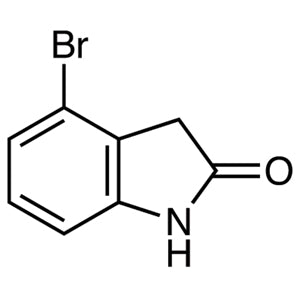
4-Bromoindolin-2-one TCI B5903
Regular price From Rp 875.700,00Regular price -
tert-Butyl2-Oxopyrrolidine-1-carboxylate TCI B6082
Regular price From Rp 1.749.300,00Regular price -
1-Benzyl-5-chloroindoline-2,3-dione TCI B6433
Regular price Rp 4.108.650,00Regular price -
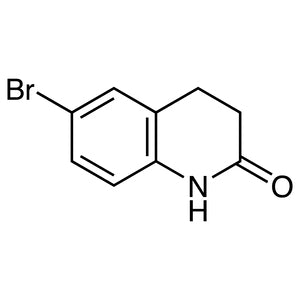
6-Bromo-3,4-dihydroquinolin-2(1H)-one TCI B6508
Regular price From Rp 2.386.650,00Regular price -
3-(5-Bromo-1-oxoisoindolin-2-yl)piperidine-2,6-dione TCI B6528
Regular price From Rp 1.060.500,00Regular price -
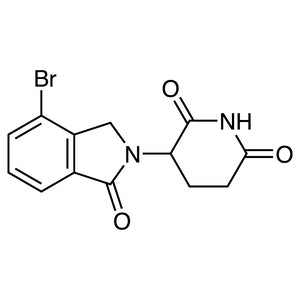
3-(4-Bromo-1-oxoisoindolin-2-yl)piperidine-2,6-dione TCI B6546
Regular price From Rp 1.220.100,00Regular price -
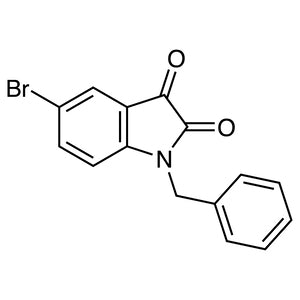
1-Benzyl-5-bromoindoline-2,3-dione TCI B6624
Regular price Rp 3.790.500,00Regular price
![tert-Butyl (3R,4S)-2-Oxo-4-phenyl-3-[(triethylsilyl)oxy]azetidine-1-carboxylate (CAS 149198-47-0) - TCI B5715 - AMI Scientific](http://amiscientific.com/cdn/shop/files/TCI2510B5715.jpg?v=1767092699&width=533)