

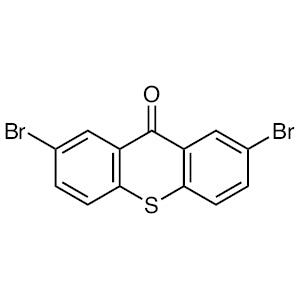
TCI D5839 2,7-Dibromo-9H-thioxanthen-9-one is a thioxanthone derivative: a tricyclic heterocyclic framework carrying a sulfur atom in the central ring and a ketone group at the nine position, with two bromine atoms attached at positions 2 and 7. The compound plays a dual role in the laboratory. It serves as a light-absorbing chromophore for photochemistry and photoinitiation studies, and it functions as a heterocyclic building block whose two bromine groups are ready to be converted through cross-coupling reactions in order to assemble larger, purposefully directed functional molecules.
The property that makes this compound a preferred choice is the ability of the thioxanthone framework to absorb light in the near-ultraviolet region and then cross efficiently into the triplet state, allowing it to act as a photosensitizer as well as a photoinitiator for energy transfer and hydrogen atom abstraction. The presence of the two bromine atoms delivers two advantages at once: a heavy-atom effect that strengthens intersystem crossing and therefore raises the triplet state yield, and a pair of symmetric reactive groups that make structural extension straightforward through Suzuki, Sonogashira or Buchwald–Hartwig reactions, as well as coupling polymerisation. The symmetry of the 2 and 7 positions also keeps the resulting derivatives more uniform and easier to characterise.
In Indonesian laboratories this material is typically handled at research scale in university chemistry and materials departments, government research institutes, and industrial development laboratories working on photochemistry, photoinitiators and functional organic materials. It is normally weighed out in small portions for exploratory synthesis, photophysical measurement, or the preparation of intermediates that will be carried forward into multi-step routes. Because it is supplied as a catalogue research chemical rather than a bulk commodity, it suits method development and small-batch preparative work.
- Photoinitiation studies: the thioxanthone core absorbs near-ultraviolet light and populates the triplet state efficiently, making it suitable for investigating initiation behaviour in light-driven reaction systems.
- Photosensitiser research: the compound transfers energy from its triplet state to acceptor molecules, so it is used where controlled energy transfer or hydrogen atom abstraction must be examined systematically.
- Suzuki cross-coupling synthesis: the two bromine substituents at positions 2 and 7 act as reliable handles for forming carbon–carbon bonds with boronic acid partners in extension work.
- Sonogashira and Buchwald–Hartwig chemistry: both bromide sites accept alkynyl or amine coupling partners, allowing researchers to install conjugated or electron-donating groups onto the heterocyclic framework.
- Coupling polymerisation and conjugated material assembly: the symmetric dibromide arrangement supports chain extension, giving access to larger functional structures with more uniform, easily characterised products.
| Brand | TCI |
|---|---|
| CAS number | 40102-86-1 |
| Molecular formula | — |
| Purity | — |
| Category | Chemistry > Building Blocks > Heterocyclic Building Blocks |
| Pack sizes | available in TCI research catalogue pack sizes; please confirm the current option when ordering |
| Physical form | — |
| Storage | keep in the closed original container, protected from light, following the storage note supplied with the product |
- Chemical name: 2,7-Dibromo-9H-thioxanthen-9-one
- Catalogue code: D5839
Store the compound in its original tightly closed container, kept in a cool, dry and well ventilated area away from direct sunlight and other light sources, since the material is a light-absorbing chromophore. Amber glass or an opaque secondary container is suitable for portions transferred out for daily use, and containers should be clearly labelled with the chemical name and CAS number. Handle the solid in a fume hood, using gloves, safety glasses and a laboratory coat, and avoid generating or inhaling dust during weighing. Keep the container closed when not in use, avoid contact with skin and eyes, and consult the manufacturer's safety data sheet before first use. Collect residues and contaminated consumables as halogenated organic chemical waste for disposal through the laboratory's established waste route.
—
Produk Terkait
-
5-Bromobenzoxazole TCI B5515
Regular price From Rp 1.696.800,00Regular price -
BMS-599626 TCI B5520
Regular price From Rp 3.525.900,00Regular price -
6-Bromobenzo[b]thiophene TCI B5523
Regular price Rp 3.392.550,00Regular price -
3-tert-Butyl4-Methyl(4R,5S)-2,2,5-Trimethyloxazolidine-3,4-dicarboxylate TCI B5538
Regular price Rp 2.969.400,00Regular price -
Biotin-PEG4-Azide TCI B5546
Regular price Rp 7.897.050,00Regular price -
Benzo[b]benzo[4,5]thieno[2,3-d]thiophene TCI B5551
Regular price From Rp 903.000,00Regular price -
2-Bromo-5-(4-hexylphenyl)thiophene TCI B5553
Regular price Rp 3.207.750,00Regular price -
Biotin-PEG4-Amine TCI B5560
Regular price From Rp 1.510.950,00Regular price


![6-Bromobenzo[b]thiophene (CAS 17347-32-9) - TCI B5523 - AMI Scientific](http://amiscientific.com/cdn/shop/files/TCI2510B5523.jpg?v=1767092466&width=533)


![Benzo[b]benzo[4,5]thieno[2,3-d]thiophene (CAS 248-70-4) - TCI B5551 - AMI Scientific](http://amiscientific.com/cdn/shop/files/TCI2510B5551.jpg?v=1768815817&width=533)

