

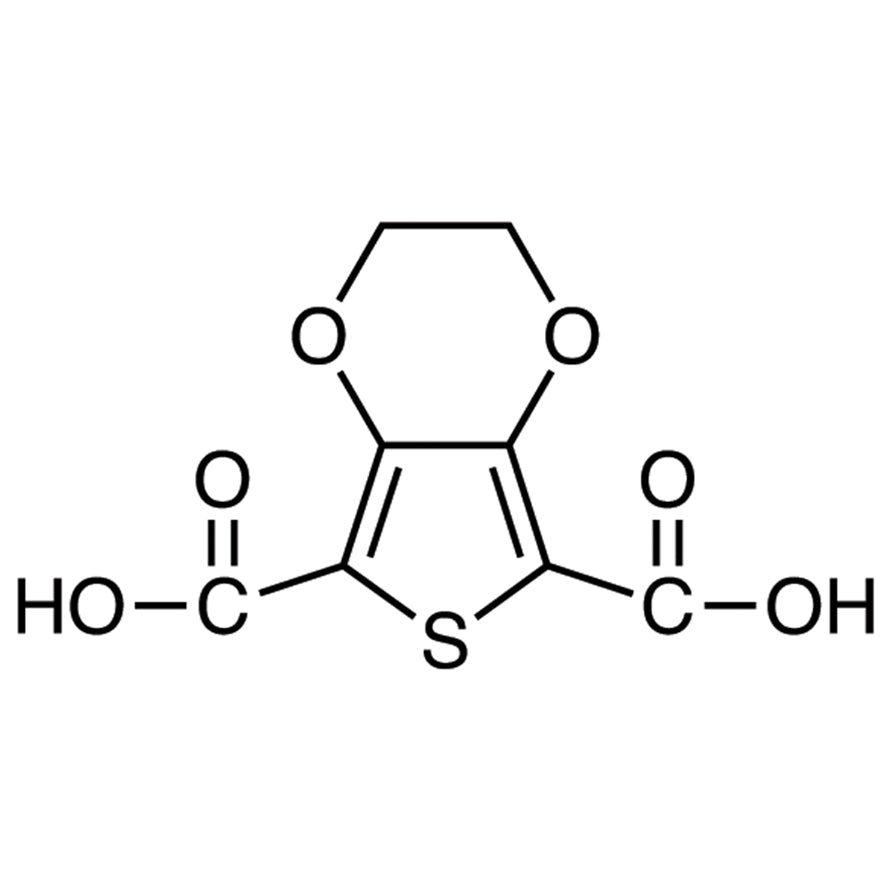
TCI E0743 3,4-Ethylenedioxythiophene-2,5-dicarboxylic Acid (CAS 18361-03-0) is an EDOT derivative carrying two carboxylic acid groups at the 2 and 5 positions of the thiophene ring. Tokyo Chemical Industry classifies it as a material building block for polymer semiconductors. Unlike ordinary EDOT, which is polymerized directly, this diacid compound serves as a versatile intermediate: its carboxylate groups can be esterified, amidated, or used as coordination linkers, and they can also be removed through decarboxylation to reopen the alpha positions. In the laboratory, this material acts as an entry point toward modified EDOT monomers and thiophene-based hybrid materials.
The property that makes this compound valuable is the combination of the electron-rich EDOT framework with two directable functional groups. The ethylenedioxy bridge retains the electron-donating character and conjugation stability found in the parent EDOT, while the symmetrical carboxylic acid groups at both ends allow the formation of repeating structures, metal coordination networks, or the anchoring of molecules onto charged surfaces. The carboxylate groups also make the compound more polar and more soluble, which simplifies handling during synthetic sequences compared with the parent monomer.
In Indonesian laboratories, materials of this type are typically used within university and institutional research groups working on conducting polymers, organic electronics, and functional thiophene materials. Because it is supplied as a defined building block rather than a finished monomer, it fits research programmes where a synthetic route is built step by step, and it is generally ordered in small research quantities alongside other TCI materials science reagents for a specific project.
- Synthesis of modified EDOT monomers: the two carboxylic acid groups provide handles for introducing substituents before the thiophene ring is taken forward into polymerization chemistry.
- Preparation of esters and amides: the diacid reacts through standard esterification and amidation routes, allowing side chains that tune solubility or attach the EDOT core to other molecular fragments.
- Metal coordination and network materials: the symmetrical carboxylate groups at both ends act as coordination linkers, supporting the assembly of extended frameworks built around an electron-rich thiophene unit.
- Surface anchoring and molecular tethering: the carboxylic acid functionality binds to charged surfaces, making the compound useful when an EDOT unit must be immobilized rather than left in solution.
- Decarboxylation routes toward alpha-free thiophenes: the acid groups can be removed to reopen the 2 and 5 positions, giving researchers a protected intermediate that is unmasked at a chosen stage.
| Brand | TCI (Tokyo Chemical Industry) |
|---|---|
| CAS number | 18361-03-0 |
| Molecular formula | — |
| Purity | — |
| Category | Materials Science > Material Building Blocks > Polymer/Macromolecule Semiconductor Building Blocks |
| Pack sizes | available in research-scale pack sizes as listed by the manufacturer |
| Physical form | — |
| Storage | keep in a tightly closed original container in a cool, dry place away from light and moisture |
- Chemical name: 3,4-Ethylenedioxythiophene-2,5-dicarboxylic Acid
Store the material in its original tightly closed container in a cool, dry, well-ventilated area, protected from light, moisture, and sources of heat or ignition. Amber glass or the supplied manufacturer packaging is suitable; keep the container closed when not in use to prevent moisture uptake, since carboxylic acids readily absorb atmospheric water. Handle in a fume hood using gloves, safety glasses, and a laboratory coat, and avoid generating dust when weighing the solid. Use clean, dry spatulas to prevent cross-contamination of the stock, return the container promptly to storage after use, and always consult the manufacturer's safety data sheet before handling or disposal.
—
Produk Terkait
-
5-Bromobenzoxazole TCI B5515
Regular price From Rp 1.696.800,00Regular price -
BMS-599626 TCI B5520
Regular price From Rp 3.525.900,00Regular price -
6-Bromobenzo[b]thiophene TCI B5523
Regular price Rp 3.392.550,00Regular price -
3-tert-Butyl4-Methyl(4R,5S)-2,2,5-Trimethyloxazolidine-3,4-dicarboxylate TCI B5538
Regular price Rp 2.969.400,00Regular price -
Biotin-PEG4-Azide TCI B5546
Regular price Rp 7.897.050,00Regular price -
Benzo[b]benzo[4,5]thieno[2,3-d]thiophene TCI B5551
Regular price From Rp 903.000,00Regular price -
2-Bromo-5-(4-hexylphenyl)thiophene TCI B5553
Regular price Rp 3.207.750,00Regular price -
Biotin-PEG4-Amine TCI B5560
Regular price From Rp 1.510.950,00Regular price


![6-Bromobenzo[b]thiophene (CAS 17347-32-9) - TCI B5523 - AMI Scientific](http://amiscientific.com/cdn/shop/files/TCI2510B5523.jpg?v=1767092466&width=533)


![Benzo[b]benzo[4,5]thieno[2,3-d]thiophene (CAS 248-70-4) - TCI B5551 - AMI Scientific](http://amiscientific.com/cdn/shop/files/TCI2510B5551.jpg?v=1768815817&width=533)

