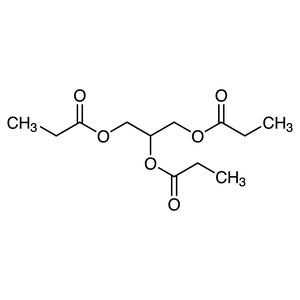
TCI G0090 Tripropionin, also known as glyceryl tripropanoate, is the triester formed between glycerol and propionic acid. Its very short acyl chains make the compound a colourless liquid at room temperature and give it far better solubility in aqueous systems than long-chain triglycerides. In the laboratory, Tripropionin serves three main roles: as a building block for organic synthesis, as a solvent or carrier, and — most commonly of all — as a model substrate for studying ester hydrolysis under both enzymatic and chemical conditions.
The principal advantage of Tripropionin is its ability to form a nearly homogeneous reaction system, so that hydrolysis kinetics can be studied without the interfacial complications that normally arise with long-chain fats. Because the material is a liquid, it is easy to pipette and to measure out volumetrically. Each of its three ester groups releases propionic acid on hydrolysis, so the progress of the reaction can be followed by automatic titration or by pH measurement. This behaviour makes it a practical standard for comparing the activity of different esterases and lipases directly against one another.
Biochemistry, biotechnology, and organic chemistry laboratories across Indonesia use Tripropionin in this way — as a dependable reference substrate and a convenient short-chain triglyceride when a long-chain fat would make the experiment harder to interpret. Its liquid form suits routine bench handling, and the direct link between hydrolysis and measurable acid release makes it equally suitable for teaching laboratories and for research groups characterising new enzyme preparations.
- Esterase and lipase activity assays — the three ester groups release propionic acid on hydrolysis, allowing enzyme activity to be quantified directly by automatic titration or pH measurement.
- Ester hydrolysis kinetics studies — the nearly homogeneous reaction system it forms lets researchers follow reaction rates without the interfacial effects that complicate work with long-chain fats.
- Organic synthesis building block — as a non-heterocyclic triester of glycerol, it provides a defined short-chain scaffold for the preparation of related esters and derivatives.
- Comparative enzyme screening — because it behaves as a practical standard substrate, different esterase and lipase preparations can be compared against one another on a common basis.
- Solvent and carrier applications — its liquid state and improved solubility in aqueous systems make it useful as a medium or carrier where long-chain triglycerides are unsuitable.
| Brand | TCI (Tokyo Chemical Industry) |
|---|---|
| CAS number | 139-45-7 |
| Molecular formula | — |
| Purity | — |
| Category | Chemistry > Building Blocks > Non-Heterocyclic Building Blocks |
| Pack sizes | available in the standard catalogue pack sizes offered for this item |
| Physical form | colourless liquid at room temperature |
| Storage | keep tightly closed in the original container, in a cool, dry, well-ventilated area |
- Chemical name: Tripropionin (glyceryl tripropanoate)
Store Tripropionin in its original tightly closed container in a cool, dry, well-ventilated place, away from heat sources, open flames, and strong oxidising agents. Because the ester groups are susceptible to hydrolysis, containers should be kept sealed and protected from moisture; repeated opening in humid conditions should be avoided. Use glass or other chemically compatible containers and pipettes when dispensing, and reseal immediately after use. Handle in a fume hood with standard laboratory personal protective equipment, including safety glasses, gloves, and a laboratory coat, and avoid contact with skin and eyes. Follow the supplied safety data sheet and applicable institutional waste-disposal procedures for the collection and disposal of residues and rinsings.
—
Produk Terkait
-
CholesterolPropionate TCI C0676
Regular price From Rp 2.466.450,00Regular price -
Galactitol TCI G0005
Regular price From Rp 1.193.850,00Regular price -
D-(+)-GalactosamineHydrochloride TCI G0007
Regular price From Rp 1.856.400,00Regular price -
D-(+)-GalactoseAnhydrous TCI G0008
Regular price From Rp 452.550,00Regular price -
alpha-D-GalacturonicAcidHydrate TCI G0010
Regular price Rp 2.254.350,00Regular price -
GallicAcid TCI G0011
Regular price From Rp 505.050,00Regular price -
IsoamylGallate TCI G0012
Regular price From Rp 1.829.100,00Regular price -
HexadecylGallate TCI G0013
Regular price From Rp 3.419.850,00Regular price