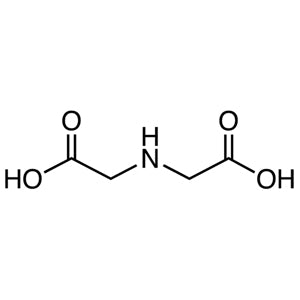
Iminodiacetic acid is a secondary amino acid carrying a single nitrogen atom linked to two acetic acid groups. This tridentate arrangement — one nitrogen donor and two carboxylate groups — makes it one of the most widely used classical chelating agents in the laboratory. Functionally it behaves as a simplified version of EDTA, and the compound serves as the base material for manufacturing chelating ion-exchange resins as well as stationary phases for metal affinity chromatography. Beyond its role as a chelator, it also acts as a building block in peptide chemistry and in the synthesis of aminocarboxylic acid derivatives.
The characteristic that makes this compound a preferred choice is the stability of the metal complexes it forms. With three coordination points, it binds divalent and trivalent metal ions to form five-membered chelate rings that are stable while still leaving open coordination positions on the metal centre. It is precisely this "binds but does not fully cap" behaviour that makes the compound ideal for immobilised metal affinity chromatography, since the metal ion remains able to interact with the analyte. The material is a crystalline solid, amphoteric in nature, and dissolves more readily in basic solution than in neutral water.
In Indonesian laboratories this compound is typically found in analytical chemistry, biochemistry, and separation science workgroups. It is used by academic research laboratories preparing chelating resins and affinity supports in-house, by protein purification laboratories building metal affinity columns, and by synthesis groups producing aminocarboxylic acid derivatives. Its role as a peptide chemistry building block also places it in laboratories working on modified amino acids and coordination compounds, where a well-characterised and reproducible chelating scaffold is required.
- Immobilised metal affinity chromatography support preparation — the tridentate binding leaves open coordination sites on the bound metal ion, allowing the immobilised metal to interact directly with target analytes and proteins.
- Chelating ion-exchange resin synthesis — the compound is the classical base material for functionalising resin backbones, giving supports that selectively capture divalent and trivalent metal ions from solution.
- Peptide chemistry building block work — as a secondary amino acid with two carboxylate arms, it introduces branched carboxyl functionality into peptide and pseudopeptide structures under standard coupling conditions.
- Aminocarboxylic acid derivative synthesis — its nitrogen and two acetic acid groups provide reactive handles for constructing more elaborate chelators and functionalised aminocarboxylate ligands in preparative work.
- Metal complexation and coordination studies — the stable five-membered chelate rings it forms make it a reliable model ligand for teaching and investigating complex stability with divalent and trivalent metals.
| Brand | TCI |
|---|---|
| CAS number | 142-73-4 |
| Molecular formula | — |
| Purity | — |
| Category | Chemistry > Chemical Biology > Peptide Chemistry |
| Pack sizes | available in standard TCI catalogue pack sizes; please confirm the size required when ordering |
| Physical form | crystalline solid, amphoteric, more soluble in basic solution than in neutral water |
| Storage | store in a tightly closed container in a cool, dry place away from moisture |
Store this compound in a tightly closed container in a cool, dry place, protected from moisture and kept away from incompatible materials. Original supplier containers or equivalent chemically resistant screw-cap bottles are suitable; amber or opaque containers are recommended where cabinet lighting is strong. Handle the solid in a well-ventilated area or fume hood to avoid generating and inhaling dust, and wear standard laboratory personal protective equipment including safety goggles, gloves, and a laboratory coat. Use clean, dry spatulas when dispensing to prevent contamination of the stock, and close the container immediately after use. Because the material is amphoteric and dissolves more readily in basic media, prepare solutions with attention to the pH required by the intended application. Refer to the manufacturer's safety data sheet before first use and dispose of waste according to institutional chemical waste procedures.
—
Produk Terkait
-
TCI B5774 5,10-Bis(4,4,5,5-tetramethyl-1,3,2-dioxaborolan-2-yl)naphtho[1,2-c:5,6-c']bis([1,2,5]oxadiazole)
Regular price Rp 11.420.850,00Regular price -
3-Bromo-5-methylaniline TCI B6015
Regular price From Rp 3.927.000,00Regular price -
TCI B6321 2,6-Bis(acetamido)-2,6-dideoxy-D-mannose
Regular price Rp 4.044.600,00Regular price -
BTP3-Neu5AcNa TCI B6529
Regular price Rp 4.251.450,00Regular price -
Dihydroiodide TCI B6569
Regular price From Rp 2.155.650,00Regular price -
Biotin-PEG3-Dz TCI B6572
Regular price From Rp 5.904.150,00Regular price -
Biotin-PEG3-PhN3 TCI B6585
Regular price From Rp 5.371.800,00Regular price -
Trifluoromethanesulfonate TCI B7003
Regular price From Rp 2.155.650,00Regular price
![5,10-Bis(4,4,5,5-tetramethyl-1,3,2-dioxaborolan-2-yl)naphtho[1,2-c:5,6-c']bis([1,2,5]oxadiazole) - TCI B5774 - AMI Scientific](http://amiscientific.com/cdn/shop/files/TCI2510B5774.jpg?v=1769180228&width=533)