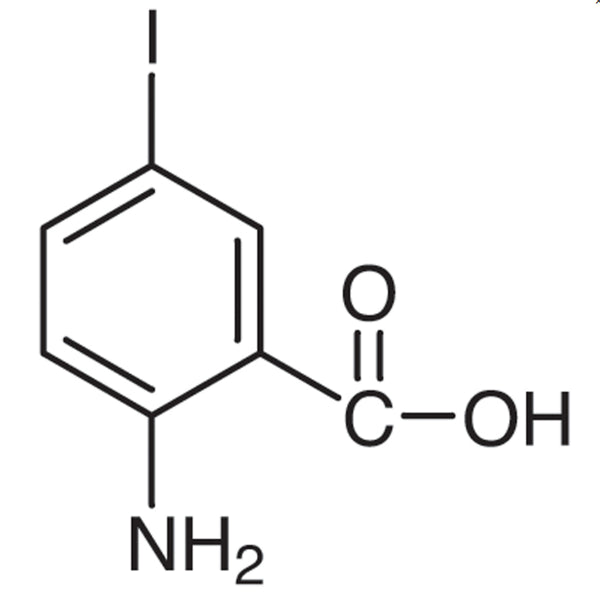
TCI 2-Amino-5-iodobenzoic Acid is an anthranilic acid derivative that carries three functional handles at once: an amino group, a carboxyl group, and an iodine atom. This density of functionality makes it a highly productive building block, because each group can be directed toward a different transformation. In the laboratory, the compound is widely used to assemble nitrogen-containing heterocyclic systems, to prepare labelling reagents, and to construct peptidomimetic fragments. Its placement in the peptide chemistry category reflects its role as a bridge between aromatic amino acid chemistry and transition-metal-based synthetic chemistry.
The property that makes this material a preferred choice is the cooperation between the neighbouring amino and carboxyl groups, which naturally drives the formation of lactam rings such as quinazolinones, benzoxazinones, and acridones. Meanwhile, the iodine atom at the 5-position sits well away from both of those groups, so it remains free to undergo cross-coupling after the ring has been closed. The carboxyl group also allows amide bond formation using common peptide coupling reagents, which makes the material straightforward to insert into a synthetic chain. As a crystalline solid, it is convenient to weigh and dispense at the bench.
In Indonesian laboratories, this reagent is typically used in synthetic organic and medicinal chemistry groups at universities and research institutes, as well as in contract synthesis and analytical support work. It is generally drawn upon when a team needs an orthogonally functionalised aromatic scaffold for multi-step routes, including heterocycle construction, coupling studies, and the preparation of reference intermediates for method development. The material is normally handled under standard bench conditions with routine weighing and transfer practice.
- Nitrogen heterocycle synthesis: the adjacent amino and carboxyl groups readily close onto lactam rings such as quinazolinones, benzoxazinones, and acridones without needing additional pre-functionalisation of the aromatic core.
- Transition-metal cross-coupling chemistry: the iodine atom at the 5-position is remote from the amino and carboxyl groups, so it stays available for coupling even after the ring system has already been formed.
- Peptidomimetic fragment construction: the carboxyl group forms amide bonds using common peptide coupling reagents, allowing this aromatic scaffold to be inserted directly into a growing synthetic chain.
- Labelling reagent preparation: the combination of three distinct functional handles on one ring lets chemists attach a reporter at one position while reserving the remaining groups for later conjugation steps.
- Multi-step medicinal chemistry route development: the orthogonal reactivity of the amino, carboxyl, and iodo groups supports sequential, selective transformations that build molecular complexity from a single inexpensive aromatic starting point.
| Brand | TCI |
|---|---|
| CAS number | 5326-47-6 |
| Molecular formula | — |
| Purity | — |
| Category | Chemistry > Chemical Biology > Peptide Chemistry |
| Pack sizes | available in the standard TCI catalogue pack sizes; please confirm the required size when ordering |
| Physical form | crystalline solid |
| Storage | keep in a cool, dry place in a tightly closed container |
- Product code: I0049
Store the material in its original tightly closed container in a cool, dry, well-ventilated place, away from direct sunlight, moisture, and incompatible chemicals. Amber glass or the supplier's original packaging is suitable, and the container should be resealed promptly after each use to limit moisture uptake. Weigh and transfer the solid in a fume hood or a well-ventilated area to avoid generating dust, and wear safety glasses, gloves, and a laboratory coat. Avoid contact with skin and eyes and avoid inhaling any airborne powder. Clean spatulas and weighing vessels between uses to prevent cross-contamination, label any prepared solutions clearly, and dispose of residues and contaminated consumables through the laboratory's chemical waste route. Consult the supplier's safety data sheet before first use.
—
Produk Terkait
-
TCI B5774 5,10-Bis(4,4,5,5-tetramethyl-1,3,2-dioxaborolan-2-yl)naphtho[1,2-c:5,6-c']bis([1,2,5]oxadiazole)
Regular price Rp 11.420.850,00Regular price -
3-Bromo-5-methylaniline TCI B6015
Regular price From Rp 3.927.000,00Regular price -
TCI B6321 2,6-Bis(acetamido)-2,6-dideoxy-D-mannose
Regular price Rp 4.044.600,00Regular price -
BTP3-Neu5AcNa TCI B6529
Regular price Rp 4.251.450,00Regular price -
Dihydroiodide TCI B6569
Regular price From Rp 2.155.650,00Regular price -
Biotin-PEG3-Dz TCI B6572
Regular price From Rp 5.904.150,00Regular price -
Biotin-PEG3-PhN3 TCI B6585
Regular price From Rp 5.371.800,00Regular price -
Trifluoromethanesulfonate TCI B7003
Regular price From Rp 2.155.650,00Regular price
![5,10-Bis(4,4,5,5-tetramethyl-1,3,2-dioxaborolan-2-yl)naphtho[1,2-c:5,6-c']bis([1,2,5]oxadiazole) - TCI B5774 - AMI Scientific](http://amiscientific.com/cdn/shop/files/TCI2510B5774.jpg?v=1769180228&width=533)