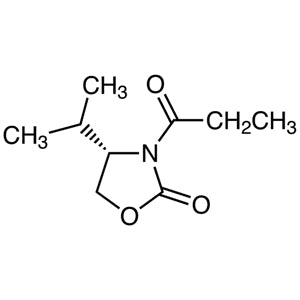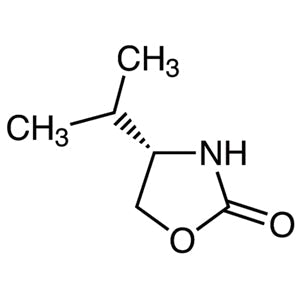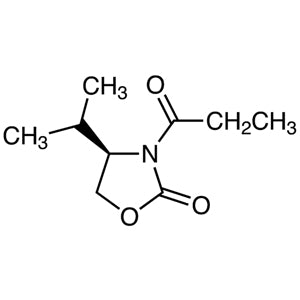
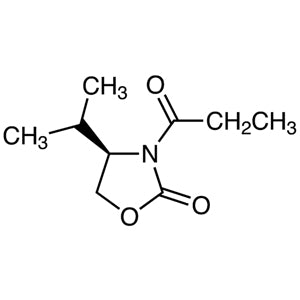
TCI I0594, (R)-(-)-4-Isopropyl-3-propionyl-2-oxazolidinone, is an oxazolidinone-type chiral auxiliary — the class commonly known as Evans auxiliaries — supplied in its already-acylated form bearing a propionyl group. The molecule consists of an oxazolidinone ring carrying an isopropyl substituent at the 4-position in the R configuration, with the ring nitrogen already loaded with a ready-to-use propionyl chain. In the laboratory, this compound acts as a temporary stereochemical director: it is attached to a substrate, steers the course of the reaction so that one diastereomer forms predominantly, and is then cleaved away once its task is complete, leaving the final product in high optical purity.
The property that has made this auxiliary a standard fixture in many laboratories is its reliability. The bulky isopropyl group effectively shields one face of the enolate, while the two carbonyl groups on the imide framework are able to bind metals such as boron or titanium in a chelated form, locking the transition-state geometry into a highly ordered arrangement. As a result, aldol and alkylation reactions using this auxiliary frequently deliver very high diastereomeric ratios and — no less important — results that can be reproduced consistently from one run to the next, which is precisely what a synthetic programme needs when a stereocentre must be set with confidence.
In Indonesian laboratories, this reagent is typically found in academic and industrial research settings concerned with asymmetric synthesis: university and institutional organic chemistry groups building enantiomerically enriched intermediates, natural-product synthesis work where a defined stereocentre must be installed early in a sequence, and pharmaceutical or fine-chemical research where a single enantiomer of an intermediate is required. Because it arrives pre-acylated, it also suits teaching and method-development work where researchers want to reach the key stereoselective step without first preparing the acyl imide themselves.
Related TCI products
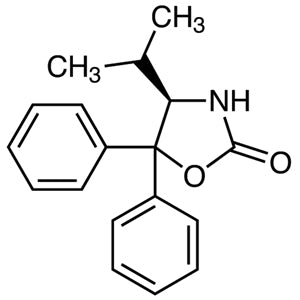
- TCI I0761 191090-32-1 (4R)-(+)-4-Isopropyl-5,5-diphenyl-2-oxazolidinone
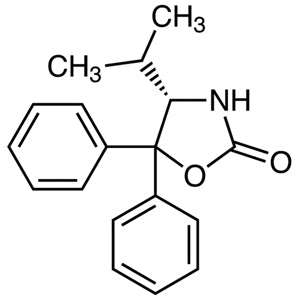
- TCI I0762 184346-45-0 (4S)-(-)-4-Isopropyl-5,5-diphenyl-2-oxazolidinone
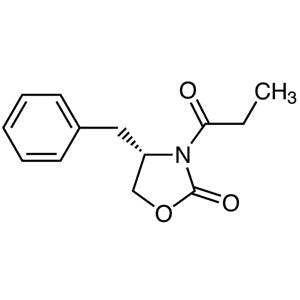
- TCI B2166 101711-78-8 (S)-(+)-4-Benzyl-3-propionyl-2-oxazolidinone
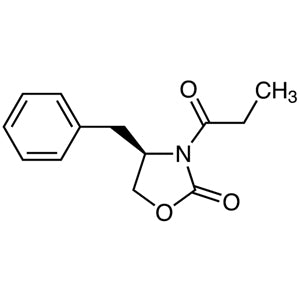
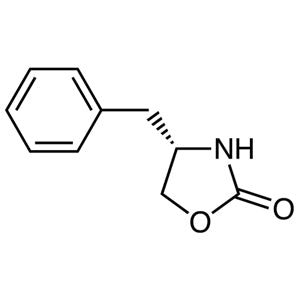
- TCI B2165 131685-53-5 (R)-(-)-4-Benzyl-3-propionyl-2-oxazolidinone
- TCI I0573 77877-19-1 (S)-(+)-4-Isopropyl-3-propionyl-2-oxazolidinone
- TCI I0572 95530-58-8 (R)-4-Isopropyl-2-oxazolidinone
- Evans asymmetric aldol reactions — the chelating imide carbonyls and the shielding isopropyl group organise the enolate transition state so that one aldol diastereomer forms predominantly and reproducibly.
- Asymmetric alkylation of enolates — the pre-installed propionyl chain provides the enolisable position directly, while the R-configured auxiliary blocks one enolate face to direct the incoming electrophile.
- Construction of propionate-derived stereocentres in natural-product synthesis — the propionyl unit maps directly onto the methyl-bearing stereocentres that recur throughout polyketide-type target molecules.
- Preparation of enantiomerically enriched pharmaceutical intermediates — the auxiliary is attached, directs the stereoselective step, and is then cleaved, leaving an intermediate of high optical purity.
- Methodology and reaction-development studies — its well-established, reproducible behaviour makes it a dependable reference auxiliary when researchers benchmark new conditions, metal enolates, or stereoselective transformations.
| Brand | TCI (Tokyo Chemical Industry) |
|---|---|
| CAS number | 89028-40-0 |
| Molecular formula | — |
| Purity | — |
| Category | Chemistry > Asymmetric Synthesis > Chiral Auxiliaries |
| Pack sizes | available in standard TCI research-scale packaging; please confirm the required pack size when ordering |
| Physical form | — |
| Storage | store in a cool, dry place in a tightly closed container, protected from moisture |
- Chemical name: (R)-(-)-4-Isopropyl-3-propionyl-2-oxazolidinone
Store the container tightly closed in a cool, dry, well-ventilated area away from moisture, direct sunlight, and sources of heat or ignition. Keep the material in its original supplier container or in a clean, chemically compatible, tightly sealed glass vessel; where the compound is to be used in moisture-sensitive enolate chemistry, storage under an inert atmosphere and handling in a dry environment help preserve its quality. Handle within a fume hood using safety glasses, gloves, and a laboratory coat, avoid the generation of dust and any contact with skin or eyes, and keep the material away from strong oxidising agents and strong bases. Always consult the manufacturer's Safety Data Sheet before use, and dispose of residues and contaminated materials in accordance with applicable laboratory waste regulations.
—
Product Categories
Produk Terkait
-
(4R)-(+)-4-Isopropyl-5,5-diphenyl-2-oxazolidinone TCI I0761
Regular price From Rp 3.260.250,00Regular price -
(4S)-(-)-4-Isopropyl-5,5-diphenyl-2-oxazolidinone TCI I0762
Regular price From Rp 3.551.100,00Regular price -
(S)-(+)-4-Benzyl-3-propionyl-2-oxazolidinone TCI B2166
Regular price From Rp 823.200,00Regular price -
(R)-(-)-4-Benzyl-3-propionyl-2-oxazolidinone TCI B2165
Regular price From Rp 1.353.450,00Regular price -
(S)-(+)-4-Isopropyl-3-propionyl-2-oxazolidinone TCI I0573
Regular price From Rp 1.167.600,00Regular price -
(R)-4-Isopropyl-2-oxazolidinone TCI I0572
Regular price From Rp 1.167.600,00Regular price -
(S)-4-Isopropyl-2-oxazolidinone TCI I0451
Regular price From Rp 530.250,00Regular price -
(S)-4-Benzyl-2-oxazolidinone TCI B1754
Regular price From Rp 477.750,00Regular price