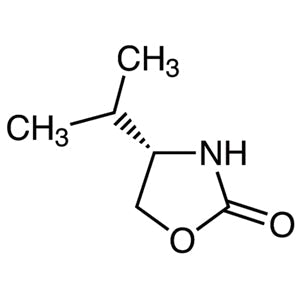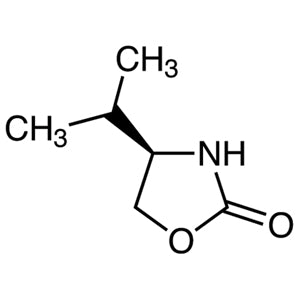
TCI I0572 (R)-4-Isopropyl-2-oxazolidinone is a classic chiral auxiliary, widely known as one of the "Evans auxiliaries" — a helper molecule that is temporarily attached to a substrate in order to control the stereochemistry of a reaction. The compound consists of a five-membered oxazolidinone ring bearing an isopropyl group at the 4-position in the (R) configuration. In the organic synthesis laboratory, its role is to act as a spatial "direction marker": once bound to an acyl group, the auxiliary forces the reaction to proceed from only one face of the molecule, and it is then cleaved off again after the new stereogenic centre has been formed, so that it does not remain part of the final product.
The reason this compound is chosen lies in its reliability and its predictable behaviour. The amide nitrogen of the oxazolidinone ring is readily acylated, and the enolate generated from its N-acyl derivatives can be chelated by a metal so that its geometry becomes locked. The reasonably bulky isopropyl group then blocks one face of the enolate, which produces high diastereoselectivity in aldol and alkylation reactions. A further practical advantage is that the diastereomeric products formed can often be purified by crystallisation or chromatography, so that the stereochemical outcome of a step can be upgraded and confirmed before the synthesis is carried forward.
In Indonesian laboratories, this material is typically used in university and institutional research groups working on asymmetric synthesis, natural product total synthesis, and the preparation of enantiomerically enriched intermediates for pharmaceutical and fine-chemical studies. It is generally handled on a small to moderate scale under anhydrous conditions, on the bench or in a fume hood, as part of methodology development work, thesis-level projects, and route-scouting studies where a single, well-understood stereocontrol element is preferred over less predictable alternatives.
Related TCI products
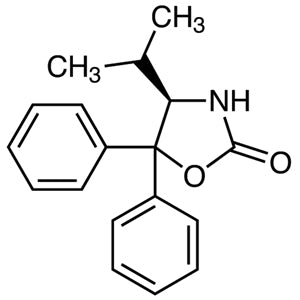
- TCI I0761 191090-32-1 (4R)-(+)-4-Isopropyl-5,5-diphenyl-2-oxazolidinone
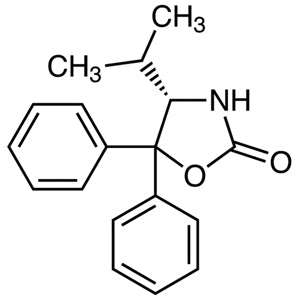
- TCI I0762 184346-45-0 (4S)-(-)-4-Isopropyl-5,5-diphenyl-2-oxazolidinone
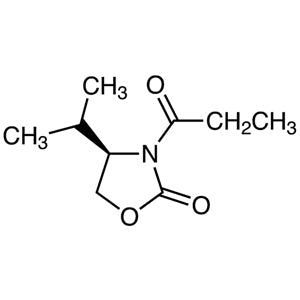
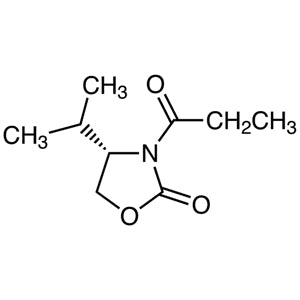
- TCI I0594 89028-40-0 (R)-(-)-4-Isopropyl-3-propionyl-2-oxazolidinone
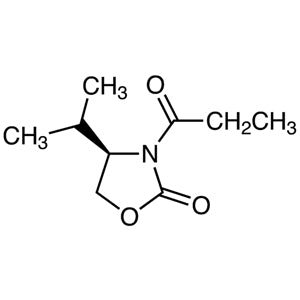
- TCI I0573 77877-19-1 (S)-(+)-4-Isopropyl-3-propionyl-2-oxazolidinone
- TCI I0451 17016-83-0 (S)-4-Isopropyl-2-oxazolidinone
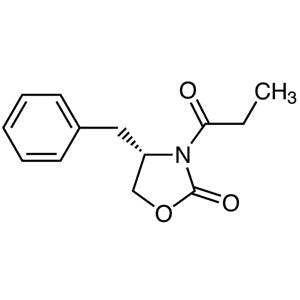
- TCI B2166 101711-78-8 (S)-(+)-4-Benzyl-3-propionyl-2-oxazolidinone
- Evans asymmetric aldol reactions: the N-acyl derivative forms a chelated enolate whose geometry is fixed, while the isopropyl group shields one enolate face and delivers high diastereoselectivity in the new carbon–carbon bond.
- Asymmetric alkylation of enolates: attaching the auxiliary to an acyl chain lets alkylating agents approach from only one face, giving predictable control over the configuration of the newly created stereogenic centre.
- Total synthesis of natural products: the auxiliary installs defined stereocentres at an early stage and is then removed, allowing the synthetic route to advance without the auxiliary contaminating the target skeleton.
- Preparation of enantiomerically enriched building blocks: diastereomeric intermediates can often be upgraded by crystallisation or chromatography, so intermediates of well-defined stereochemistry are obtained before being carried forward.
- Methodology and stereoselectivity studies: because the (R) configuration and its behaviour are well documented, this auxiliary serves as a dependable reference point when new asymmetric reaction conditions are being evaluated and compared.
| Brand | TCI (Tokyo Chemical Industry) |
|---|---|
| CAS number | 95530-58-8 |
| Molecular formula | — |
| Purity | — |
| Category | Chemistry > Asymmetric Synthesis > Chiral Auxiliaries |
| Pack sizes | available in standard TCI research-scale packaging; please confirm the currently available size when ordering |
| Physical form | — |
| Storage | keep tightly closed in a cool, dry place away from moisture |
- Product code: I0572
- Chemical name: (R)-4-Isopropyl-2-oxazolidinone
Store the container tightly closed in a cool, dry and well-ventilated place, away from moisture, direct sunlight and sources of heat or ignition. The original manufacturer's container is the most suitable primary packaging; if the material is transferred, use clean, dry, chemically compatible glass containers with tight-fitting closures and label them clearly. Because the compound is normally used under anhydrous conditions, minimise exposure to atmospheric humidity by closing the container promptly after weighing and, where appropriate, working under an inert atmosphere. Handle in a fume hood using safety glasses, gloves and a laboratory coat, avoid generating dust, avoid contact with skin and eyes, and wash hands thoroughly after use. Keep the container away from incompatible reagents, and dispose of residues and contaminated materials in accordance with the applicable institutional and local chemical waste procedures. Always consult the manufacturer's safety data sheet before use.
—
Product Categories
Produk Terkait
-
(4R)-(+)-4-Isopropyl-5,5-diphenyl-2-oxazolidinone TCI I0761
Regular price From Rp 3.260.250,00Regular price -
(4S)-(-)-4-Isopropyl-5,5-diphenyl-2-oxazolidinone TCI I0762
Regular price From Rp 3.551.100,00Regular price -
(R)-(-)-4-Isopropyl-3-propionyl-2-oxazolidinone TCI I0594
Regular price From Rp 2.147.250,00Regular price -
(S)-(+)-4-Isopropyl-3-propionyl-2-oxazolidinone TCI I0573
Regular price From Rp 1.167.600,00Regular price -
(S)-4-Isopropyl-2-oxazolidinone TCI I0451
Regular price From Rp 530.250,00Regular price -
(S)-(+)-4-Benzyl-3-propionyl-2-oxazolidinone TCI B2166
Regular price From Rp 823.200,00Regular price -
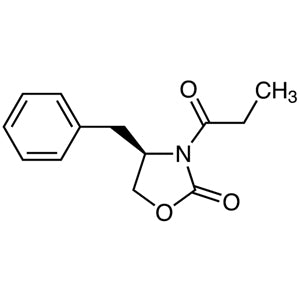
(R)-(-)-4-Benzyl-3-propionyl-2-oxazolidinone TCI B2165
Regular price From Rp 1.353.450,00Regular price -
(S)-4-Benzyl-2-oxazolidinone TCI B1754
Regular price From Rp 477.750,00Regular price