2-Iodobenzaldehyde is a benzaldehyde derivative carrying an iodine atom at the ortho position, directly adjacent to the aldehyde group. This close placement of the two groups is precisely what gives the compound its special value as a non-heterocyclic building block. In organic synthesis laboratories, it is widely used as a starting material for constructing heterocyclic rings through a sequence of coupling reactions followed by intramolecular ring closure — a strategy that allows researchers to assemble complex frameworks in only a few steps.
The property that makes it a preferred choice is the presence of two complementary centres of reactivity held at very close range. The carbon–iodine bond is ready to undergo oxidative addition at transition metal catalysts, while the aldehyde group is a classic electrophile that can react with amines, organometallic reagents, and phosphonium ylides. Because both sit at ortho positions relative to one another, the coupling product that forms is placed in a geometrically favourable arrangement to immediately attack the neighbouring carbonyl group. This is what makes the compound a favoured substrate in the synthesis of isoquinolines, indoles, and various other ring systems.
In Indonesian laboratories, 2-iodobenzaldehyde is typically found in university and institutional organic synthesis groups, where it serves as a reliable entry point into heterocyclic scaffolds without requiring a long preparatory route. It suits methodology development work, exploratory route-scouting on a small scale, and teaching-level demonstrations of cross-coupling chemistry, where a single reagent offering two distinct handles helps keep step counts and reagent inventories manageable.
- Isoquinoline synthesis — the ortho relationship between the iodine and the aldehyde allows coupling followed by intramolecular closure onto the carbonyl, delivering the ring system efficiently.
- Indole construction — the carbon–iodine bond engages transition metal catalysts while the adjacent aldehyde provides the electrophilic partner needed to complete the nitrogen-containing ring.
- Transition metal catalysed cross-coupling studies — the carbon–iodine bond readily undergoes oxidative addition, making this a dependable substrate for evaluating catalysts and reaction conditions.
- Condensation chemistry with amines — the aldehyde group behaves as a classic electrophile toward amines, giving imine intermediates that can be carried forward into cyclisation sequences.
- Olefination and organometallic addition work — the carbonyl reacts cleanly with phosphonium ylides and organometallic reagents, extending the carbon framework while leaving the iodine available for later coupling.
| Brand | TCI |
|---|---|
| CAS number | 26260-02-6 |
| Molecular formula | — |
| Purity | — |
| Category | Chemistry > Building Blocks > Non-Heterocyclic Building Blocks |
| Pack sizes | available in standard TCI laboratory pack sizes; please confirm the option required when ordering. |
| Physical form | — |
| Storage | keep in the closed original container under the conditions indicated on the manufacturer's label. |
- Catalogue number: I0610
Store the material in its tightly closed original container in a cool, dry, and well ventilated place, away from direct sunlight, heat sources, and incompatible substances. Aryl iodides and aldehydes are both sensitive to prolonged exposure to light and air, so the container should be reclosed promptly after each use and kept in a dark cabinet where possible. Handle in a fume hood using safety goggles, gloves, and a laboratory coat, and avoid contact with skin, eyes, and clothing. Use clean, dry spatulas and glassware for weighing and transfer to prevent contamination, and consult the manufacturer's safety data sheet before first use for full handling, first-aid, and disposal guidance.
—
Produk Terkait
-
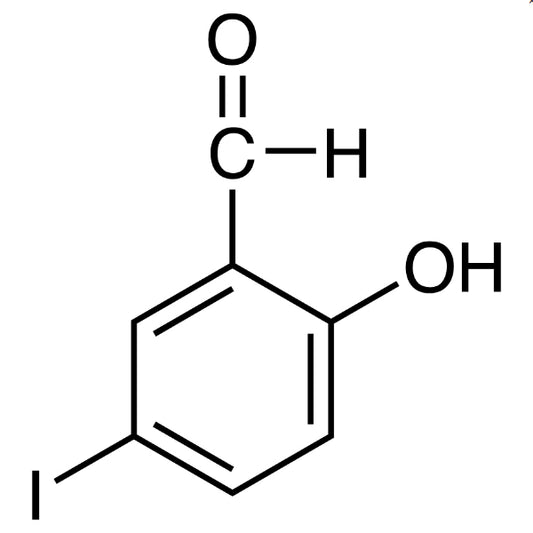
2-Hydroxy-5-iodobenzaldehyde TCI I1175
Regular price From Rp 903.000,00Regular price -
4-Iodobenzaldehyde TCI I0612
Regular price From Rp 1.431.150,00Regular price -
3-Iodobenzaldehyde TCI I0611
Regular price From Rp 3.419.850,00Regular price -
4-Hydroxy-3-iodobenzaldehyde TCI H1960
Regular price From Rp 1.087.800,00Regular price -
3-Hydroxy-2,4,6-triiodobenzaldehyde TCI H1944
Regular price From Rp 2.889.600,00Regular price -
4-Hydroxy-3,5-diiodobenzaldehyde TCI H1539
Regular price From Rp 2.650.200,00Regular price -
2-Iodobenzamide TCI I0734
Regular price From Rp 2.704.800,00Regular price -
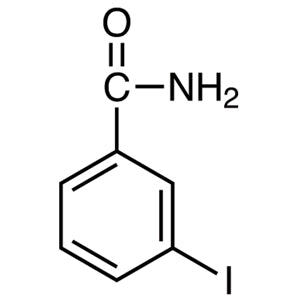
3-Iodobenzamide TCI I1035
Regular price From Rp 1.936.200,00Regular price